1Y18 | pdb_00001y18

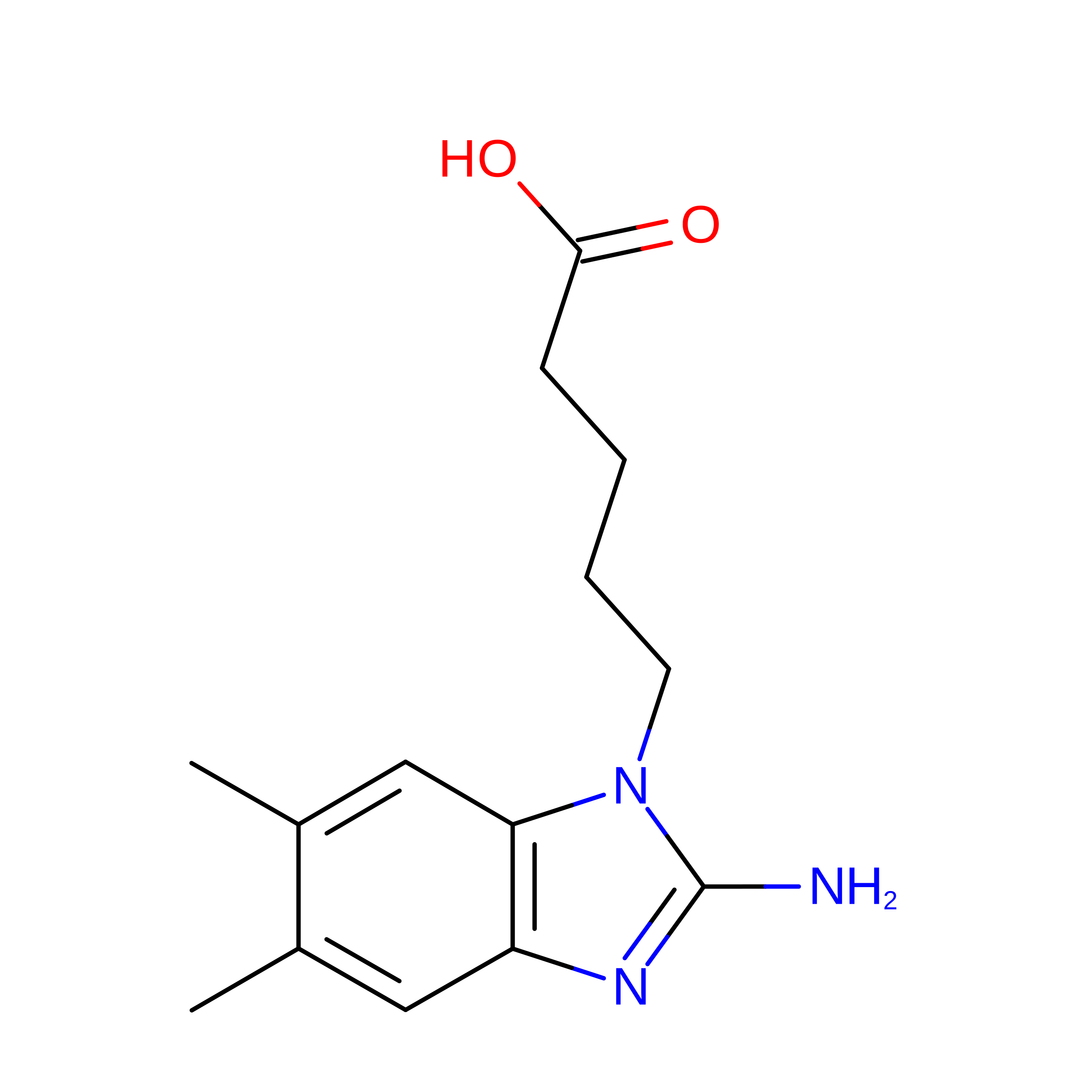
Fab fragment of catalytic elimination antibody 34E4 E(H50)D mutant in complex with hapten


Experimental Data Snapshot

  • Method: X-RAY DIFFRACTION
  • Resolution: 2.80 Å
  • R-Value Free: 
    0.252 (Depositor), 0.260 (DCC) 
  • R-Value Work: 
    0.215 (Depositor), 0.224 (DCC) 
  • R-Value Observed: 
    0.215 (Depositor) 

Starting Model: experimental
View more details

wwPDB Validation 3D Report Full Report

Validation slider image for 1Y18

Ligand Structure Quality Assessment 


This is version 1.5 of the entry. See complete history

Literature

Structural origins of efficient proton abstraction from carbon by a catalytic antibody

Debler, E.W.Ito, S.Seebeck, F.P.Heine, A.Hilvert, D.Wilson, I.A.

(2005) Proc Natl Acad Sci U S A 102: 4984-4989

  • DOI: https://doi.org/10.1073/pnas.0409207102
  • Primary Citation Related Structures: 
    1Y0L, 1Y18

  • PubMed Abstract: 

    Antibody 34E4 catalyzes the conversion of benzisoxazoles to salicylonitriles with high rates and multiple turnovers. The crystal structure of its complex with the benzimidazolium hapten at 2.5-angstroms resolution shows that a combination of hydrogen bonding, pi stacking, and van der Waals interactions is exploited to position both the base, Glu(H50), and the substrate for efficient proton transfer. Suboptimal placement of the catalytic carboxylate, as observed in the 2.8-angstroms structure of the Glu(H50)Asp variant, results in substantially reduced catalytic efficiency. In addition to imposing high positional order on the transition state, the antibody pocket provides a highly structured microenvironment for the reaction in which the carboxylate base is activated through partial desolvation, and the highly polarizable transition state is stabilized by dispersion interactions with the aromatic residue Trp(L91) and solvation of the leaving group oxygen by external water. The enzyme-like efficiency of general base catalysis in this system directly reflects the original hapten design, in which a charged guanidinium moiety was strategically used to elicit an accurately positioned functional group in an appropriate reaction environment and suggests that even larger catalytic effects may be achievable by extending this approach to the induction of acid-base pairs capable of bifunctional catalysis.


  • Organizational Affiliation
    • Department of Molecular Biology and The Skaggs Institute for Chemical Biology, The Scripps Research Institute, 10550 North Torrey Pines Road, La Jolla, CA 92037, USA.

Macromolecule Content 

  • Total Structure Weight: 192.41 kDa 
  • Atom Count: 13,824 
  • Modeled Residue Count: 1,768 
  • Deposited Residue Count: 1,768 
  • Unique protein chains: 2

Macromolecules

Find similar proteins by:|  3D Structure
Entity ID: 1
MoleculeChains  Sequence LengthOrganismDetailsImage
Catalytic antibody 34E4 light chainA [auth L],
C [auth A],
E [auth C],
G [auth E]
216Mus musculusHomo sapiens
This entity is chimeric
Mutation(s): 0 
Find similar proteins by:|  3D Structure
Entity ID: 2
MoleculeChains  Sequence LengthOrganismDetailsImage
Catalytic antibody 34E4 heavy chainB [auth H],
D [auth B],
F [auth D],
H [auth F]
226Mus musculusHomo sapiens
This entity is chimeric
Mutation(s): 0 

Experimental Data & Validation

Experimental Data

  • Method: X-RAY DIFFRACTION
  • Resolution: 2.80 Å
  • R-Value Free:  0.252 (Depositor), 0.260 (DCC) 
  • R-Value Work:  0.215 (Depositor), 0.224 (DCC) 
  • R-Value Observed: 0.215 (Depositor) 
Space Group: P 32 2 1
Unit Cell:
Length ( Å )Angle ( ˚ )
a = 163α = 90
b = 163β = 90
c = 151.2γ = 120
Software Package:
Software NamePurpose
HKL-2000data collection
SCALEPACKdata scaling
AMoREphasing
CNSrefinement
HKL-2000data reduction

Structure Validation

View Full Validation Report


Ligand Structure Quality Assessment 


Entry History 

Deposition Data

Revision History  (Full details and data files)

  • Version 1.0: 2005-04-05
    Type: Initial release
  • Version 1.1: 2008-04-30
    Changes: Version format compliance
  • Version 1.2: 2011-07-13
    Changes: Version format compliance
  • Version 1.3: 2018-01-31
    Changes: Experimental preparation
  • Version 1.4: 2023-08-23
    Changes: Data collection, Database references, Derived calculations, Refinement description
  • Version 1.5: 2024-10-30
    Changes: Structure summary