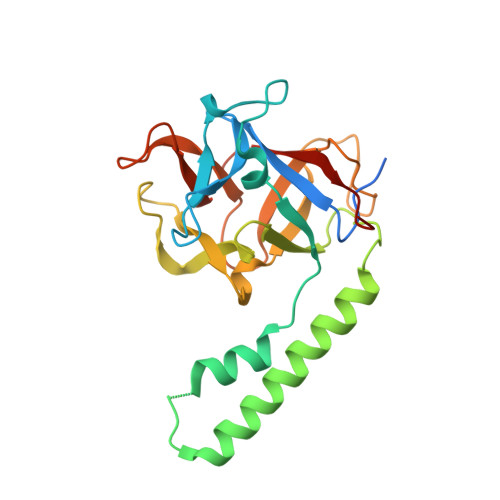
1XZZ | pdb_00001xzz

Crystal structure of the ligand binding suppressor domain of type 1 inositol 1,4,5-trisphosphate receptor


Experimental Data Snapshot

  • Method: X-RAY DIFFRACTION
  • Resolution: 1.80 Å
  • R-Value Free: 
    0.238 (Depositor), 0.237 (DCC) 
  • R-Value Work: 
    0.205 (Depositor), 0.205 (DCC) 
  • R-Value Observed: 
    0.205 (Depositor) 

wwPDB Validation 3D Report Full Report

Validation slider image for 1XZZ

This is version 1.3 of the entry. See complete history

Literature

Crystal structure of the ligand binding suppressor domain of type 1 inositol 1,4,5-trisphosphate receptor.

Bosanac, I.Yamazaki, H.Matsu-Ura, T.Michikawa, T.Mikoshiba, K.Ikura, M.

(2005) Mol Cell 17: 193-203

  • DOI: https://doi.org/10.1016/j.molcel.2004.11.047
  • Primary Citation Related Structures: 
    1XZZ

  • PubMed Abstract: 

    Binding of inositol 1,4,5-trisphosphate (IP(3)) to the amino-terminal region of IP(3) receptor promotes Ca(2+) release from the endoplasmic reticulum. Within the amino terminus, the first 220 residues directly preceding the IP(3) binding core domain play a key role in IP(3) binding suppression and regulatory protein interaction. Here we present a crystal structure of the suppressor domain of the mouse type 1 IP(3) receptor at 1.8 A. Displaying a shape akin to a hammer, the suppressor region contains a Head subdomain forming the beta-trefoil fold and an Arm subdomain possessing a helix-turn-helix structure. The conserved region on the Head subdomain appeared to interact with the IP(3) binding core domain and is in close proximity to the previously proposed binding sites of Homer, RACK1, calmodulin, and CaBP1. The present study sheds light onto the mechanism underlying the receptor's sensitivity to the ligand and its communication with cellular signaling proteins.


  • Organizational Affiliation
    • Division of Molecular and Structural Biology, Ontario Cancer Institute and Department of Medical Biophysics, University of Toronto, 610 University Avenue, Toronto, Ontario, M5G 2M9, Canada.

Macromolecule Content 

  • Total Structure Weight: 27.51 kDa 
  • Atom Count: 1,841 
  • Modeled Residue Count: 216 
  • Deposited Residue Count: 246 
  • Unique protein chains: 1

Macromolecules

Find similar proteins by:|  3D Structure
Entity ID: 1
MoleculeChains  Sequence LengthOrganismDetailsImage
Inositol 1,4,5-trisphosphate receptor type 1246Mus musculusMutation(s): 0 
Gene Names: Itpr1Insp3rPcd6Pcp1
UniProt & NIH Common Fund Data Resources
Find proteins for P11881 (Mus musculus)
Explore P11881 
Go to UniProtKB:  P11881
IMPC:  MGI:96623
Entity Groups
Sequence Clusters30% Identity50% Identity70% Identity90% Identity95% Identity100% Identity
UniProt GroupP11881
Sequence Annotations
Expand
Reference Sequence

Small Molecules

Ligands 1 Unique
IDChains Name / Formula / InChI Key2D Diagram3D Interactions
GOL

Query on GOL


Download:Ideal Coordinates CCD File
B [auth A]GLYCEROL
C3 H8 O3
PEDCQBHIVMGVHV-UHFFFAOYSA-N

Experimental Data & Validation

Experimental Data

  • Method: X-RAY DIFFRACTION
  • Resolution: 1.80 Å
  • R-Value Free:  0.238 (Depositor), 0.237 (DCC) 
  • R-Value Work:  0.205 (Depositor), 0.205 (DCC) 
  • R-Value Observed: 0.205 (Depositor) 
Space Group: H 3 2
Unit Cell:
Length ( Å )Angle ( ˚ )
a = 147.3α = 90
b = 147.3β = 90
c = 65γ = 120
Software Package:
Software NamePurpose
CNSrefinement
HKL-2000data reduction
SCALEPACKdata scaling
SOLVEphasing

Structure Validation

View Full Validation Report


Entry History 

Deposition Data

Revision History  (Full details and data files)

  • Version 1.0: 2005-01-25
    Type: Initial release
  • Version 1.1: 2008-04-30
    Changes: Version format compliance
  • Version 1.2: 2011-07-13
    Changes: Non-polymer description, Version format compliance
  • Version 1.3: 2024-02-14
    Changes: Data collection, Database references, Derived calculations