Download Mendeley
Structural Basis of Constitutive Activity and a Unique Nucleotide Binding Mode of Human Pim-1 Kinase.
Qian, K.C., Wang, L., Hickey, E.R., Studts, J., Barringer, K., Peng, C., Kronkaitis, A., Li, J., White, A., Mische, S., Farmer, B.(2005) J Biol Chem 280: 6130-6137
- PubMed: 15525646 Search on PubMed
- DOI: https://doi.org/10.1074/jbc.M409123200
- Primary Citation Related Structures:
1XQZ, 1XR1 - PubMed Abstract:
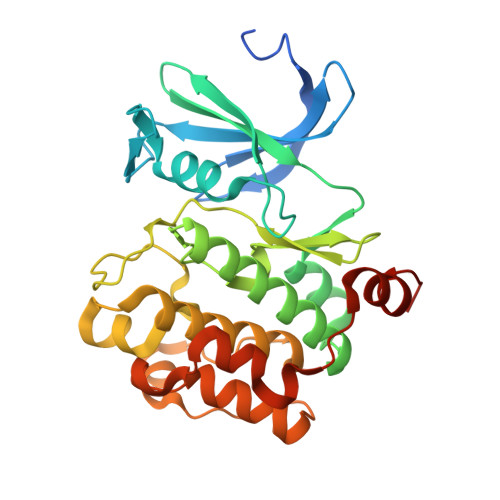
Pim-1 kinase is a member of a distinct class of serine/threonine kinases consisting of Pim-1, Pim-2, and Pim-3. Pim kinases are highly homologous to one another and share a unique consensus hinge region sequence, ER-PXPX, with its two proline residues separated by a non-conserved residue, but they (Pim kinases) have <30% sequence identity with other kinases. Pim-1 has been implicated in both cytokine-induced signal transduction and the development of lymphoid malignancies. We have determined the crystal structures of apo Pim-1 kinase and its AMP-PNP (5'-adenylyl-beta,gamma-imidodiphosphate) complex to 2.1-angstroms resolutions. The structures reveal the following. 1) The kinase adopts a constitutively active conformation, and extensive hydrophobic and hydrogen bond interactions between the activation loop and the catalytic loop might be the structural basis for maintaining such a conformation. 2) The hinge region has a novel architecture and hydrogen-bonding pattern, which not only expand the ATP pocket but also serve to establish unambiguously the alignment of the Pim-1 hinge region with that of other kinases. 3) The binding mode of AMP-PNP to Pim-1 kinase is unique and does not involve a critical hinge region hydrogen bond interaction. Analysis of the reported Pim-1 kinase-domain structures leads to a hypothesis as to how Pim kinase activity might be regulated in vivo.
- Departments of Medicinal Chemistry and Immunology and Inflammation, Boehringer Ingelheim Pharmaceuticals, Inc., Research and Development, 175 Briar Ridge Rd., Ridgefield, CT 06877, USA.
Organizational Affiliation: