1XAM | pdb_00001xam

Cobalt hexammine induced tautameric shift in Z-DNA: structure of d(CGCGCA).d(TGCGCG) in two crystal forms.


Experimental Data Snapshot

  • Method: X-RAY DIFFRACTION
  • Resolution: 1.86 Å
  • R-Value Free: 
    0.346 (Depositor), 0.368 (DCC) 
  • R-Value Work: 
    0.273 (Depositor) 
  • R-Value Observed: 
    0.279 (Depositor) 

Starting Model: experimental
View more details

wwPDB Validation 3D Report Full Report

Validation slider image for 1XAM

This is version 1.5 of the entry. See complete history

Literature

Cobalt hexammine induced tautomeric shift in Z-DNA: the structure of d(CGCGCA)*d(TGCGCG) in two crystal forms.

Thiyagarajan, S.Rajan, S.S.Gautham, N.

(2004) Nucleic Acids Res 32: 5945-5953

  • DOI: https://doi.org/10.1093/nar/gkh919
  • Primary Citation Related Structures: 
    1XA2, 1XAM

  • PubMed Abstract: 

    We report here the crystal structure of the DNA hexamer duplex d(CGCGCA)*d(TGCGCG) at 1.71 A resolution. The crystals, in orthorhombic space group, were grown in the presence of cobalt hexammine, a known inducer of the left-handed Z form of DNA. The interaction of this ion with the DNA helix results in a change of the adenine base from the common amino tautomeric form to the imino tautomer. Consequently the A:T base pair is disrupted from the normal Watson-Crick base pairing to a 'wobble' like base pairing. This change is accommodated easily within the helix, and the helical parameters are those expected for Z-DNA. When the cobalt hexammine concentration is decreased slightly in the crystallization conditions, the duplex crystallizes in a different, hexagonal space group, with two hexamer duplexes in the asymmetric unit. One of these is situated on a crystallographic 6-fold screw axis, leading to disorder. The tautomeric shift is not observed in this space group. We show that the change in inter-helix interactions that lead to the two different space groups probably arise from the small decrease in ion concentration, and consequently disordered positions for the ion.


  • Organizational Affiliation
    • Department of Crystallography and Biophysics, University of Madras, Guindy Campus, Chennai 600 025, India.

Macromolecule Content 

  • Total Structure Weight: 4.96 kDa 
  • Atom Count: 349 
  • Modeled Residue Count: 16 
  • Deposited Residue Count: 16 
  • Unique nucleic acid chains: 3

Macromolecules

Find similar nucleic acids by:  Sequence
Entity ID: 1
MoleculeChains LengthOrganismImage
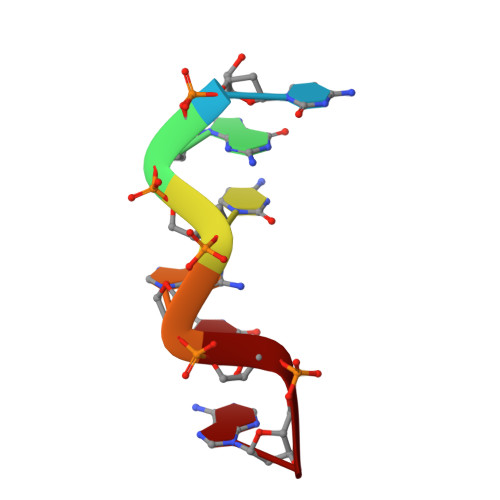
CGCGCA6N/A
Sequence Annotations
Expand
Reference Sequence
Find similar nucleic acids by:  Sequence
Entity ID: 2
MoleculeChains LengthOrganismImage
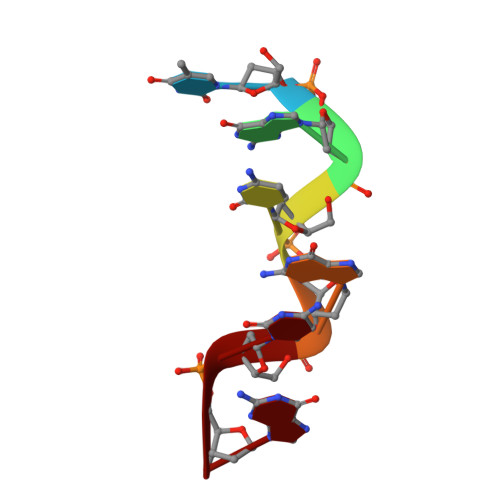
TGCGCG6N/A
Sequence Annotations
Expand
Reference Sequence
Find similar nucleic acids by:  Sequence
Entity ID: 3
MoleculeChains LengthOrganismImage
TGC [auth D],
D [auth E]
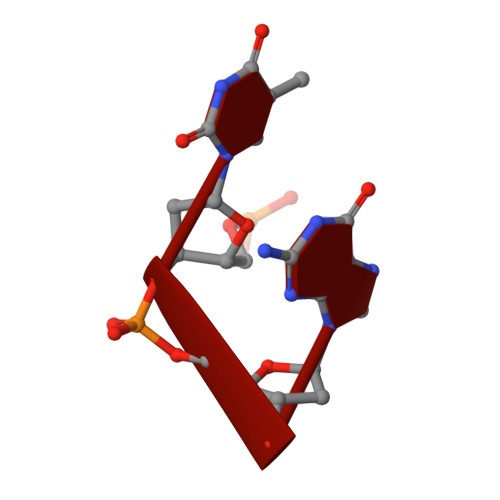
2N/A
Sequence Annotations
Expand
Reference Sequence

Small Molecules

Ligands 1 Unique
IDChains Name / Formula / InChI Key2D Diagram3D Interactions
NCO

Query on NCO


Download:Ideal Coordinates CCD File
E
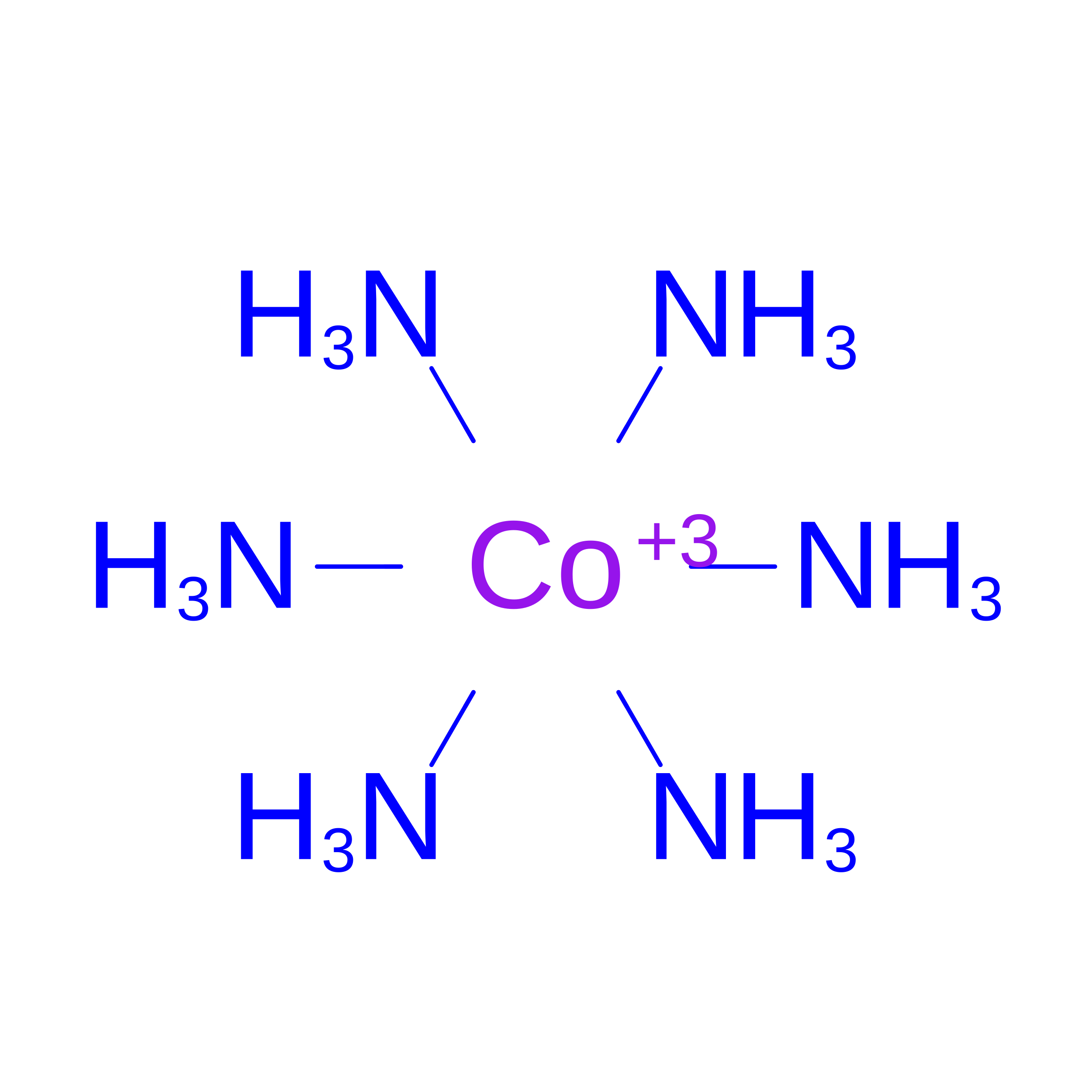
COBALT HEXAMMINE(III)
Co H18 N6
DYLMFCCYOUSRTK-UHFFFAOYSA-N

Experimental Data & Validation

Experimental Data

  • Method: X-RAY DIFFRACTION
  • Resolution: 1.86 Å
  • R-Value Free:  0.346 (Depositor), 0.368 (DCC) 
  • R-Value Work:  0.273 (Depositor) 
  • R-Value Observed: 0.279 (Depositor) 
Space Group: P 65
Unit Cell:
Length ( Å )Angle ( ˚ )
a = 35.588α = 90
b = 35.588β = 90
c = 44.518γ = 120
Software Package:
Software NamePurpose
REFMACrefinement
XDSdata reduction
AUTOMARdata reduction
AMoREphasing

Structure Validation

View Full Validation Report


Entry History 

Deposition Data

Revision History  (Full details and data files)

  • Version 1.0: 2004-11-16
    Type: Initial release
  • Version 1.1: 2008-04-30
    Changes: Version format compliance
  • Version 1.2: 2011-07-13
    Changes: Version format compliance
  • Version 1.3: 2017-10-11
    Changes: Refinement description
  • Version 1.4: 2024-02-14
    Changes: Data collection, Database references, Derived calculations
  • Version 1.5: 2024-04-03
    Changes: Refinement description