1W62 | pdb_00001w62

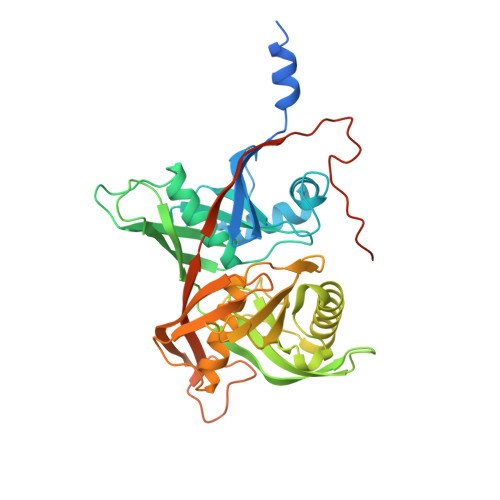
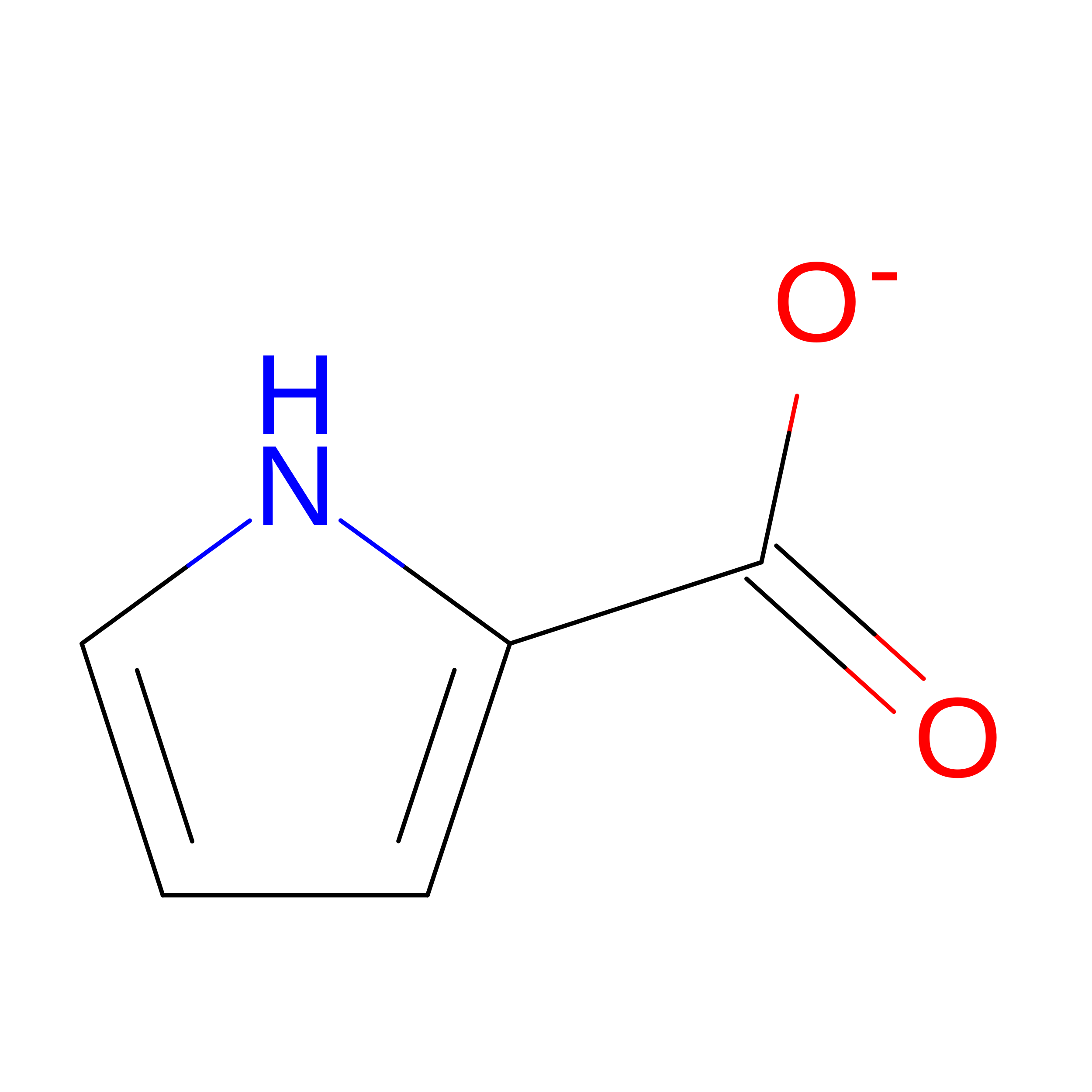
proline racemase in complex with one molecule of pyrrole-2-carboxylic acid (hemi form)


Experimental Data Snapshot

  • Method: X-RAY DIFFRACTION
  • Resolution: 2.50 Å
  • R-Value Free: 
    0.236 (Depositor), 0.241 (DCC) 
  • R-Value Work: 
    0.170 (Depositor), 0.179 (DCC) 
  • R-Value Observed: 
    0.177 (Depositor) 

Starting Model: experimental
View more details

wwPDB Validation 3D Report Full Report

Validation slider image for 1W62

This is version 1.3 of the entry. See complete history

Literature

Crystal structure, catalytic mechanism, and mitogenic properties of Trypanosoma cruzi proline racemase.

Buschiazzo, A.Goytia, M.Schaeffer, F.Degrave, W.Shepard, W.Gregoire, C.Chamond, N.Cosson, A.Berneman, A.Coatnoan, N.Alzari, P.M.Minoprio, P.

(2006) Proc Natl Acad Sci U S A 103: 1705-1710

  • DOI: https://doi.org/10.1073/pnas.0509010103
  • Primary Citation Related Structures: 
    1W61, 1W62

  • PubMed Abstract: 

    Amino acid racemases catalyze the stereoinversion of the chiral C alpha to produce the d-enantiomers that participate in biological processes, such as cell wall construction in prokaryotes. Within this large protein family, bacterial proline racemases have been extensively studied as a model of enzymes acting with a pyridoxal-phosphate-independent mechanism. Here we report the crystal structure of the proline racemase from the human parasite Trypanosoma cruzi (TcPRACA), a secreted enzyme that triggers host B cell polyclonal activation, which prevents specific humoral immune responses and is crucial for parasite evasion and fate. The enzyme is a homodimer, with each monomer folded in two symmetric alpha/beta subunits separated by a deep crevice. The structure of TcPRACA in complex with a transition-state analog, pyrrole-2-carboxylic acid, reveals the presence of one reaction center per monomer, with two Cys residues optimally located to perform acid/base catalysis through a carbanion stabilization mechanism. Mutation of the catalytic Cys residues abolishes the enzymatic activity but preserves the mitogenic properties of the protein. In contrast, inhibitor binding promotes the closure of the interdomain crevice and completely abrogates B cell proliferation, suggesting that the mitogenic properties of TcPRACA depend on the exposure of transient epitopes in the ligand-free enzyme.


  • Organizational Affiliation
    • Unité de Biochimie Structurale, Centre National de la Recherche Scientifique/Institut Pasteur, 25 Rue du Dr. Roux, F-75724 Paris, France.

Macromolecule Content 

  • Total Structure Weight: 91.7 kDa 
  • Atom Count: 5,554 
  • Modeled Residue Count: 713 
  • Deposited Residue Count: 828 
  • Unique protein chains: 1

Macromolecules

Find similar proteins by:|  3D Structure
Entity ID: 1
MoleculeChains  Sequence LengthOrganismDetailsImage
Proline racemase A
A, B
414Trypanosoma cruzi strain CL BrenerMutation(s): 0 
Gene Names: PA45-ATc00.1047053506795.80
EC: 5.1.1.4
UniProt
Find proteins for Q4DA80 (Trypanosoma cruzi (strain CL Brener))
Explore Q4DA80 
Go to UniProtKB:  Q4DA80
Entity Groups
Sequence Clusters30% Identity50% Identity70% Identity90% Identity95% Identity100% Identity
UniProt GroupQ4DA80
Sequence Annotations
Expand
Reference Sequence

Small Molecules

Ligands 1 Unique
IDChains Name / Formula / InChI Key2D Diagram3D Interactions
PYC

Query on PYC


Download:Ideal Coordinates CCD File
C [auth A]PYRROLE-2-CARBOXYLATE
C5 H4 N O2
WRHZVMBBRYBTKZ-UHFFFAOYSA-M

Experimental Data & Validation

Experimental Data

  • Method: X-RAY DIFFRACTION
  • Resolution: 2.50 Å
  • R-Value Free:  0.236 (Depositor), 0.241 (DCC) 
  • R-Value Work:  0.170 (Depositor), 0.179 (DCC) 
  • R-Value Observed: 0.177 (Depositor) 
Space Group: C 1 2 1
Unit Cell:
Length ( Å )Angle ( ˚ )
a = 136.018α = 90
b = 89.382β = 125.98
c = 84.456γ = 90
Software Package:
Software NamePurpose
REFMACrefinement
MOSFLMdata reduction
SCALAdata scaling
AMoREphasing

Structure Validation

View Full Validation Report


Entry History 

Deposition Data

Revision History  (Full details and data files)

  • Version 1.0: 2006-02-03
    Type: Initial release
  • Version 1.1: 2011-07-13
    Changes: Advisory, Version format compliance
  • Version 1.2: 2018-06-13
    Changes: Data collection, Database references, Source and taxonomy, Structure summary
  • Version 1.3: 2023-12-13
    Changes: Data collection, Database references, Derived calculations, Other, Refinement description