Download Mendeley
Nucleophilic and General Acid Catalysis at Physiological Ph by a Designed Miniature Esterase
Nicoll, A., Allemann, R.K.(2004) Org Biomol Chem 2: 2175
- PubMed: 15280952 Search on PubMed
- DOI: https://doi.org/10.1039/B404730C
- Primary Citation Related Structures:
1V1D - PubMed Abstract:
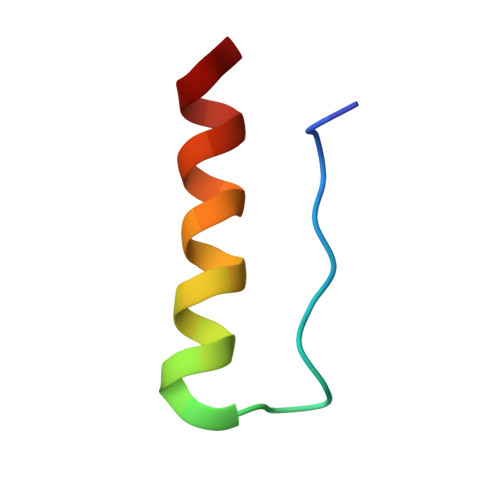
A 31-residue peptide (Art-Est) was designed to catalyse the hydrolysis of p-nitrophenyl esters through histidine catalysis on the solvent exposed face of the alpha-helix of bovine pancreatic polypeptide. NMR spectroscopy indicated that Art-Est adopted a stable 3-dimensional structure in solution. Art-Est was an efficient catalyst with second order rate constants of up to 0.050 M(-1) s(-1). The activity of Art-Est was a consequence of the increased nucleophilicity of His-22, which had a reduced pK(a) value of 5.5 as a consequence of its interaction with His-18 and the positively charged Arg-25 and Arg-26. Mass spectrometry and NMR spectroscopy confirmed that the Art-Est catalysed hydrolysis of p-nitrophenyl esters proceeded through an acyl-enzyme intermediate. A solvent kinetic isotope effect of 1.8 indicated that the transition state preceding the acyl intermediate was stabilised through interaction with the protonated side-chain of His-18 and indicated a reaction mechanism similar to that generally observed for natural esterases. The involvement in the reaction of two histidine residues with different pK(a) values led to a bell-shaped dependence of the reaction rate on the pH of the solution. The catalytic behaviour of Art-Est indicated that designed miniature enzymes can act in a transparent mechanism based fashion with enzyme-like behaviour through the interplay of several amino acid residues.
- School of Chemistry, University of Birmingham, Edgbaston, Birmingham, UKB15 2TT.
Organizational Affiliation: