1TAD | pdb_00001tad

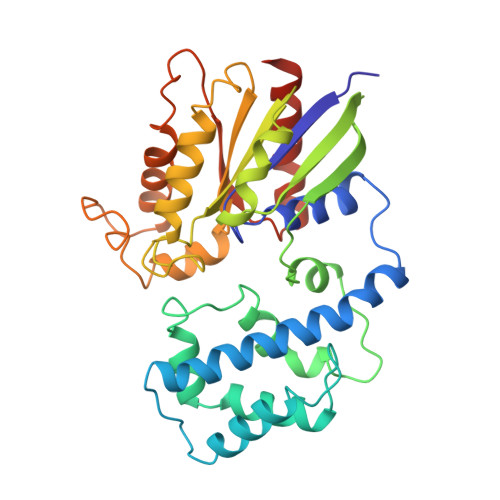
GTPASE MECHANISM OF GPROTEINS FROM THE 1.7-ANGSTROM CRYSTAL STRUCTURE OF TRANSDUCIN ALPHA-GDP-ALF4-


Experimental Data Snapshot

  • Method: X-RAY DIFFRACTION
  • Resolution: 1.70 Å
  • R-Value Free: 
    0.266 (Depositor) 
  • R-Value Work: 
    0.209 (Depositor) 
  • R-Value Observed: 
    0.209 (Depositor) 

wwPDB Validation 3D Report Full Report

Validation slider image for 1TAD

This is version 1.4 of the entry. See complete history

Literature

GTPase mechanism of Gproteins from the 1.7-A crystal structure of transducin alpha-GDP-AIF-4.

Sondek, J.Lambright, D.G.Noel, J.P.Hamm, H.E.Sigler, P.B.

(1994) Nature 372: 276-279

  • DOI: https://doi.org/10.1038/372276a0
  • Primary Citation Related Structures: 
    1TAD

  • PubMed Abstract: 

    Aluminium fluoride (AIF-4) activates members of the heterotrimeric G-protein (G alpha beta gamma) family by binding to inactive G alpha.GDP near the site occupied by the gamma-phosphate in G alpha.GTP (ref. 3). Here we describe the crystal structure of transducin alpha.GDP activated with aluminium fluoride (Gt alpha.GDP.AIF-4.H2O) at 1.7 A, a resolution sufficient to establish the coordination geometry of the bound aluminium fluoride as well as the extensive network of direct and water-mediated interactions that stabilize it. These observations are derived from three independent representations in the asymmetric unit, eliminating any chance of drawing conclusions based on stereochemistry imposed by crystal packing. Surprisingly, aluminium fluoride activates G alpha.GDP by binding with a geometry resembling a pentavalent intermediate for GTP hydrolysis. The stabilizing interactions involve not only residues that interact with the gamma-phosphate in Gt alpha.GTP gamma S, but also conserved residues for GTPase activity. Thus the Gt alpha.GDP.AIF-4.H2O structure provides new insight into the mechanism of GTP hydrolysis.


  • Organizational Affiliation
    • Department of Molecular Biophysics and Biochemistry, Yale University, New Haven, Connecticut.

Macromolecule Content 

  • Total Structure Weight: 114.01 kDa 
  • Atom Count: 8,773 
  • Modeled Residue Count: 950 
  • Deposited Residue Count: 972 
  • Unique protein chains: 1

Macromolecules

Find similar proteins by:|  3D Structure
Entity ID: 1
MoleculeChains  Sequence LengthOrganismDetailsImage
TRANSDUCIN-ALPHA
A, B, C
324Bos taurusMutation(s): 0 
UniProt
Find proteins for P04695 (Bos taurus)
Explore P04695 
Go to UniProtKB:  P04695
Entity Groups
Sequence Clusters30% Identity50% Identity70% Identity90% Identity95% Identity100% Identity
UniProt GroupP04695
Sequence Annotations
Expand
Reference Sequence

Small Molecules

Ligands 4 Unique
IDChains Name / Formula / InChI Key2D Diagram3D Interactions
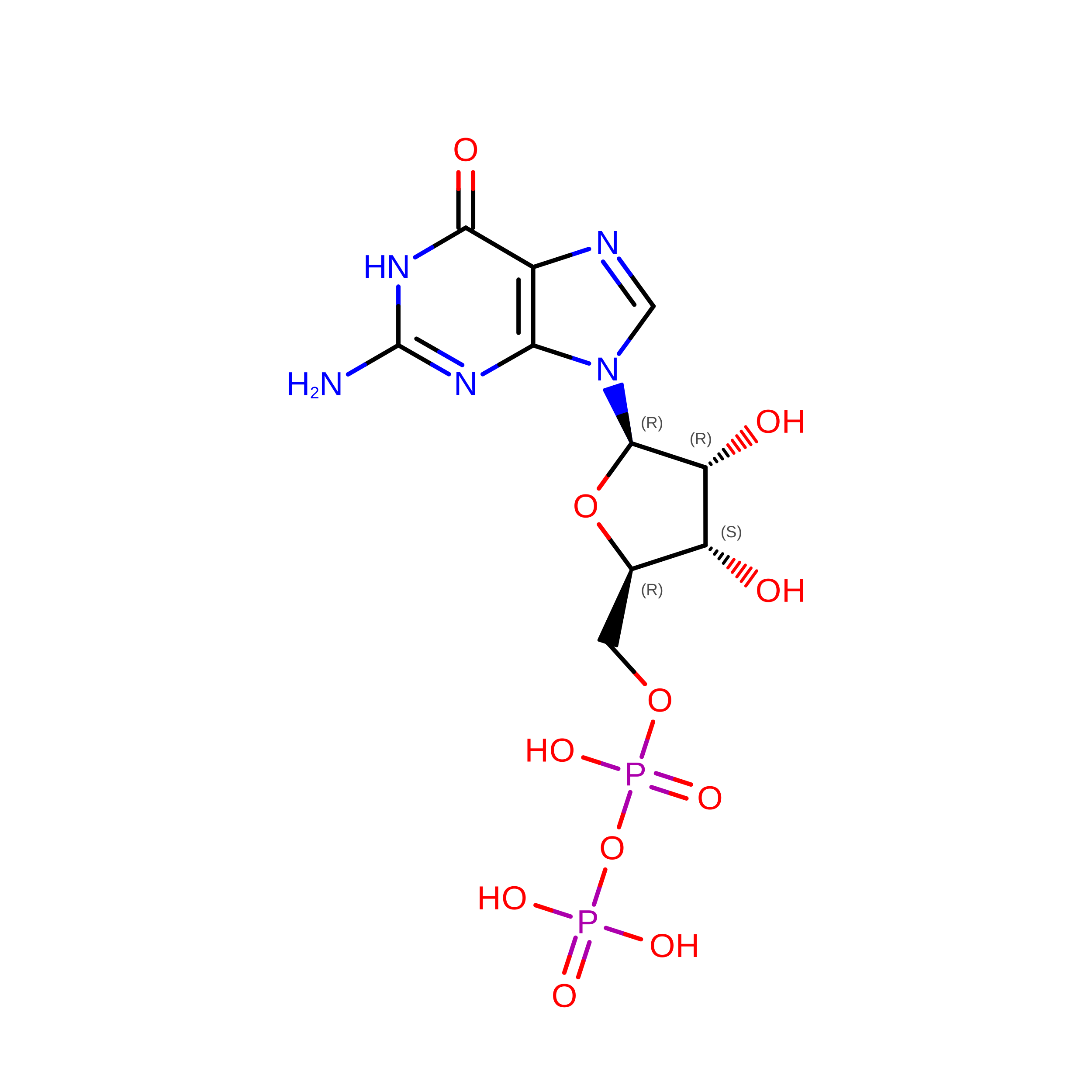
GDP

Query on GDP


Download:Ideal Coordinates CCD File
H [auth A],
M [auth B],
R [auth C]
GUANOSINE-5'-DIPHOSPHATE
C10 H15 N5 O11 P2
QGWNDRXFNXRZMB-UUOKFMHZSA-N
CAC

Query on CAC


Download:Ideal Coordinates CCD File
E [auth A]
F [auth A]
J [auth B]
K [auth B]
O [auth C]
E [auth A],
F [auth A],
J [auth B],
K [auth B],
O [auth C],
P [auth C]
CACODYLATE ION
C2 H6 As O2
OGGXGZAMXPVRFZ-UHFFFAOYSA-M
ALF

Query on ALF


Download:Ideal Coordinates CCD File
G [auth A],
L [auth B],
Q [auth C]
TETRAFLUOROALUMINATE ION
Al F4
UYOMQIYKOOHAMK-UHFFFAOYSA-J
CA

Query on CA


Download:Ideal Coordinates CCD File
D [auth A],
I [auth B],
N [auth C]
CALCIUM ION
Ca
BHPQYMZQTOCNFJ-UHFFFAOYSA-N

Experimental Data & Validation

Experimental Data

  • Method: X-RAY DIFFRACTION
  • Resolution: 1.70 Å
  • R-Value Free:  0.266 (Depositor) 
  • R-Value Work:  0.209 (Depositor) 
  • R-Value Observed: 0.209 (Depositor) 
Space Group: P 1 21 1
Unit Cell:
Length ( Å )Angle ( ˚ )
a = 74.9α = 90
b = 108.2β = 111.7
c = 79γ = 90
Software Package:
Software NamePurpose
X-PLORmodel building
X-PLORrefinement
DENZOdata reduction
X-PLORphasing

Structure Validation

View Full Validation Report


Entry History 

Deposition Data

Revision History  (Full details and data files)

  • Version 1.0: 1995-05-08
    Type: Initial release
  • Version 1.1: 2008-03-24
    Changes: Version format compliance
  • Version 1.2: 2011-07-13
    Changes: Non-polymer description, Version format compliance
  • Version 1.3: 2017-11-29
    Changes: Derived calculations, Other
  • Version 1.4: 2024-02-14
    Changes: Data collection, Database references, Derived calculations