1T43 | pdb_00001t43

Crystal Structure Analysis of E.coli Protein (N5)-Glutamine Methyltransferase (HemK)


Experimental Data Snapshot

  • Method: X-RAY DIFFRACTION
  • Resolution: 3.20 Å
  • R-Value Free: 
    0.315 (Depositor) 
  • R-Value Work: 
    0.289 (Depositor) 
  • R-Value Observed: 
    0.289 (Depositor) 

Starting Model: experimental
View more details

wwPDB Validation 3D Report Full Report

Validation slider image for 1T43

This is version 1.4 of the entry. See complete history

Literature

Structural characterization and comparative phylogenetic analysis of Escherichia coli HemK, a protein (N5)-glutamine methyltransferase.

Yang, Z.Shipman, L.Zhang, M.Anton, B.P.Roberts, R.J.Cheng, X.

(2004) J Mol Biology 340: 695-706

  • DOI: https://doi.org/10.1016/j.jmb.2004.05.019
  • Primary Citation Related Structures: 
    1T43

  • PubMed Abstract: 

    Protein glutamine methylation at GGQ sites of protein chain release factors plays a pivotal role in the termination of translation. We report here the crystal structure of the Escherichia coli HemK protein (N5)-glutamine methyltransferase (MTase) in a binary complex with the methyl-donor product S-adenosyl-L-homocysteine (AdoHcy). HemK contains two domains: a putative substrate binding domain at the N terminus consisting of a five helix bundle and a seven-stranded catalytic domain at the C terminus that harbors the binding site for AdoHcy. The two domains are linked by a beta-hairpin. Structure-guided sequence analysis of the HemK family revealed 11 invariant residues functioning in methyl-donor binding and catalysis of methyl transfer. The putative substrate-binding domains of HemK from E.coli and Thermotoga maritima are structurally similar, despite the fact that they share very little sequence similarity. When the two proteins are aligned structurally, the helical N-terminal domain is subject to approximately 10 degrees of hinge movement relative to the C-terminal domain. The apparent hinge mobility of the two domains may reflect functional importance during the reaction cycle. Comparative phylogenetic analysis of the hemK gene and its frequent neighbor gene, prfA, which encodes a major substrate, provides evidence for several examples of lateral gene transfer.


  • Organizational Affiliation
    • Department of Biochemistry, Emory University School of Medicine, 1510 Clifton Road, Atlanta, GA 30322, USA.

Macromolecule Content 

  • Total Structure Weight: 31.39 kDa 
  • Atom Count: 2,177 
  • Modeled Residue Count: 274 
  • Deposited Residue Count: 277 
  • Unique protein chains: 1

Macromolecules

Find similar proteins by:|  3D Structure
Entity ID: 1
MoleculeChains  Sequence LengthOrganismDetailsImage
Protein methyltransferase hemK277Escherichia coliMutation(s): 0 
Gene Names: HEMKB1212SF1215S1299
EC: 2.1.1 (PDB Primary Data), 2.1.1.297 (UniProt)
UniProt
Find proteins for P0ACC1 (Escherichia coli (strain K12))
Explore P0ACC1 
Go to UniProtKB:  P0ACC1
Entity Groups
Sequence Clusters30% Identity50% Identity70% Identity90% Identity95% Identity100% Identity
UniProt GroupP0ACC1
Sequence Annotations
Expand
Reference Sequence

Small Molecules

Ligands 1 Unique
IDChains Name / Formula / InChI Key2D Diagram3D Interactions
SAH

Query on SAH


Download:Ideal Coordinates CCD File
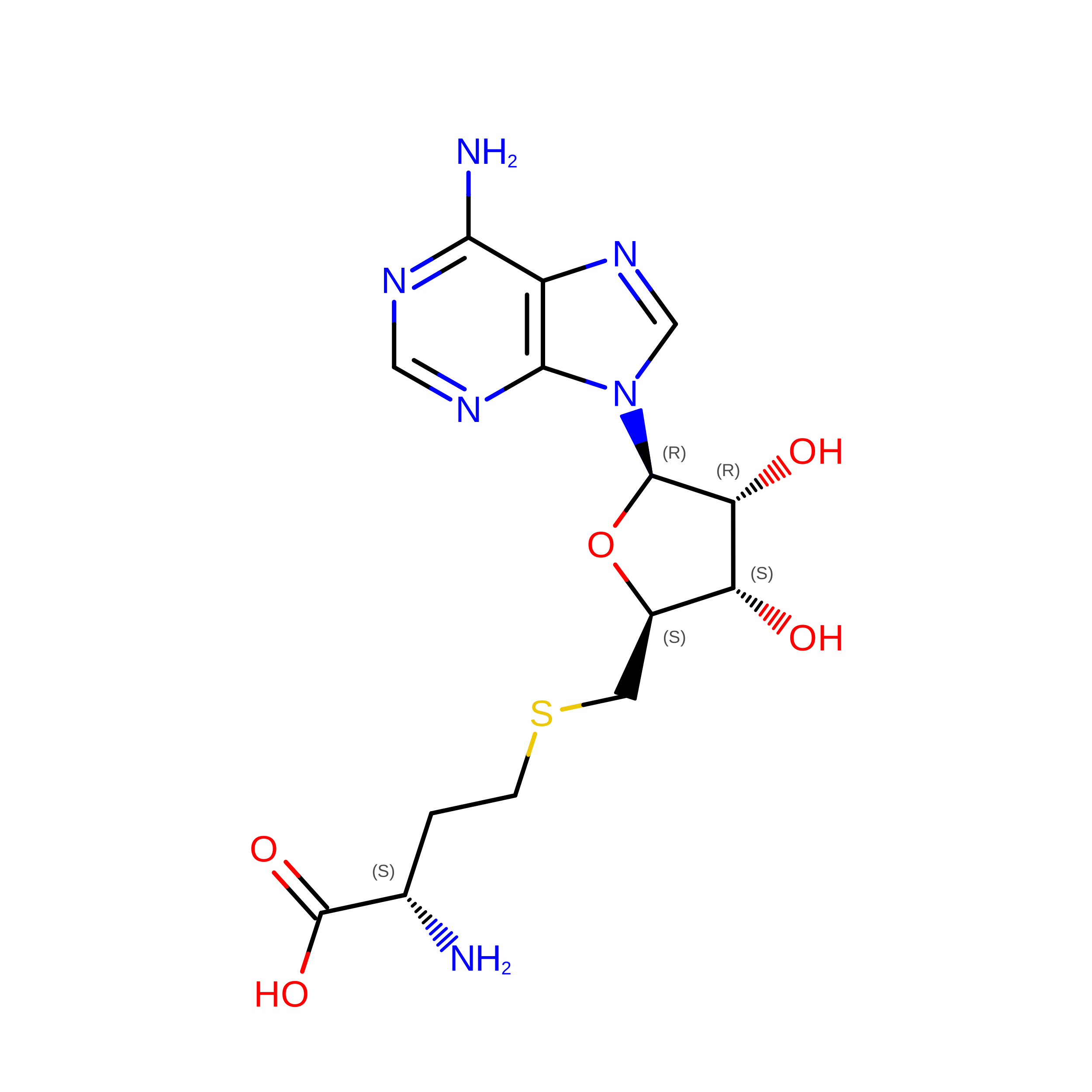
B [auth A]S-ADENOSYL-L-HOMOCYSTEINE
C14 H20 N6 O5 S
ZJUKTBDSGOFHSH-WFMPWKQPSA-N

Experimental Data & Validation

Experimental Data

  • Method: X-RAY DIFFRACTION
  • Resolution: 3.20 Å
  • R-Value Free:  0.315 (Depositor) 
  • R-Value Work:  0.289 (Depositor) 
  • R-Value Observed: 0.289 (Depositor) 
Space Group: P 63
Unit Cell:
Length ( Å )Angle ( ˚ )
a = 138.933α = 90
b = 138.933β = 90
c = 40.583γ = 120
Software Package:
Software NamePurpose
HKL-2000data collection
SCALEPACKdata scaling
AMoREphasing
CNSrefinement
HKL-2000data reduction

Structure Validation

View Full Validation Report


Entry History 

Deposition Data

Revision History  (Full details and data files)

  • Version 1.0: 2004-06-29
    Type: Initial release
  • Version 1.1: 2008-04-30
    Changes: Version format compliance
  • Version 1.2: 2011-07-13
    Changes: Version format compliance
  • Version 1.3: 2014-09-10
    Changes: Database references
  • Version 1.4: 2023-08-23
    Changes: Data collection, Database references, Derived calculations, Refinement description