Download Mendeley
The crystal structure of the hydrolase domain of 10-formyltetrahydrofolate dehydrogenase: mechanism of hydrolysis and its interplay with the dehydrogenase domain.
Chumanevich, A.A., Krupenko, S.A., Davies, C.(2004) J Biol Chem 279: 14355-14364
- PubMed: 14729668 Search on PubMed
- DOI: https://doi.org/10.1074/jbc.M313934200
- Primary Citation Related Structures:
1S3I - PubMed Abstract:
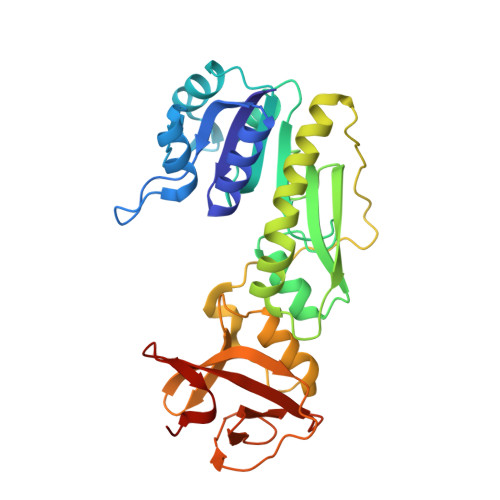
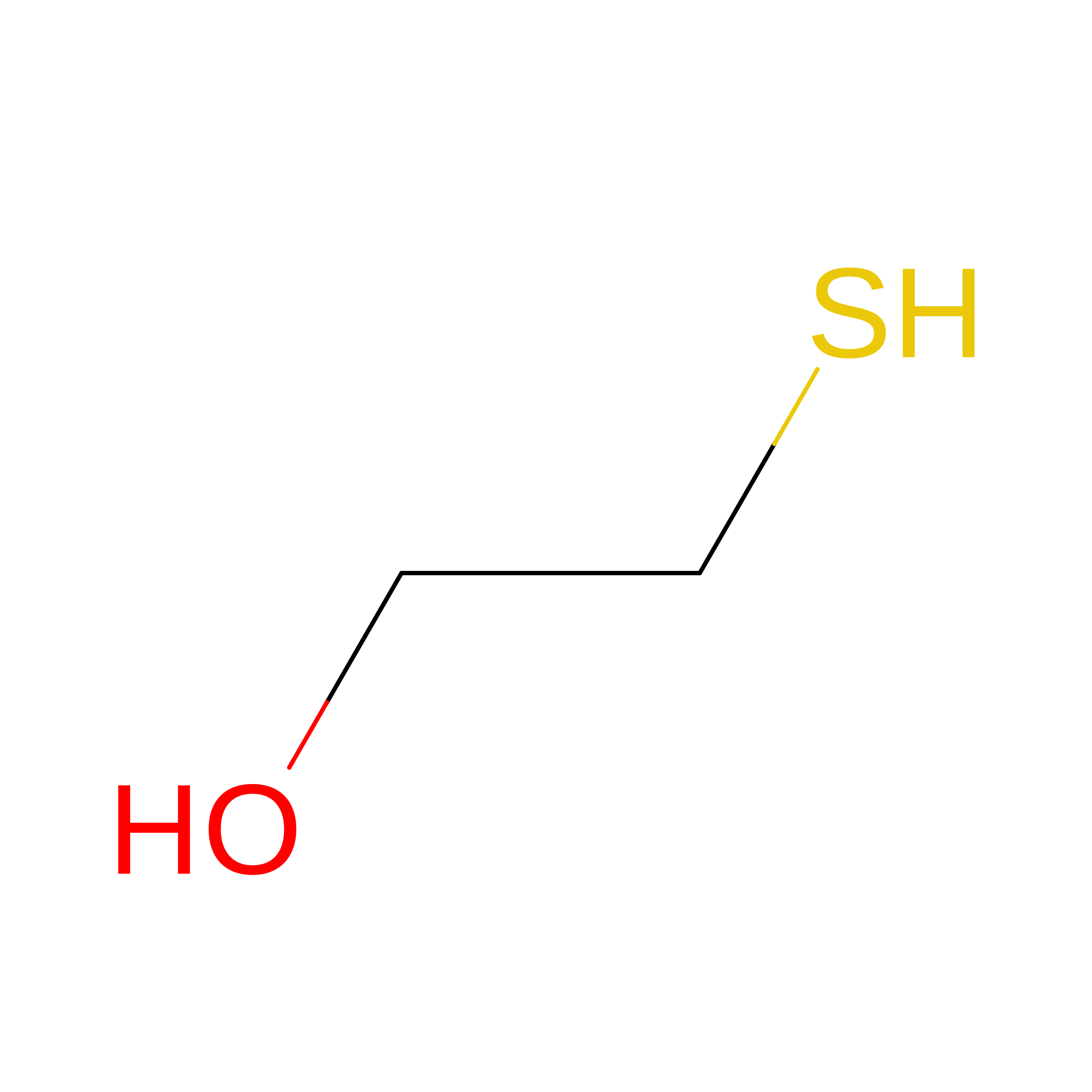
10-Formyltetrahydrofolate dehydrogenase (FDH) converts 10-formyltetrahydrofolate, a precursor for nucleotide biosynthesis, to tetrahydrofolate. The protein comprises two functional domains: a hydrolase domain that removes a formyl group from 10-formyltetrahydrofolate and a NADP(+)-dependent dehydrogenase domain that reduces the formyl to carbon dioxide. As a first step toward deciphering the catalytic mechanism of the enzyme, we have determined the crystal structure of the hydrolase domain of FDH from rat, solved to 2.3-A resolution. The structure comprises two domains. As expected, domain 1 shares the same Rossmann fold as the related enzymes, methionyl-tRNA-formyltransferase and glycinamide ribonucleotide formyltransferase, but, unexpectedly, the structural similarity between the amino-terminal domain of 10-formyltetrahydrofolate dehydrogenase and methionyl-tRNA-formyltransferase extends to the C terminus of both proteins. The active site contains a molecule of beta-mercaptoethanol that is positioned between His-106 and Asp-142 and that appears to mimic the formate product. We propose a catalytic mechanism for the hydrolase reaction in which Asp-142 polarizes the catalytic water molecule and His-106 orients the carbonyl group of formyl. The structure also provides clues as to how, in the native enzyme, the hydrolase domain transfers its product to the dehydrogenase domain.
- Department of Biochemistry and Molecular Biology, Medical University of South Carolina, Charleston, South Carolina 29425, USA.
Organizational Affiliation: