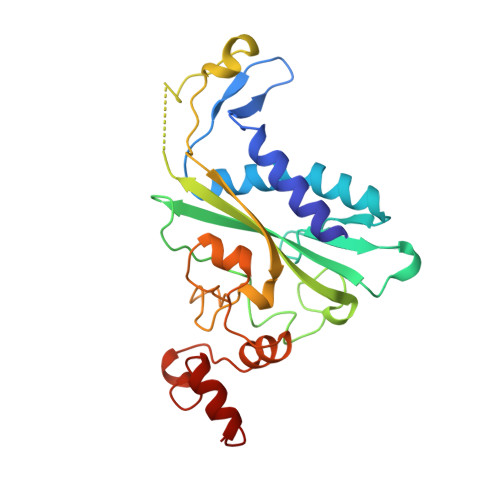
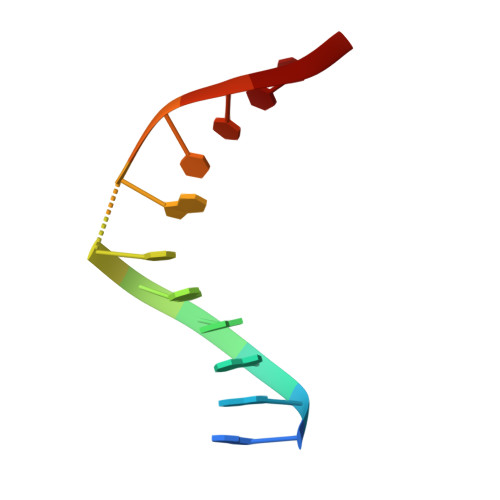
1RV5 | pdb_00001rv5

COMPLEX OF ECORV ENDONUCLEASE WITH D(AAAGAT)/D(ATCTT)


Experimental Data Snapshot

  • Method: X-RAY DIFFRACTION
  • Resolution: 2.10 Å
  • R-Value Free: 
    0.272 (Depositor) 
  • R-Value Work: 
    0.193 (Depositor) 
  • R-Value Observed: 
    0.193 (Depositor) 

Starting Model: experimental
View more details

wwPDB Validation 3D Report Full Report

Validation slider image for 1RV5

This is version 1.3 of the entry. See complete history

Literature

Role of protein-induced bending in the specificity of DNA recognition: crystal structure of EcoRV endonuclease complexed with d(AAAGAT) + d(ATCTT).

Horton, N.C.Perona, J.J.

(1998) J Mol Biology 277: 779-783

  • DOI: https://doi.org/10.1006/jmbi.1998.1655
  • Primary Citation Related Structures: 
    1RV5

  • PubMed Abstract: 

    The crystal structure of EcoRV endonuclease has been determined at 2. 1 A resolution complexed to two five-base-pair DNA duplexes each containing the cognate recognition half-site. The highly localized 50 degrees bend into the major groove seen at the center TA-step of the continuous GATATC site is preserved in this discontinuous DNA complex lacking the scissile phosphates. Thus, this crystal structure provides evidence that covalent constraints associated with a continuous target site are not essential to enzyme-induced DNA bending, even when these constraints are removed directly at the locus of the bend. The scissile phosphates are also absent in the crystal structure of EcoRV bound to the non-specific site TCGCGA, which shows a straight B-like conformation. We conclude that DNA bending by EcoRV is governed only by the sequence and is not influenced by the continuity of the phosphodiester backbone. Together with other data showing that cleavable non-cognate sites are bent, these results indicate that EcoRV bends non-cognate sites differing by one or two base-pairs from GATATC, but does not bend non-specific sites that are less similar. Structural and thermodynamic considerations suggest that the sequence-dependent energy cost of DNA bending is likely to play an important role in determining the specificity of EcoRV. This differential cost is manifested at the binding step for bent non-cognate sequences and at the catalytic step for unbent non-specific sequences.


  • Organizational Affiliation
    • Department of Chemistry and Interdepartmental Program in Biochemistry and Molecular Biology, University of California at Santa Barbara, Santa Barbara, CA, 93106-9510, USA.

Macromolecule Content 

  • Total Structure Weight: 63.83 kDa 
  • Atom Count: 4,396 
  • Modeled Residue Count: 489 
  • Deposited Residue Count: 510 
  • Unique protein chains: 1
  • Unique nucleic acid chains: 1

Macromolecules


Find similar proteins by:|  3D Structure
Entity ID: 2
MoleculeChains  Sequence LengthOrganismDetailsImage
ECORV ENDONUCLEASEC [auth A],
D [auth B]
244Escherichia coliMutation(s): 0 
EC: 3.1.21.4
UniProt
Find proteins for P04390 (Escherichia coli)
Explore P04390 
Go to UniProtKB:  P04390
Entity Groups
Sequence Clusters30% Identity50% Identity70% Identity90% Identity95% Identity100% Identity
UniProt GroupP04390
Sequence Annotations
Expand
Reference Sequence
Find similar nucleic acids by:  Sequence
Entity ID: 1
MoleculeChains LengthOrganismImage
5'-D(*AP*AP*AP*GP*AP*T*AP*TP*CP*TP*T)-3'A [auth C],
B [auth D]
11N/A
Sequence Annotations
Expand
Reference Sequence

Experimental Data & Validation

Experimental Data

  • Method: X-RAY DIFFRACTION
  • Resolution: 2.10 Å
  • R-Value Free:  0.272 (Depositor) 
  • R-Value Work:  0.193 (Depositor) 
  • R-Value Observed: 0.193 (Depositor) 
Space Group: P 1
Unit Cell:
Length ( Å )Angle ( ˚ )
a = 49.6α = 96.4
b = 50.4β = 109.2
c = 63.9γ = 108.5
Software Package:
Software NamePurpose
X-PLORrefinement
DENZOdata reduction
SCALEPACKdata scaling

Structure Validation

View Full Validation Report


Entry History 

Deposition Data

Revision History  (Full details and data files)

  • Version 1.0: 1998-11-11
    Type: Initial release
  • Version 1.1: 2008-05-22
    Changes: Version format compliance
  • Version 1.2: 2011-07-13
    Changes: Version format compliance
  • Version 1.3: 2023-08-02
    Changes: Database references, Refinement description