1R9M | pdb_00001r9m

Crystal Structure of Human Dipeptidyl Peptidase IV at 2.1 Ang. Resolution.


Experimental Data Snapshot

  • Method: X-RAY DIFFRACTION
  • Resolution: 2.10 Å
  • R-Value Free: 
    0.249 (Depositor) 
  • R-Value Work: 
    0.218 (Depositor) 
  • R-Value Observed: 
    0.219 (Depositor) 

wwPDB Validation 3D Report Full Report

Validation slider image for 1R9M

This is version 2.1 of the entry. See complete history

Literature

Crystal structure of human dipeptidyl peptidase IV in complex with a decapeptide reveals details on substrate specificity and tetrahedral intermediate formation.

Aertgeerts, K.Ye, S.Tennant, M.G.Kraus, M.L.Rogers, J.Sang, B.C.Skene, R.J.Webb, D.R.Prasad, G.S.

(2004) Protein Sci 13: 412-421

  • DOI: https://doi.org/10.1110/ps.03460604
  • Primary Citation Related Structures: 
    1R9M, 1R9N

  • PubMed Abstract: 

    Dipeptidyl peptidase IV (DPPIV) is a member of the prolyl oligopeptidase family of serine proteases. DPPIV removes dipeptides from the N terminus of substrates, including many chemokines, neuropeptides, and peptide hormones. Specific inhibition of DPPIV is being investigated in human trials for the treatment of type II diabetes. To understand better the molecular determinants that underlie enzyme catalysis and substrate specificity, we report the crystal structures of DPPIV in the free form and in complex with the first 10 residues of the physiological substrate, Neuropeptide Y (residues 1-10; tNPY). The crystal structure of the free form of the enzyme reveals two potential channels through which substrates could access the active site-a so-called propeller opening, and side opening. The crystal structure of the DPPIV/tNPY complex suggests that bioactive peptides utilize the side opening unique to DPPIV to access the active site. Other structural features in the active site such as the presence of a Glu motif, a well-defined hydrophobic S1 subsite, and minimal long-range interactions explain the substrate recognition and binding properties of DPPIV. Moreover, in the DPPIV/tNPY complex structure, the peptide is not cleaved but trapped in a tetrahedral intermediate that occurs during catalysis. Conformational changes of S630 and H740 between DPPIV in its free form and in complex with tNPY were observed and contribute to the stabilization of the tetrahedral intermediate. Our results facilitate the design of potent, selective small molecule inhibitors of DPPIV that may yield compounds for the development of novel drugs to treat type II diabetes.


  • Organizational Affiliation
    • Syrrx Inc., 10410 Science Center Drive, San Diego, CA 92121, USA.

Macromolecule Content 

  • Total Structure Weight: 349.3 kDa 
  • Atom Count: 26,111 
  • Modeled Residue Count: 2,914 
  • Deposited Residue Count: 2,932 
  • Unique protein chains: 1

Macromolecules

Find similar proteins by:|  3D Structure
Entity ID: 1
MoleculeChains  Sequence LengthOrganismDetailsImage
Dipeptidyl peptidase IV
A, B, C, D
733Homo sapiensMutation(s): 0 
Gene Names: DPP4ADCP2CD26
EC: 3.4.14.5
UniProt & NIH Common Fund Data Resources
Find proteins for P27487 (Homo sapiens)
Explore P27487 
Go to UniProtKB:  P27487
PHAROS:  P27487
GTEx:  ENSG00000197635 
Entity Groups
Sequence Clusters30% Identity50% Identity70% Identity90% Identity95% Identity100% Identity
UniProt GroupP27487
Glycosylation
Glycosylation Sites: 7Go to GlyGen: P27487-1
Sequence Annotations
Expand
Reference Sequence

Oligosaccharides

Help  
Entity ID: 2
MoleculeChains Length2D Diagram GlycosylationD Interactions
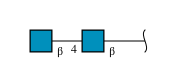
2-acetamido-2-deoxy-beta-D-glucopyranose-(1-4)-2-acetamido-2-deoxy-beta-D-glucopyranose
E, G, H, I, J
E, G, H, I, J, L
2N-Glycosylation
Glycosylation Resources
GlyTouCan: G42666HT
GlyCosmos: G42666HT
GlyGen: G42666HT
Entity ID: 3
MoleculeChains Length2D Diagram GlycosylationD Interactions
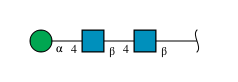
alpha-D-mannopyranose-(1-4)-2-acetamido-2-deoxy-beta-D-glucopyranose-(1-4)-2-acetamido-2-deoxy-beta-D-glucopyranose
F
3N-Glycosylation
Glycosylation Resources
GlyTouCan: G62182OO
GlyCosmos: G62182OO
GlyGen: G62182OO
Entity ID: 4
MoleculeChains Length2D Diagram GlycosylationD Interactions
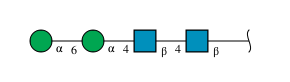
alpha-D-mannopyranose-(1-6)-alpha-D-mannopyranose-(1-4)-2-acetamido-2-deoxy-beta-D-glucopyranose-(1-4)-2-acetamido-2-deoxy-beta-D-glucopyranose
K
4N-Glycosylation
Glycosylation Resources
GlyTouCan: G04854NQ
GlyCosmos: G04854NQ
GlyGen: G04854NQ

Small Molecules

Ligands 2 Unique
IDChains Name / Formula / InChI Key2D Diagram3D Interactions
NAG

Query on NAG


Download:Ideal Coordinates CCD File
AA [auth C]
BA [auth C]
CA [auth D]
DA [auth D]
EA [auth D]
AA [auth C],
BA [auth C],
CA [auth D],
DA [auth D],
EA [auth D],
FA [auth D],
GA [auth D],
HA [auth D],
M [auth A],
N [auth A],
O [auth A],
P [auth A],
Q [auth B],
R [auth B],
T [auth B],
U [auth B],
V [auth B],
W [auth B],
X [auth C],
Y [auth C],
Z [auth C]
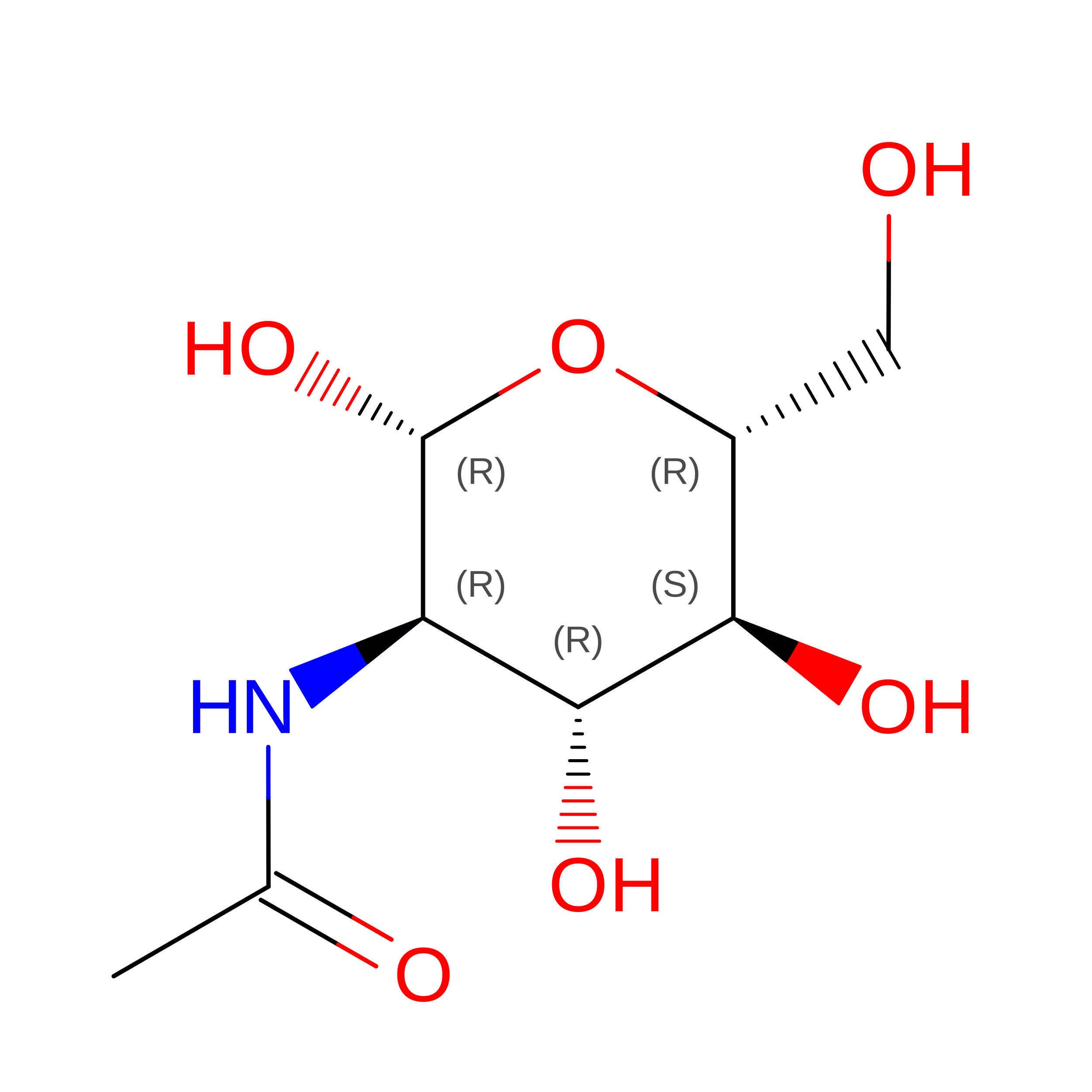
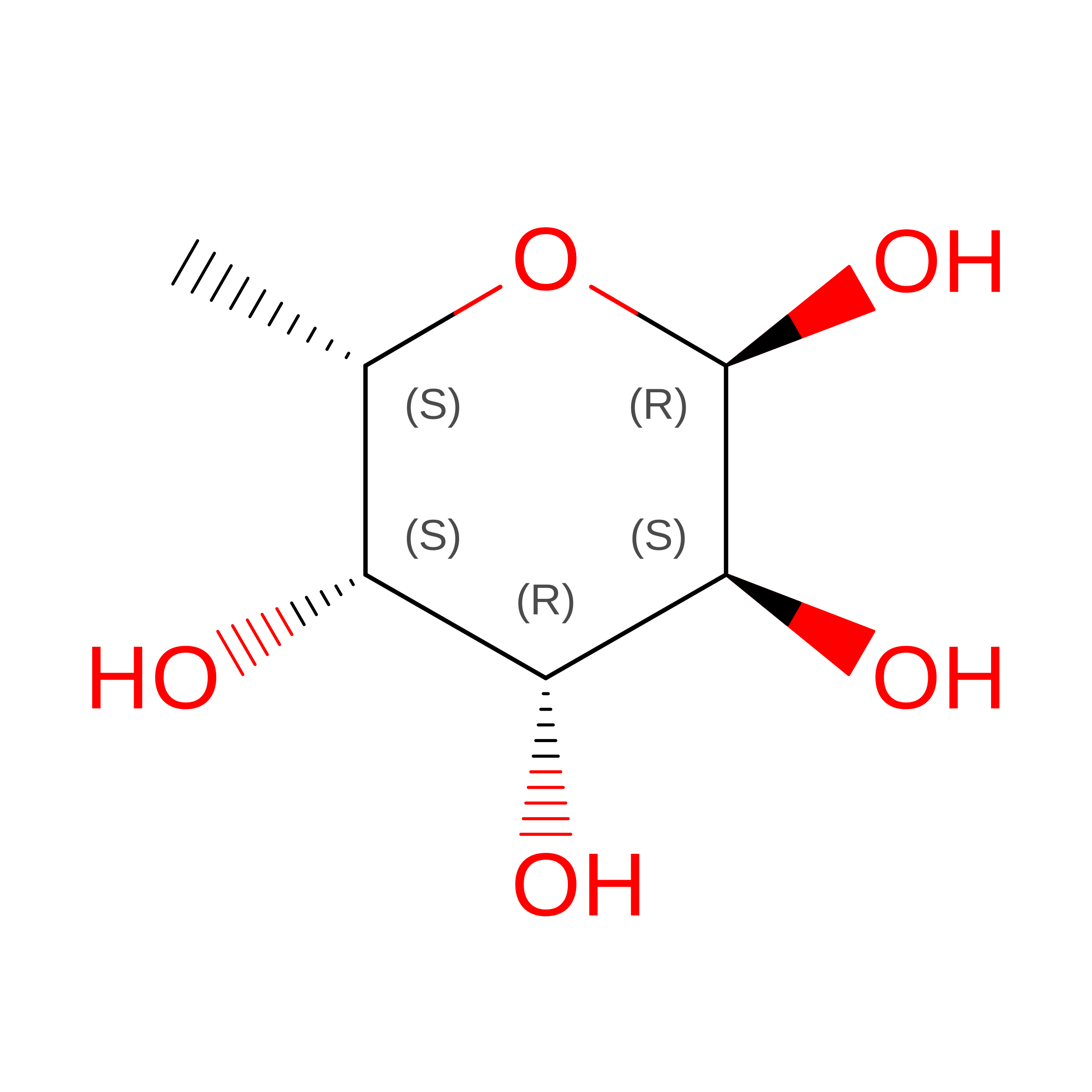
2-acetamido-2-deoxy-beta-D-glucopyranose
C8 H15 N O6
OVRNDRQMDRJTHS-FMDGEEDCSA-N
FUC

Query on FUC


Download:Ideal Coordinates CCD File
S [auth B]alpha-L-fucopyranose
C6 H12 O5
SHZGCJCMOBCMKK-SXUWKVJYSA-N

Experimental Data & Validation

Experimental Data

  • Method: X-RAY DIFFRACTION
  • Resolution: 2.10 Å
  • R-Value Free:  0.249 (Depositor) 
  • R-Value Work:  0.218 (Depositor) 
  • R-Value Observed: 0.219 (Depositor) 
Space Group: P 1 21 1
Unit Cell:
Length ( Å )Angle ( ˚ )
a = 121.823α = 90
b = 124.056β = 114.71
c = 144.491γ = 90
Software Package:
Software NamePurpose
REFMACrefinement
SCALEPACKdata scaling
SHARPphasing

Structure Validation

View Full Validation Report


Entry History 

Deposition Data

Revision History  (Full details and data files)

  • Version 1.0: 2004-06-29
    Type: Initial release
  • Version 1.1: 2008-04-29
    Changes: Version format compliance
  • Version 1.2: 2011-07-13
    Changes: Non-polymer description, Version format compliance
  • Version 1.3: 2017-10-11
    Changes: Advisory, Refinement description
  • Version 2.0: 2020-07-29
    Type: Remediation
    Reason: Carbohydrate remediation
    Changes: Advisory, Atomic model, Data collection, Database references, Derived calculations, Structure summary
  • Version 2.1: 2024-10-09
    Changes: Data collection, Database references, Refinement description, Structure summary