1R9L | pdb_00001r9l

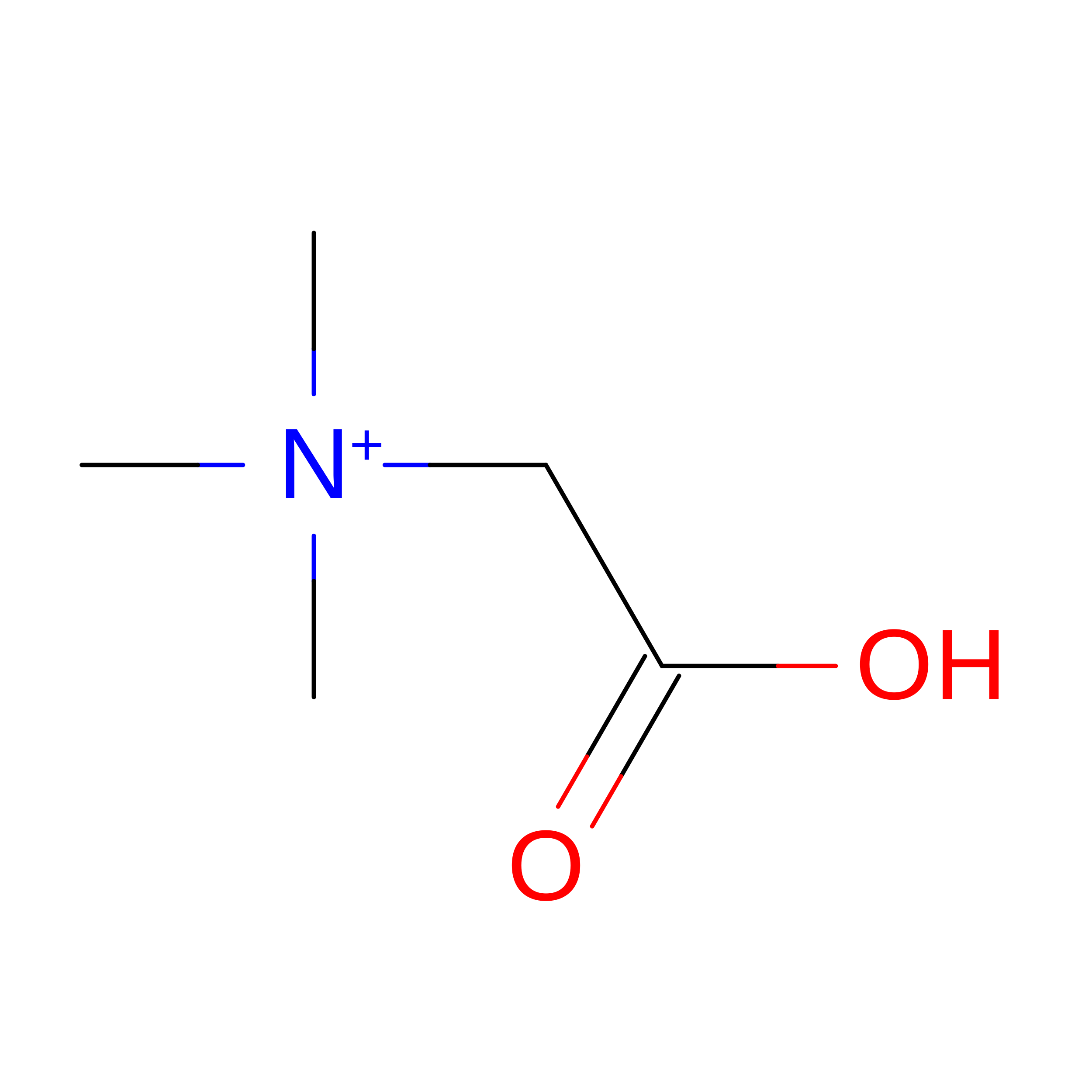
structure analysis of ProX in complex with glycine betaine


Experimental Data Snapshot

  • Method: X-RAY DIFFRACTION
  • Resolution: 1.59 Å
  • R-Value Free: 
    0.186 (Depositor), 0.198 (DCC) 
  • R-Value Work: 
    0.150 (Depositor), 0.169 (DCC) 

wwPDB Validation 3D Report Full Report

Validation slider image for 1R9L

This is version 2.0 of the entry. See complete history

Literature

Cation-pi Interactions as Determinants for Binding of the Compatible Solutes Glycine Betaine and Proline Betaine by the Periplasmic Ligand-binding Protein ProX from Escherichia coli

Schiefner, A.Breed, J.Bosser, L.Kneip, S.Gade, J.Holtmann, G.Diederichs, K.Welte, W.Bremer, E.

(2004) J Biological Chem 279: 5588-5596

  • DOI: https://doi.org/10.1074/jbc.M309771200
  • Primary Citation Related Structures: 
    1R9L, 1R9Q

  • PubMed Abstract: 

    Compatible solutes such as glycine betaine and proline betaine are accumulated to exceedingly high intracellular levels by many organisms in response to high osmolarity to offset the loss of cell water. They are excluded from the immediate hydration shell of proteins and thereby stabilize their native structure. Despite their exclusion from protein surfaces, the periplasmic ligand-binding protein ProX from the Escherichia coli ATP-binding cassette transport system ProU binds the compatible solutes glycine betaine and proline betaine with high affinity and specificity. To understand the mechanism of compatible solute binding, we determined the high resolution structure of ProX in complex with its ligands glycine betaine and proline betaine. This crystallographic study revealed that cation-pi interactions between the positive charge of the quaternary amine of the ligands and three tryptophan residues forming a rectangular aromatic box are the key determinants of the high affinity binding of compatible solutes by ProX. The structural analysis was combined with site-directed mutagenesis of the ligand binding pocket to estimate the contributions of the tryptophan residues involved in binding.


  • Organizational Affiliation
    • Fachbereich Biologie, Universität Konstanz, Universitätsstrasse 10, D-78457 Konstanz, Germany.

Macromolecule Content 

  • Total Structure Weight: 33.88 kDa 
  • Atom Count: 2,827 
  • Modeled Residue Count: 309 
  • Deposited Residue Count: 309 
  • Unique protein chains: 1

Macromolecules

Find similar proteins by:|  3D Structure
Entity ID: 1
MoleculeChains  Sequence LengthOrganismDetailsImage
Glycine betaine-binding periplasmic protein309Escherichia coliMutation(s): 0 
Gene Names: proX
UniProt
Find proteins for P0AFM2 (Escherichia coli (strain K12))
Explore P0AFM2 
Go to UniProtKB:  P0AFM2
Entity Groups
Sequence Clusters30% Identity50% Identity70% Identity90% Identity95% Identity100% Identity
UniProt GroupP0AFM2
Sequence Annotations
Expand
Reference Sequence

Experimental Data & Validation

Experimental Data

  • Method: X-RAY DIFFRACTION
  • Resolution: 1.59 Å
  • R-Value Free:  0.186 (Depositor), 0.198 (DCC) 
  • R-Value Work:  0.150 (Depositor), 0.169 (DCC) 
Space Group: P 21 21 21
Unit Cell:
Length ( Å )Angle ( ˚ )
a = 47.43α = 90
b = 53.9β = 90
c = 115.2γ = 90
Software Package:
Software NamePurpose
MAR345data collection
XDSdata reduction
SOLVEphasing
REFMACrefinement
XDSdata scaling

Structure Validation

View Full Validation Report


Entry History 

Deposition Data

Revision History  (Full details and data files)

  • Version 1.0: 2004-02-24
    Type: Initial release
  • Version 1.1: 2008-04-29
    Changes: Version format compliance
  • Version 1.2: 2011-07-13
    Changes: Version format compliance
  • Version 1.3: 2017-10-11
    Changes: Refinement description
  • Version 2.0: 2023-11-15
    Changes: Atomic model, Data collection, Database references, Derived calculations