1R0O | pdb_00001r0o

Crystal Structure of the Heterodimeric Ecdysone Receptor DNA-binding Complex


Experimental Data Snapshot

  • Method: X-RAY DIFFRACTION
  • Resolution: 2.24 Å
  • R-Value Free: 
    0.270 (Depositor), 0.273 (DCC) 
  • R-Value Work: 
    0.232 (Depositor), 0.232 (DCC) 
  • R-Value Observed: 
    0.232 (Depositor) 

Starting Model: experimental
View more details

wwPDB Validation 3D Report Full Report

Validation slider image for 1R0O

This is version 1.3 of the entry. See complete history

Literature

Structure of the Heterodimeric Ecdysone Receptor DNA-binding Complex

Devarakonda, S.Harp, J.M.Kim, Y.Ozyhar, A.Rastinejad, F.

(2003) EMBO J 22: 5827-5840

  • DOI: https://doi.org/10.1093/emboj/cdg569
  • Primary Citation Related Structures: 
    1R0N, 1R0O

  • PubMed Abstract: 

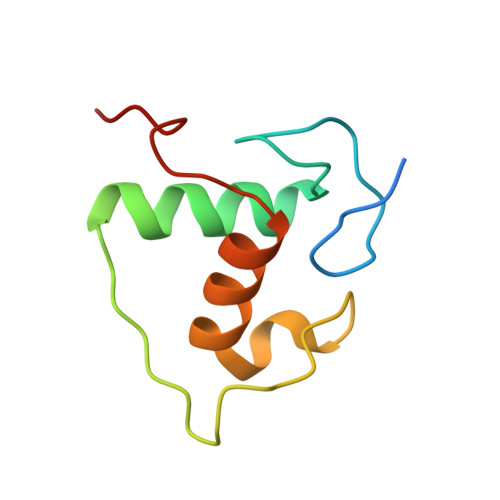
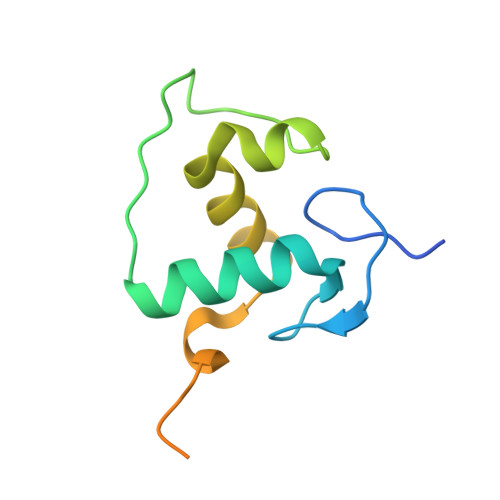
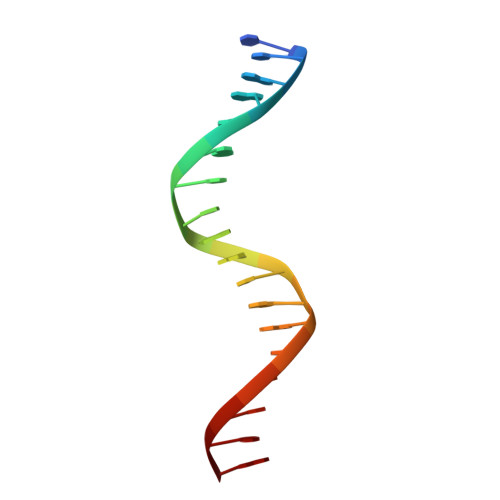
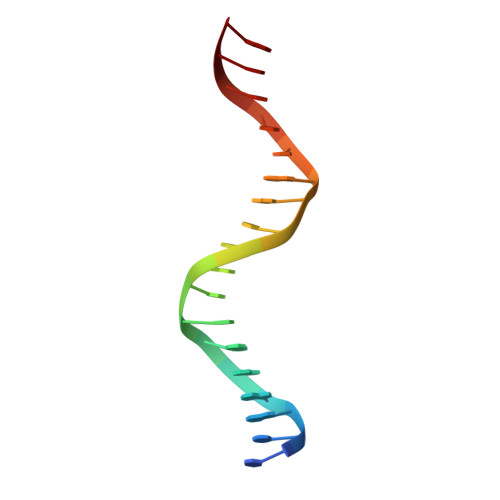
    Ecdysteroids initiate molting and metamorphosis in insects via a heterodimeric receptor consisting of the ecdysone receptor (EcR) and ultraspiracle (USP). The EcR-USP heterodimer preferentially mediates transcription through highly degenerate pseudo-palindromic response elements, resembling inverted repeats of 5'-AGGTCA-3' separated by 1 bp (IR-1). The requirement for a heterodimeric arrangement of EcR-USP subunits to bind to a symmetric DNA is unusual within the nuclear receptor superfamily. We describe the 2.24 A structure of the EcR-USP DNA-binding domain (DBD) heterodimer bound to an idealized IR-1 element. EcR and USP use similar surfaces, and rely on the deformed minor groove of the DNA to establish protein-protein contacts. As retinoid X receptor (RXR) is the mammalian homolog of USP, we also solved the 2.60 A crystal structure of the EcR-RXR DBD heterodimer on IR-1 and found the dimerization and DNA-binding interfaces to be the same as in the EcR-USP complex. Sequence alignments indicate that the EcR-RXR heterodimer is an important model for understanding how the FXR-RXR heterodimer binds to IR-1 sites.


  • Organizational Affiliation
    • Department of Pharmacology, University of Virginia Health System, Charlottesville, VA 22908, USA.

Macromolecule Content 

  • Total Structure Weight: 33.9 kDa 
  • Atom Count: 2,240 
  • Modeled Residue Count: 190 
  • Deposited Residue Count: 231 
  • Unique protein chains: 2
  • Unique nucleic acid chains: 2

Macromolecules


Find similar proteins by:|  3D Structure
Entity ID: 3
MoleculeChains  Sequence LengthOrganismDetailsImage
Ultraspiracle proteinC [auth A]86Drosophila melanogasterMutation(s): 0 
Gene Names: USP
UniProt
Find proteins for P20153 (Drosophila melanogaster)
Explore P20153 
Go to UniProtKB:  P20153
Entity Groups
Sequence Clusters30% Identity50% Identity70% Identity90% Identity95% Identity100% Identity
UniProt GroupP20153
Sequence Annotations
Expand
Reference Sequence
Find similar proteins by:|  3D Structure
Entity ID: 4
MoleculeChains  Sequence LengthOrganismDetailsImage
Ecdysone receptorD [auth B]109Drosophila melanogasterMutation(s): 0 
Gene Names: ECR
UniProt
Find proteins for P34021 (Drosophila melanogaster)
Explore P34021 
Go to UniProtKB:  P34021
Entity Groups
Sequence Clusters30% Identity50% Identity70% Identity90% Identity95% Identity100% Identity
UniProt GroupP34021
Sequence Annotations
Expand
Reference Sequence
Find similar nucleic acids by:  Sequence
Entity ID: 1
MoleculeChains LengthOrganismImage
Ecdysone Response ElementA [auth C]18N/A
Sequence Annotations
Expand
Reference Sequence
Find similar nucleic acids by:  Sequence
Entity ID: 2
MoleculeChains LengthOrganismImage
Ecdysone Response ElementB [auth D]18N/A
Sequence Annotations
Expand
Reference Sequence

Experimental Data & Validation

Experimental Data

  • Method: X-RAY DIFFRACTION
  • Resolution: 2.24 Å
  • R-Value Free:  0.270 (Depositor), 0.273 (DCC) 
  • R-Value Work:  0.232 (Depositor), 0.232 (DCC) 
  • R-Value Observed: 0.232 (Depositor) 
Space Group: P 21 21 21
Unit Cell:
Length ( Å )Angle ( ˚ )
a = 50.37α = 90
b = 59.88β = 90
c = 113.77γ = 90
Software Package:
Software NamePurpose
CNSrefinement
HKL-2000data reduction
SCALEPACKdata scaling
MOLREPphasing

Structure Validation

View Full Validation Report


Entry History 

Deposition Data

Revision History  (Full details and data files)

  • Version 1.0: 2003-10-21
    Type: Initial release
  • Version 1.1: 2008-04-29
    Changes: Version format compliance
  • Version 1.2: 2011-07-13
    Changes: Version format compliance
  • Version 1.3: 2023-08-23
    Changes: Data collection, Database references, Derived calculations, Refinement description