1QYV | pdb_00001qyv

Crystal structure of human estrogenic 17beta-hydroxysteroid dehydrogenase complex with NADP


Experimental Data Snapshot

  • Method: X-RAY DIFFRACTION
  • Resolution: 1.81 Å
  • R-Value Free: 
    0.235 (Depositor) 
  • R-Value Work: 
    0.191 (Depositor) 

Starting Model: experimental
View more details

wwPDB Validation 3D Report Full Report

Validation slider image for 1QYV

This is version 1.4 of the entry. See complete history

Literature

Cofactor hydrogen bonding onto the protein main chain is conserved in the short chain dehydrogenase/reductase family and contributes to nicotinamide orientation.

Shi, R.Lin, S.X.

(2004) J Biological Chem 279: 16778-16785

  • DOI: https://doi.org/10.1074/jbc.M313156200
  • Primary Citation Related Structures: 
    1QYV, 1QYW, 1QYX

  • PubMed Abstract: 

    Human estrogenic 17beta-hydroxysteroid dehydrogenase (17beta-HSD1), a member of the short chain dehydrogenase/reductase (SDR) family, is responsible for the biosynthesis of all active estrogens. The crystal structures of two C19-steroid ternary complexes (17beta-HSD1-androstanedione-NADP and 17beta-HSD1-androstenedione-NADP) reveal the critical role of Leu149 in regulating the substrate specificity and provide novel insight into the different fates of a conserved glutamate residue in the estrogen-specific proteins upon the binding of the keto and hydroxyl groups of steroids. The whole NADP molecule can be unambiguously defined in the NADP binary complex, whereas both ternary complexes show that the nicotinamide moiety of NADP cannot be located in the density maps. In both ternary complexes, the expected position of carboxamide oxygen of NADP is occupied by a water molecule, which makes a bifurcated hydrogen bond with the O3 of C19-steroid and the main chain nitrogen of Val188. These results demonstrate that the hydrogen bonding interaction between the main chain amide group and the carboxamide group of NAD(P)(H) plays an important role in anchoring the nicotinamide ring to the enzyme. This finding is substantiated by structural analyses of all 33 NAD(P)(H) complexes of different SDR proteins, because 29 structures of 33 show this interaction. This common feature reveals a general mechanism among the SDR family, providing a rational basis for inhibitor design against biologically relevant SDR targets.


  • Organizational Affiliation
    • Oncology and Molecular Endocrinology Research Center, Laval University Medical Center (CHUQ) and Laval University, Quebec G1V 4G2, Canada.

Macromolecule Content 

  • Total Structure Weight: 35.72 kDa 
  • Atom Count: 2,328 
  • Modeled Residue Count: 276 
  • Deposited Residue Count: 327 
  • Unique protein chains: 1

Macromolecules

Find similar proteins by:|  3D Structure
Entity ID: 1
MoleculeChains  Sequence LengthOrganismDetailsImage
Estradiol 17 beta-dehydrogenase 1327Homo sapiensMutation(s): 0 
EC: 1.1.1.62 (PDB Primary Data), 1.1.1.51 (UniProt)
UniProt & NIH Common Fund Data Resources
Find proteins for P14061 (Homo sapiens)
Explore P14061 
Go to UniProtKB:  P14061
PHAROS:  P14061
GTEx:  ENSG00000108786 
Entity Groups
Sequence Clusters30% Identity50% Identity70% Identity90% Identity95% Identity100% Identity
UniProt GroupP14061
Sequence Annotations
Expand
Reference Sequence

Small Molecules

Ligands 2 Unique
IDChains Name / Formula / InChI Key2D Diagram3D Interactions
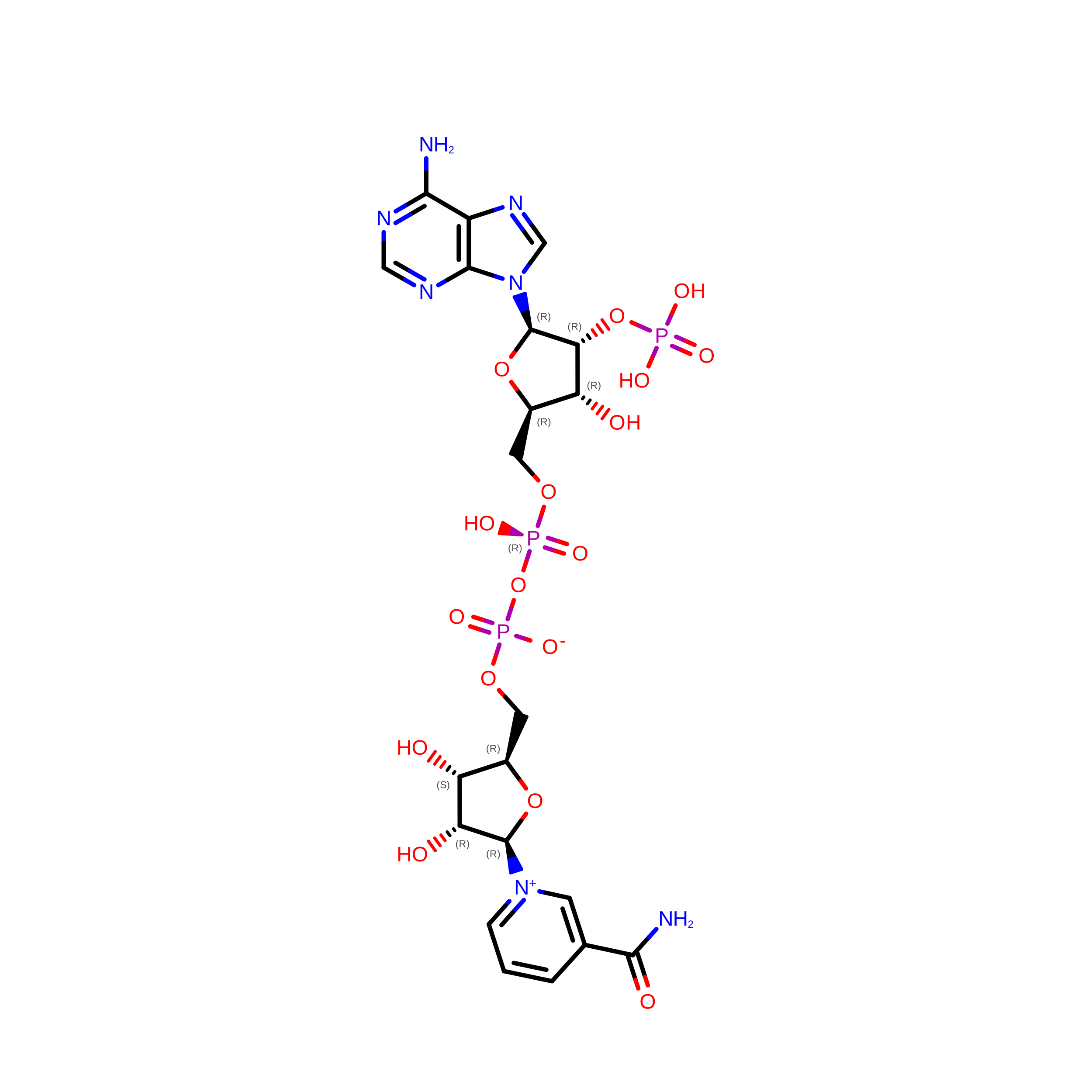
NAP

Query on NAP


Download:Ideal Coordinates CCD File
B [auth A]NADP NICOTINAMIDE-ADENINE-DINUCLEOTIDE PHOSPHATE
C21 H28 N7 O17 P3
XJLXINKUBYWONI-NNYOXOHSSA-N
GOL

Query on GOL


Download:Ideal Coordinates CCD File
C [auth A]GLYCEROL
C3 H8 O3
PEDCQBHIVMGVHV-UHFFFAOYSA-N

Experimental Data & Validation

Experimental Data

  • Method: X-RAY DIFFRACTION
  • Resolution: 1.81 Å
  • R-Value Free:  0.235 (Depositor) 
  • R-Value Work:  0.191 (Depositor) 
Space Group: C 1 2 1
Unit Cell:
Length ( Å )Angle ( ˚ )
a = 122.399α = 90
b = 43.916β = 99.36
c = 60.45γ = 90
Software Package:
Software NamePurpose
DENZOdata reduction
SCALEPACKdata scaling
REFMACrefinement

Structure Validation

View Full Validation Report


Entry History 

Deposition Data

Revision History  (Full details and data files)

  • Version 1.0: 2004-08-03
    Type: Initial release
  • Version 1.1: 2008-04-29
    Changes: Version format compliance
  • Version 1.2: 2011-07-13
    Changes: Derived calculations, Version format compliance
  • Version 1.3: 2017-10-11
    Changes: Refinement description
  • Version 1.4: 2023-08-23
    Changes: Data collection, Database references, Derived calculations, Refinement description