1QVR | pdb_00001qvr

Crystal Structure Analysis of ClpB


Experimental Data Snapshot

  • Method: X-RAY DIFFRACTION
  • Resolution: 3.00 Å
  • R-Value Free: 
    0.307 (Depositor), 0.310 (DCC) 
  • R-Value Work: 
    0.263 (Depositor), 0.265 (DCC) 
  • R-Value Observed: 
    0.263 (Depositor) 

wwPDB Validation 3D Report Full Report

Validation slider image for 1QVR

Ligand Structure Quality Assessment 


This is version 1.3 of the entry. See complete history

Literature

The Structure of ClpB: A Molecular Chaperone that Rescues Proteins from an Aggregated State

Lee, S.Sowa, M.E.Watanabe, Y.Sigler, P.B.Chiu, W.Yoshida, M.Tsai, F.T.F.

(2003) Cell 115: 229-240

  • DOI: https://doi.org/10.1016/s0092-8674(03)00807-9
  • Primary Citation Related Structures: 
    1QVR

  • PubMed Abstract: 

    Molecular chaperones assist protein folding by facilitating their "forward" folding and preventing aggregation. However, once aggregates have formed, these chaperones cannot facilitate protein disaggregation. Bacterial ClpB and its eukaryotic homolog Hsp104 are essential proteins of the heat-shock response, which have the remarkable capacity to rescue stress-damaged proteins from an aggregated state. We have determined the structure of Thermus thermophilus ClpB (TClpB) using a combination of X-ray crystallography and cryo-electron microscopy (cryo-EM). Our single-particle reconstruction shows that TClpB forms a two-tiered hexameric ring. The ClpB/Hsp104-linker consists of an 85 A long and mobile coiled coil that is located on the outside of the hexamer. Our mutagenesis and biochemical data show that both the relative position and motion of this coiled coil are critical for chaperone function. Taken together, we propose a mechanism by which an ATP-driven conformational change is coupled to a large coiled-coil motion, which is indispensable for protein disaggregation.


  • Organizational Affiliation
    • Verna and Marrs McLean Department of Biochemistry and Molecular Biology, Baylor College of Medicine, Houston, TX 77030, USA.

Macromolecule Content 

  • Total Structure Weight: 296.68 kDa 
  • Atom Count: 19,496 
  • Modeled Residue Count: 2,409 
  • Deposited Residue Count: 2,562 
  • Unique protein chains: 1

Macromolecules

Find similar proteins by:|  3D Structure
Entity ID: 1
MoleculeChains  Sequence LengthOrganismDetailsImage
ClpB protein
A, B, C
854Thermus thermophilusMutation(s): 0 
Gene Names: CLPB
UniProt
Find proteins for Q9RA63 (Thermus thermophilus (strain ATCC 27634 / DSM 579 / HB8))
Explore Q9RA63 
Go to UniProtKB:  Q9RA63
Entity Groups
Sequence Clusters30% Identity50% Identity70% Identity90% Identity95% Identity100% Identity
UniProt GroupQ9RA63
Sequence Annotations
Expand
Reference Sequence

Small Molecules

Ligands 2 Unique
IDChains Name / Formula / InChI Key2D Diagram3D Interactions
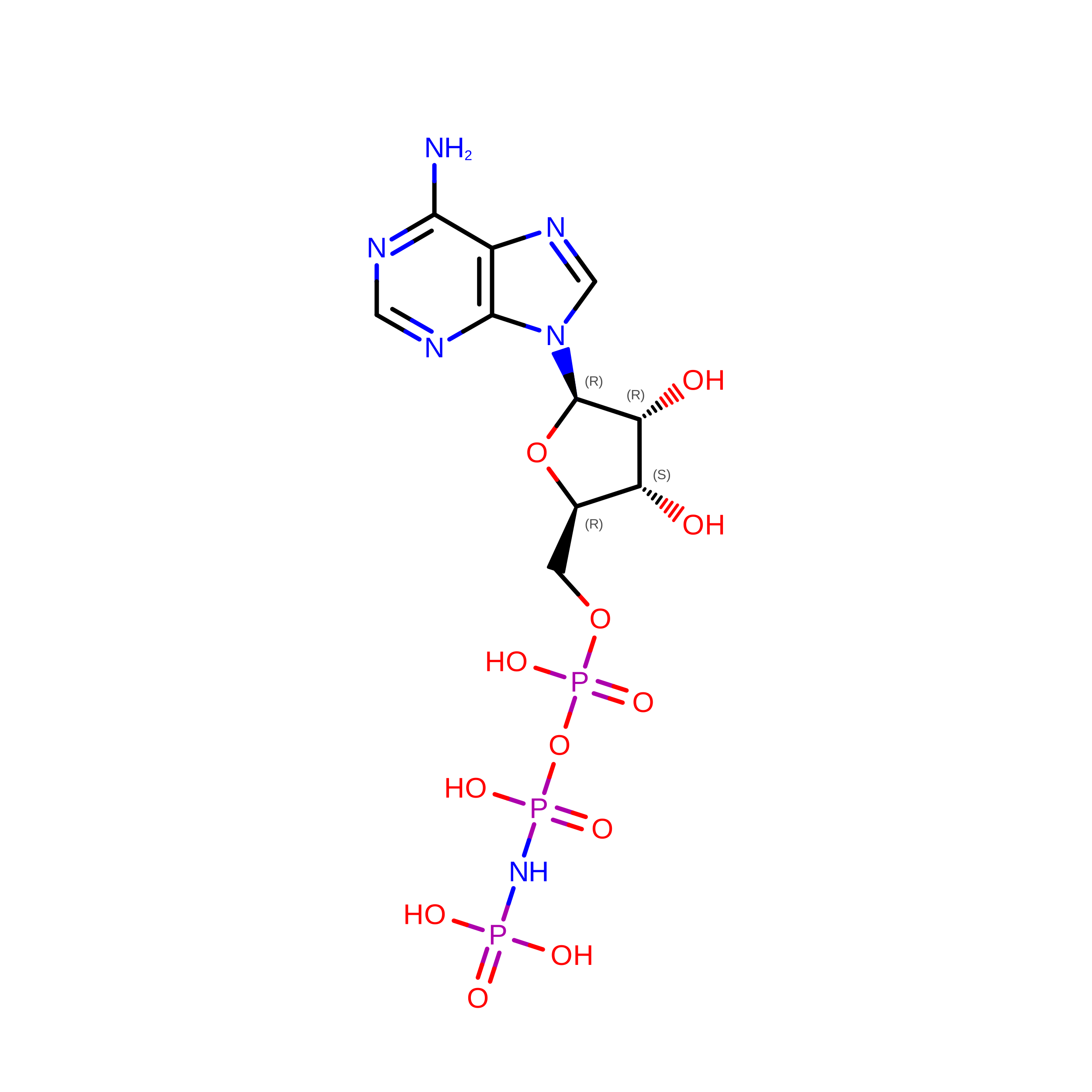
ANP

Query on ANP


Download:Ideal Coordinates CCD File
EA [auth C]
FA [auth C]
L [auth A]
M [auth A]
V [auth B]
EA [auth C],
FA [auth C],
L [auth A],
M [auth A],
V [auth B],
W [auth B]
PHOSPHOAMINOPHOSPHONIC ACID-ADENYLATE ESTER
C10 H17 N6 O12 P3
PVKSNHVPLWYQGJ-KQYNXXCUSA-N
PT

Query on PT


Download:Ideal Coordinates CCD File
AA [auth C]
BA [auth C]
CA [auth C]
D [auth A]
DA [auth C]
AA [auth C],
BA [auth C],
CA [auth C],
D [auth A],
DA [auth C],
E [auth A],
F [auth A],
G [auth A],
H [auth A],
I [auth A],
J [auth A],
K [auth A],
N [auth B],
O [auth B],
P [auth B],
Q [auth B],
R [auth B],
S [auth B],
T [auth B],
U [auth B],
X [auth C],
Y [auth C],
Z [auth C]
PLATINUM (II) ION
Pt
HRGDZIGMBDGFTC-UHFFFAOYSA-N

Experimental Data & Validation

Experimental Data

  • Method: X-RAY DIFFRACTION
  • Resolution: 3.00 Å
  • R-Value Free:  0.307 (Depositor), 0.310 (DCC) 
  • R-Value Work:  0.263 (Depositor), 0.265 (DCC) 
  • R-Value Observed: 0.263 (Depositor) 
Space Group: P 21 21 21
Unit Cell:
Length ( Å )Angle ( ˚ )
a = 107.747α = 90
b = 138.482β = 90
c = 212.215γ = 90
Software Package:
Software NamePurpose
CNSrefinement
HKL-2000data reduction
SCALEPACKdata scaling
CNSphasing

Structure Validation

View Full Validation Report


Ligand Structure Quality Assessment 


Entry History 

Deposition Data

Revision History  (Full details and data files)

  • Version 1.0: 2003-10-21
    Type: Initial release
  • Version 1.1: 2008-04-29
    Changes: Version format compliance
  • Version 1.2: 2011-07-13
    Changes: Version format compliance
  • Version 1.3: 2024-02-14
    Changes: Data collection, Database references, Derived calculations