1QGJ | pdb_00001qgj

ARABIDOPSIS THALIANA PEROXIDASE N


Experimental Data Snapshot

  • Method: X-RAY DIFFRACTION
  • Resolution: 1.90 Å
  • R-Value Free: 
    0.205 (Depositor), 0.198 (DCC) 
  • R-Value Work: 
    0.170 (Depositor), 0.169 (DCC) 
  • R-Value Observed: 
    0.170 (Depositor) 

wwPDB Validation 3D Report Full Report

Validation slider image for 1QGJ

Ligand Structure Quality Assessment 


This is version 1.3 of the entry. See complete history

Literature

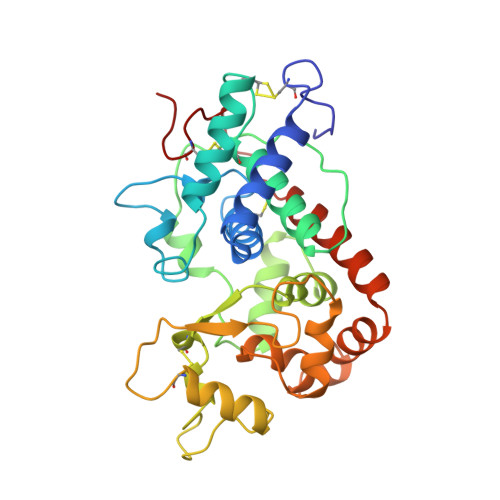
Arabidopsis thaliana peroxidase N: structure of a novel neutral peroxidase.

Mirza, O.Henriksen, A.Ostergaard, L.Welinder, K.G.Gajhede, M.

(2000) Acta Crystallogr D Biol Crystallogr 56: 372-375

  • DOI: https://doi.org/10.1107/s0907444999016340
  • Primary Citation Related Structures: 
    1QGJ

  • PubMed Abstract: 

    The structure of the neutral peroxidase from Arabidopsis thaliana (ATP N) has been determined to a resolution of 1.9 A and a free R value of 20.5%. ATP N has the expected characteristic fold of the class III peroxidases, with a C(alpha) r.m.s.d. of 0.82 A when compared with horseradish peroxidase C (HRP C). HRP C is 54% identical to ATP N in sequence. When the structures of four class III plant peroxidases are superimposed, the regions with structural differences are non-randomly distributed; all are located in one half of the molecule. The architecture of the haem pocket of ATP N is very similar to that of HRP C, in agreement with the low small-molecule substrate specificity of all class III peroxidases. The structure of ATP N suggests that the pH dependence of the substrate turnover will differ from that of HRP C owing to differences in polarity of the residues in the substrate-access channel. Since there are fewer hydrogen bonds to haem C17 propionate O atoms in ATP N than in HRP C, it is suggested that ATP N will lose haem more easily than HRP C. Unlike almost all other class III plant peroxidases, ATP N has a free cysteine residue at a similar position to the suggested secondary substrate-binding site in lignin peroxidase.


  • Organizational Affiliation
    • Protein Structure Group, Department of Chemistry, University of Copenhagen, Universitetsparken 5, DK-2100 Kobenhavn O, Denmark.

Macromolecule Content 

  • Total Structure Weight: 66.01 kDa 
  • Atom Count: 5,936 
  • Modeled Residue Count: 600 
  • Deposited Residue Count: 600 
  • Unique protein chains: 1

Macromolecules

Find similar proteins by:|  3D Structure
Entity ID: 1
MoleculeChains  Sequence LengthOrganismDetailsImage
PEROXIDASE N
A, B
300Arabidopsis thalianaMutation(s): 0 
EC: 1.11.1 (PDB Primary Data), 1.11.1.7 (UniProt)
UniProt
Find proteins for Q39034 (Arabidopsis thaliana)
Explore Q39034 
Go to UniProtKB:  Q39034
Entity Groups
Sequence Clusters30% Identity50% Identity70% Identity90% Identity95% Identity100% Identity
UniProt GroupQ39034
Sequence Annotations
Expand
Reference Sequence

Small Molecules

Ligands 3 Unique
IDChains Name / Formula / InChI Key2D Diagram3D Interactions
HEM

Query on HEM


Download:Ideal Coordinates CCD File
E [auth A],
I [auth B]
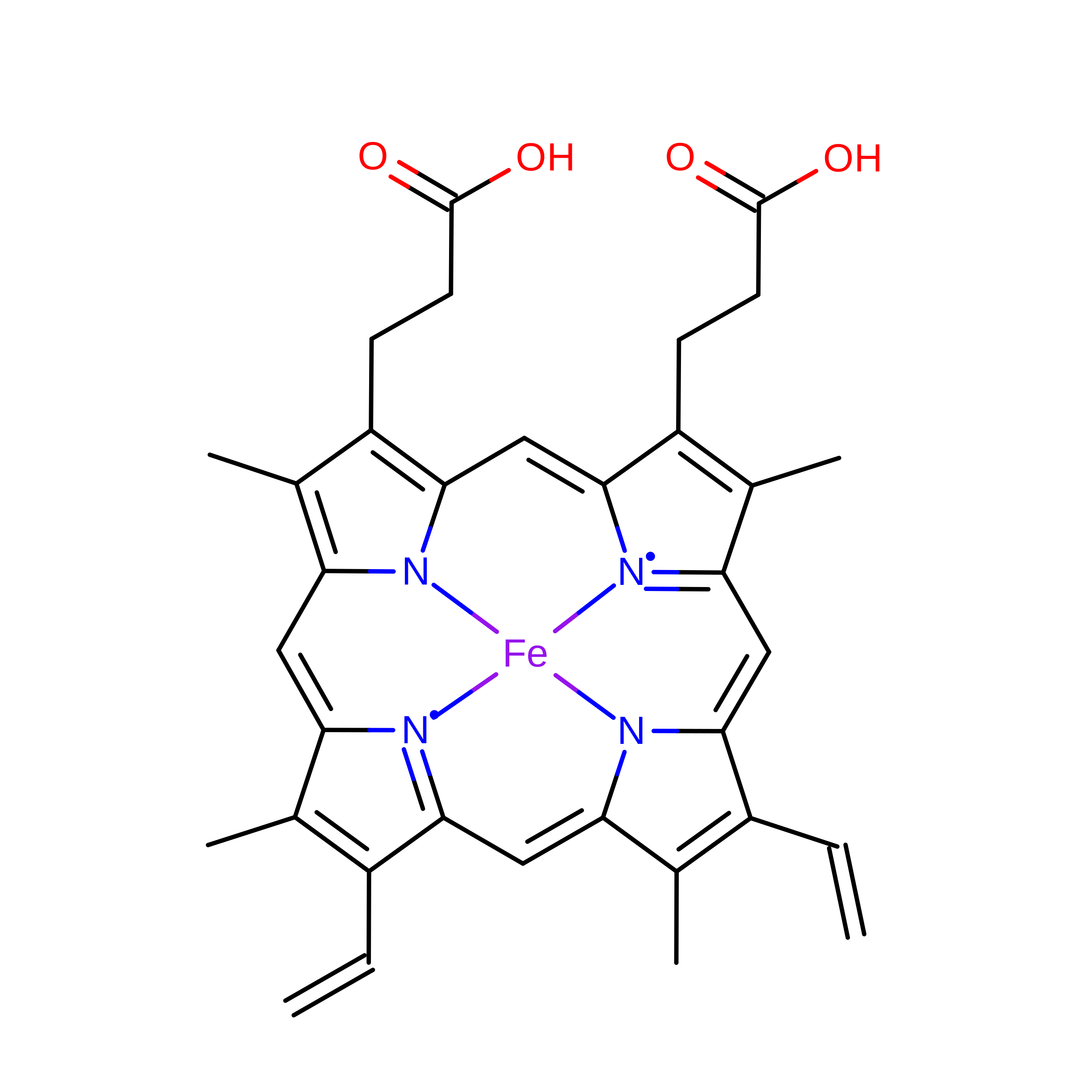
PROTOPORPHYRIN IX CONTAINING FE
C34 H32 Fe N4 O4
KABFMIBPWCXCRK-RGGAHWMASA-L
GSH

Query on GSH


Download:Ideal Coordinates CCD File
F [auth A],
J [auth B]
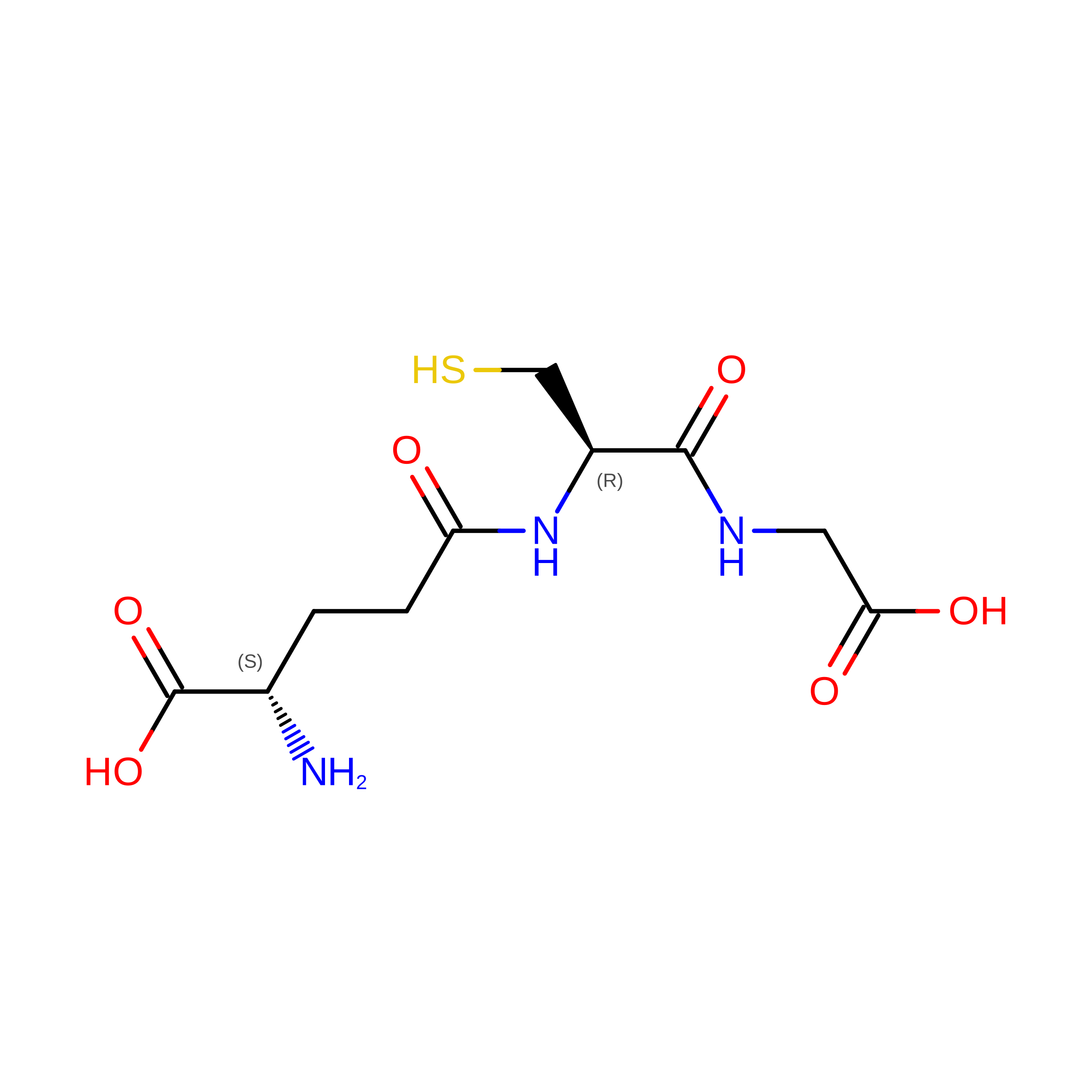
Glutathione
C10 H17 N3 O6 S
RWSXRVCMGQZWBV-WDSKDSINSA-N
CA

Query on CA


Download:Ideal Coordinates CCD File
C [auth A],
D [auth A],
G [auth B],
H [auth B]
CALCIUM ION
Ca
BHPQYMZQTOCNFJ-UHFFFAOYSA-N

Biologically Interesting Molecules (External Reference) 

1 Unique

Experimental Data & Validation

Experimental Data

  • Method: X-RAY DIFFRACTION
  • Resolution: 1.90 Å
  • R-Value Free:  0.205 (Depositor), 0.198 (DCC) 
  • R-Value Work:  0.170 (Depositor), 0.169 (DCC) 
  • R-Value Observed: 0.170 (Depositor) 
Space Group: P 21 21 21
Unit Cell:
Length ( Å )Angle ( ˚ )
a = 72.989α = 90
b = 87.457β = 90
c = 91.371γ = 90
Software Package:
Software NamePurpose
CNSrefinement

Structure Validation

View Full Validation Report


Ligand Structure Quality Assessment 


Entry History 

Deposition Data

Revision History  (Full details and data files)

  • Version 1.0: 2000-03-08
    Type: Initial release
  • Version 1.1: 2008-04-26
    Changes: Version format compliance
  • Version 1.2: 2011-07-13
    Changes: Version format compliance
  • Version 1.3: 2023-12-27
    Changes: Data collection, Database references, Derived calculations