1PQP | pdb_00001pqp

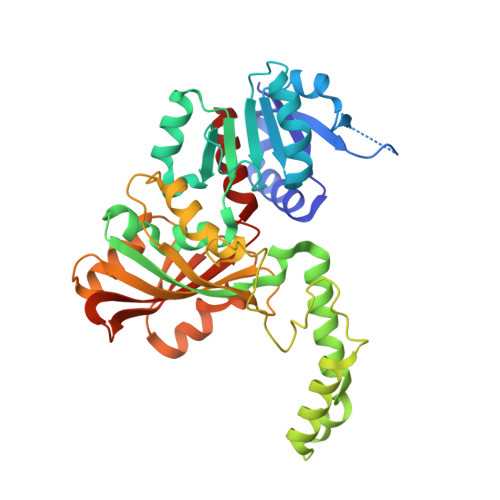
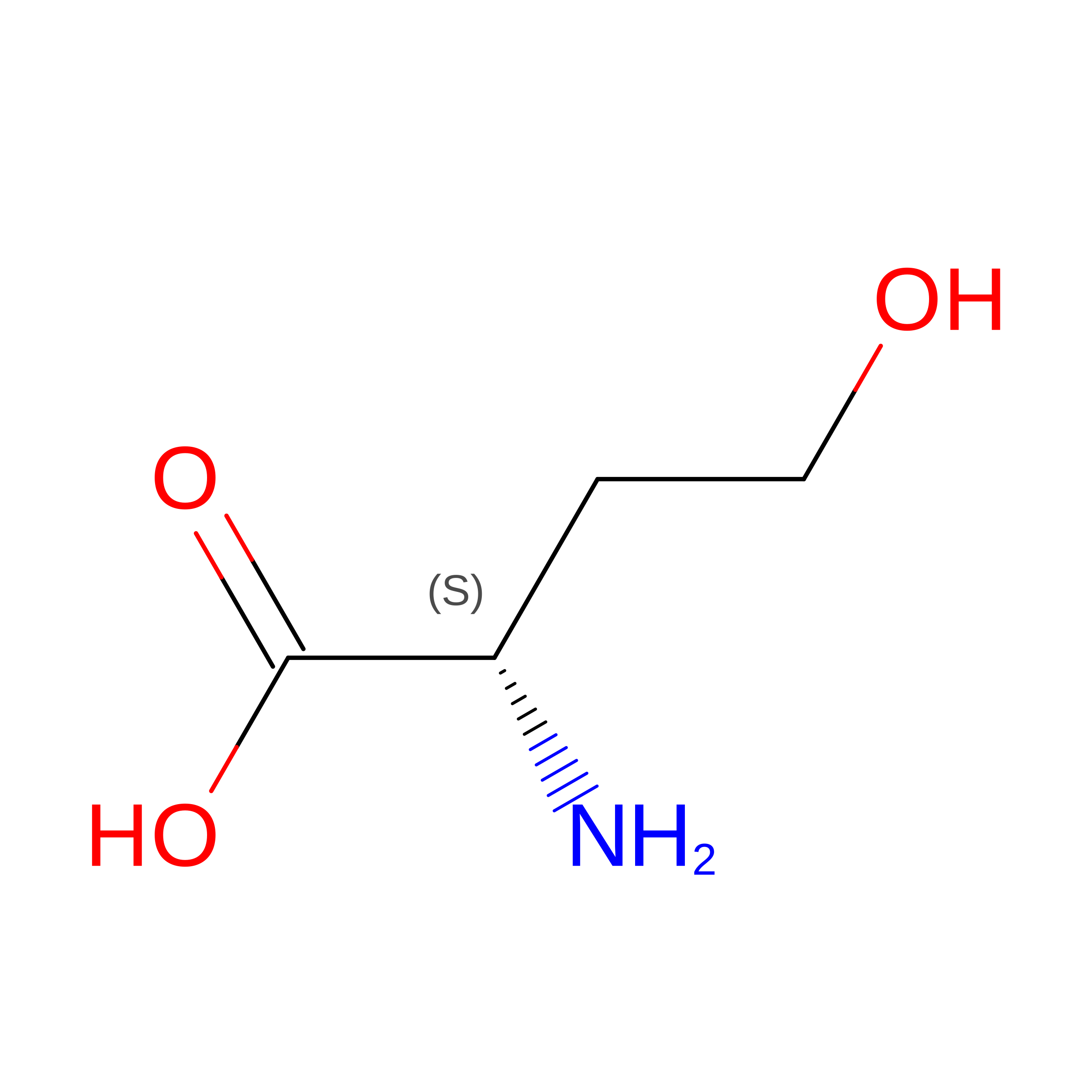
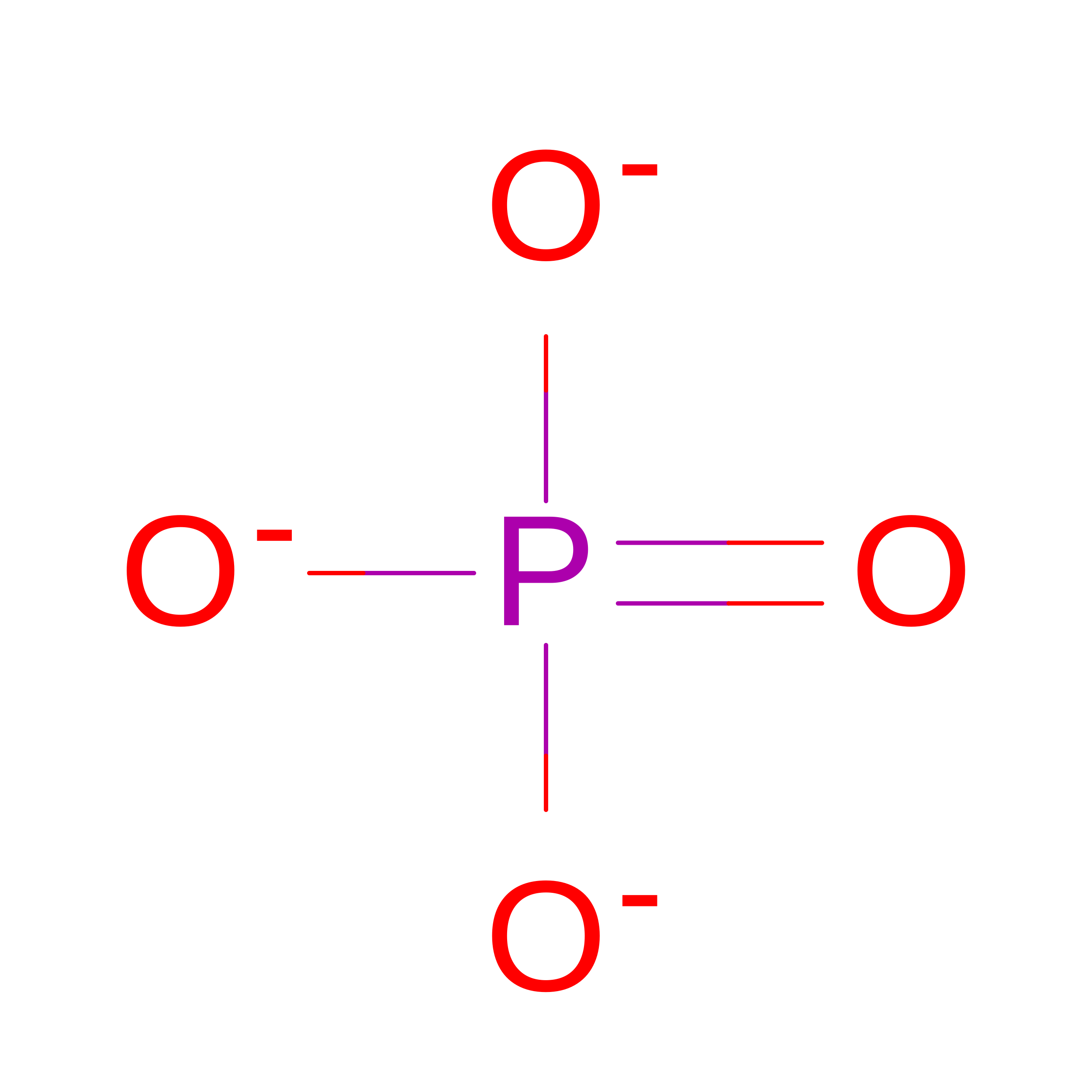
Crystal Structure of the C136S Mutant of Aspartate Semialdehyde Dehydrogenase from Haemophilus influenzae Bound with Aspartate Semialdehyde and Phosphate


Experimental Data Snapshot

  • Method: X-RAY DIFFRACTION
  • Resolution: 2.06 Å
  • R-Value Free: 
    0.286 (Depositor), 0.280 (DCC) 
  • R-Value Work: 
    0.228 (Depositor), 0.220 (DCC) 
  • R-Value Observed: 
    0.228 (Depositor) 

Starting Model: experimental
View more details

wwPDB Validation   3D Report Full Report


This is version 2.1 of the entry. See complete history


Literature

Critical catalytic functional groups in the mechanism of aspartate-beta-semialdehyde dehydrogenase.

Blanco, J.Moore, R.A.Faehnle, C.R.Viola, R.E.

(2004) Acta Crystallogr D Biol Crystallogr 60: 1808-1815

  • DOI: https://doi.org/10.1107/S0907444904020104
  • Primary Citation of Related Structures:  
    1PQP, 1PQU

  • PubMed Abstract: 

    Aspartate-beta-semialdehyde dehydrogenase (ASADH) catalyzes the reductive dephosphorylation of beta-aspartyl phosphate to L-aspartate-beta-semialdehyde in the aspartate biosynthetic pathway. This pathway is not found in humans or other eukaryotic organisms, yet is required for the production of threonine, isoleucine, methionine and lysine in most microorganisms. The mechanism of this enzyme has been examined through the structures of two active-site mutants of ASADH from Haemophilus influenzae. Replacement of the enzyme active-site cysteine with serine (C136S) leads to a dramatic loss of catalytic activity caused by the expected decrease in nucleophilicity, but also by a change in the orientation of the serine hydroxyl group relative to the cysteine thiolate. In contrast, in the H277N active-site mutant the introduced amide is oriented in virtually the same position as that of the histidine imidazole ring. However, a shift in the position of the bound reaction intermediate to accommodate this shorter asparagine side chain, coupled with the inability of this introduced amide to serve as a proton acceptor, results in a 100-fold decrease in the catalytic efficiency of H277N relative to the native enzyme. These mutant enzymes have the same overall fold and high structural identity to native ASADH. However, small perturbations in the positioning of essential catalytic groups or reactive intermediates have dramatic effects on catalytic efficiency.


  • Organizational Affiliation
    • Department of Chemistry, University of Toledo, Toledo, Ohio 43606, USA.

Macromolecules
Find similar proteins by:  (by identity cutoff)  |  3D Structure
Entity ID: 1
MoleculeChains Sequence LengthOrganismDetailsImage
Aspartate-semialdehyde dehydrogenase371Haemophilus influenzae Rd KW20Mutation(s): 1 
Gene Names: asd
EC: 1.2.1.11
UniProt
Find proteins for P44801 (Haemophilus influenzae (strain ATCC 51907 / DSM 11121 / KW20 / Rd))
Explore P44801 
Go to UniProtKB:  P44801
Entity Groups  
Sequence Clusters30% Identity50% Identity70% Identity90% Identity95% Identity100% Identity
UniProt GroupP44801
Sequence Annotations
Expand
  • Reference Sequence
Experimental Data & Validation

Experimental Data

  • Method: X-RAY DIFFRACTION
  • Resolution: 2.06 Å
  • R-Value Free:  0.286 (Depositor), 0.280 (DCC) 
  • R-Value Work:  0.228 (Depositor), 0.220 (DCC) 
  • R-Value Observed: 0.228 (Depositor) 
Space Group: P 21 21 2
Unit Cell:
Length ( Å )Angle ( ˚ )
a = 113.949α = 90
b = 55.059β = 90
c = 57.832γ = 90
Software Package:
Software NamePurpose
CNSrefinement
HKL-2000data reduction
SCALEPACKdata scaling
CNSphasing

Structure Validation

View Full Validation Report


Entry History 

Deposition Data

Revision History  (Full details and data files)

  • Version 1.0: 2004-08-10
    Type: Initial release
  • Version 1.1: 2008-04-29
    Changes: Version format compliance
  • Version 1.2: 2011-07-13
    Changes: Derived calculations, Source and taxonomy, Version format compliance
  • Version 1.3: 2021-10-27
    Changes: Database references, Derived calculations
  • Version 1.4: 2023-08-16
    Changes: Data collection, Refinement description
  • Version 2.0: 2023-11-15
    Changes: Atomic model, Data collection
  • Version 2.1: 2025-11-12
    Changes: Database references, Structure summary