Download Mendeley
Unique stabilizing interactions identified in the two-stranded alpha-helical coiled-coil: crystal structure of a cortexillin I/GCN4 hybrid coiled-coil peptide.
Lee, D.L., Ivaninskii, S., Burkhard, P., Hodges, R.S.(2003) Protein Sci 12: 1395-1405
- PubMed: 12824486 Search on PubMedSearch on PubMed Central
- DOI: https://doi.org/10.1110/ps.0241403
- Primary Citation Related Structures:
1P9I - PubMed Abstract:
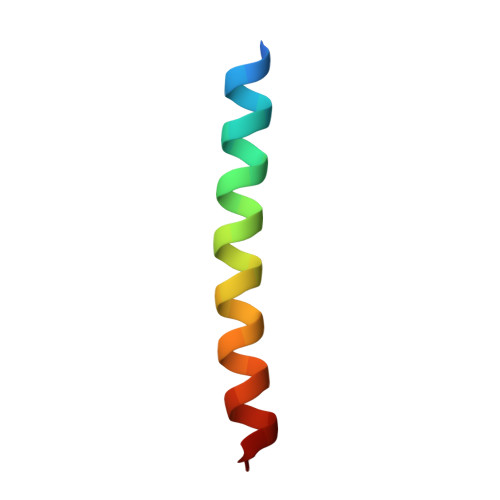
We determined the 1.17 A resolution X-ray crystal structure of a hybrid peptide based on sequences from coiled-coil regions of the proteins GCN4 and cortexillin I. The peptide forms a parallel homodimeric coiled-coil, with C(alpha) backbone geometry similar to GCN4 (rmsd value 0.71 A). Three stabilizing interactions have been identified: a unique hydrogen bonding-electrostatic network not previously observed in coiled-coils, and two other hydrophobic interactions involving leucine residues at positions e and g from both g-a' and d-e' interchain interactions with the hydrophobic core. This is also the first report of the quantitative significance of these interactions. The GCN4/cortexillin hybrid surprisingly has two interchain Glu-Lys' ion pairs that form a hydrogen bonding network with the Asn residues in the core. This network, which was not observed for the reversed Lys-Glu' pair in GCN4, increases the combined stability contribution of each Glu-Lys' salt bridge across the central Asn15-Asn15' core to approximately 0.7 kcal/mole, compared to approximately 0.4 kcal mole(-1) from a Glu-Lys' salt bridge on its own. In addition to electrostatic and hydrogen bonding stabilization of the coiled-coil, individual leucine residues at positions e and g in the hybrid peptide also contribute to stability by 0.7 kcal/mole relative to alanine. These interactions are of critical importance to understanding the stability requirements for coiled-coil folding and in modulating the stability of de novo designed macromolecules containing this motif.
- Department of Biochemistry, University of Alberta, Edmonton, Alberta T6G 2H7, Canada.
Organizational Affiliation: