1P4F | pdb_00001p4f

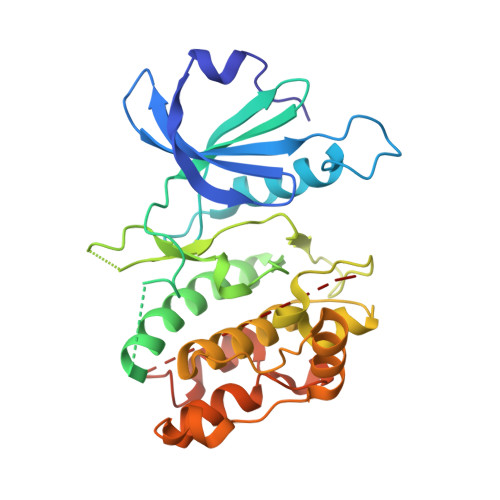
DEATH ASSOCIATED PROTEIN KINASE CATALYTIC DOMAIN WITH BOUND INHIBITOR FRAGMENT


Experimental Data Snapshot

  • Method: X-RAY DIFFRACTION
  • Resolution: 1.90 Å
  • R-Value Free: 
    0.233 (Depositor), 0.254 (DCC) 
  • R-Value Work: 
    0.185 (Depositor) 
  • R-Value Observed: 
    0.186 (Depositor) 

Starting Model: experimental
View more details

wwPDB Validation 3D Report Full Report

Validation slider image for 1P4F

Ligand Structure Quality Assessment 


This is version 2.1 of the entry. See complete history

Literature

An aminopyridazine-based inhibitor of a pro-apoptotic protein kinase attenuates hypoxia-ischemia induced acute brain injury.

Velentza, A.V.Wainwright, M.S.Zasadzki, M.Mirzoeva, S.Schumacher, A.M.Haiech, J.Focia, P.J.Egli, M.Watterson, D.M.

(2003) Bioorg Med Chem Lett 13: 3465-3470

  • DOI: https://doi.org/10.1016/s0960-894x(03)00733-9
  • Primary Citation Related Structures: 
    1P4F

  • PubMed Abstract: 

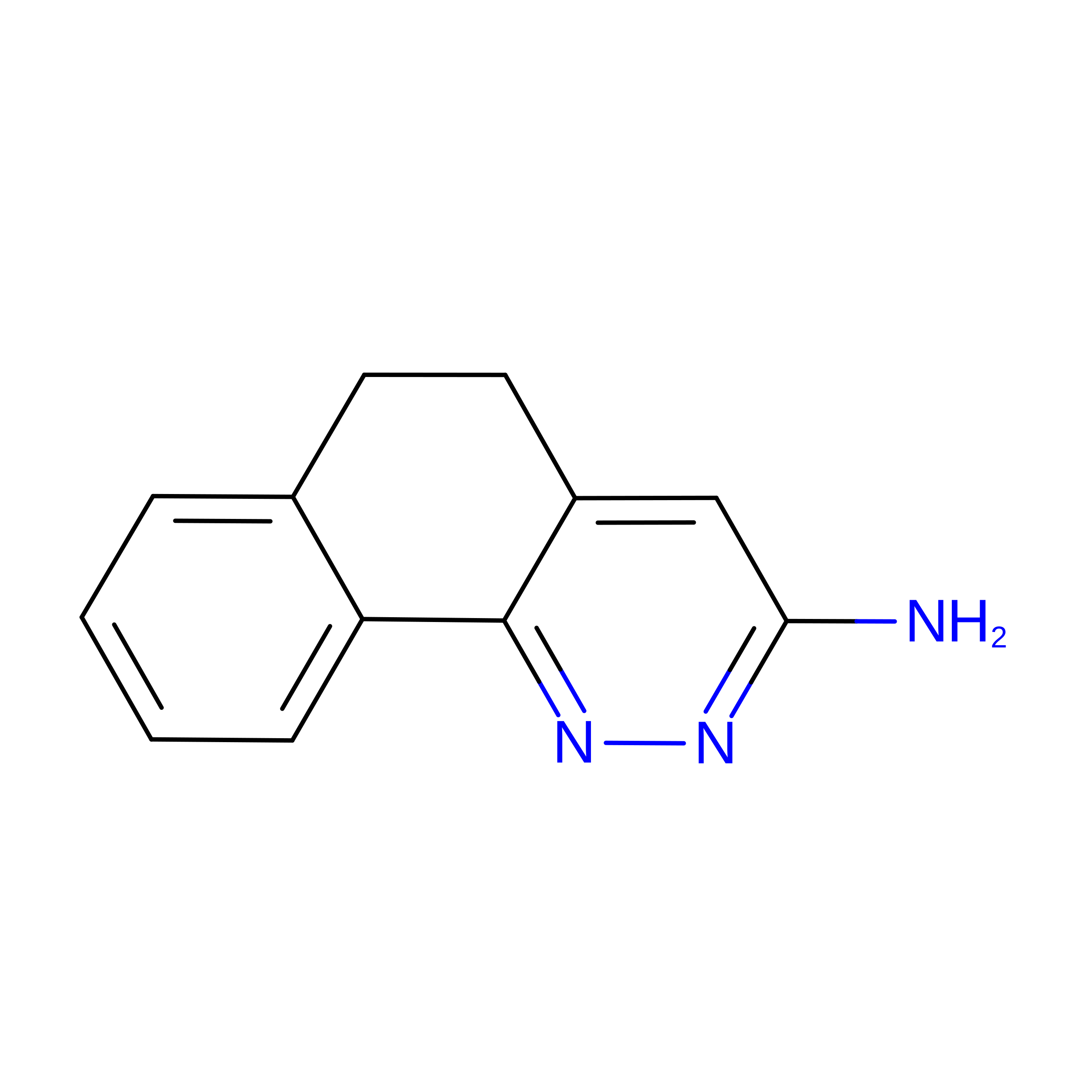
    Death associated protein kinase (DAPK) is a calcium and calmodulin regulated enzyme that functions early in eukaryotic programmed cell death, or apoptosis. To validate DAPK as a potential drug discovery target for acute brain injury, the first small molecule DAPK inhibitor was synthesized and tested in vivo. A single injection of the aminopyridazine-based inhibitor administered 6 h after injury attenuated brain tissue or neuronal biomarker loss measured, respectively, 1 week and 3 days later. Because aminopyridazine is a privileged structure in neuropharmacology, we determined the high-resolution crystal structure of a binary complex between the kinase domain and a molecular fragment of the DAPK inhibitor. The co-crystal structure describes a structural basis for interaction and provides a firm foundation for structure-assisted design of lead compounds with appropriate molecular properties for future drug development.


  • Organizational Affiliation
    • Drug Discovery Program, Northwestern University, 303 E. Chicago Avenue, Ward 8-196, Chicago, IL 60611, USA.

Macromolecule Content 

  • Total Structure Weight: 33.86 kDa 
  • Atom Count: 2,407 
  • Modeled Residue Count: 269 
  • Deposited Residue Count: 293 
  • Unique protein chains: 1

Macromolecules

Find similar proteins by:|  3D Structure
Entity ID: 1
MoleculeChains  Sequence LengthOrganismDetailsImage
Death-associated protein kinase 1293Homo sapiensMutation(s): 0 
Gene Names: DAPK1 OR DAPK
EC: 2.7.1 (PDB Primary Data), 2.7.11.1 (UniProt)
UniProt & NIH Common Fund Data Resources
Find proteins for P53355 (Homo sapiens)
Explore P53355 
Go to UniProtKB:  P53355
PHAROS:  P53355
GTEx:  ENSG00000196730 
Entity Groups
Sequence Clusters30% Identity50% Identity70% Identity90% Identity95% Identity100% Identity
UniProt GroupP53355
Sequence Annotations
Expand
Reference Sequence

Small Molecules

Ligands 1 Unique
IDChains Name / Formula / InChI Key2D Diagram3D Interactions
86Q

Query on 86Q


Download:Ideal Coordinates CCD File
B [auth A]5,6-Dihydro-benzo[H]cinnolin-3-ylamine
C12 H11 N3
QKVREUJWFZJEJK-UHFFFAOYSA-N

Experimental Data & Validation

Experimental Data

  • Method: X-RAY DIFFRACTION
  • Resolution: 1.90 Å
  • R-Value Free:  0.233 (Depositor), 0.254 (DCC) 
  • R-Value Work:  0.185 (Depositor) 
  • R-Value Observed: 0.186 (Depositor) 
Space Group: P 21 21 21
Unit Cell:
Length ( Å )Angle ( ˚ )
a = 47.238α = 90
b = 62.527β = 90
c = 88.927γ = 90
Software Package:
Software NamePurpose
REFMACrefinement
SCALEPACKdata scaling
CNSrefinement
CNSphasing
MAR345data collection

Structure Validation

View Full Validation Report


Ligand Structure Quality Assessment 


Entry History 

Deposition Data

Revision History  (Full details and data files)

  • Version 1.0: 2004-09-28
    Type: Initial release
  • Version 1.1: 2008-04-29
    Changes: Version format compliance
  • Version 1.2: 2011-07-13
    Changes: Version format compliance
  • Version 1.3: 2017-10-11
    Changes: Advisory, Refinement description
  • Version 1.4: 2019-07-24
    Changes: Data collection, Refinement description
  • Version 2.0: 2021-09-15
    Changes: Advisory, Atomic model, Data collection, Database references, Derived calculations, Non-polymer description, Structure summary
  • Version 2.1: 2023-08-16
    Changes: Data collection, Refinement description