1O6S | pdb_00001o6s

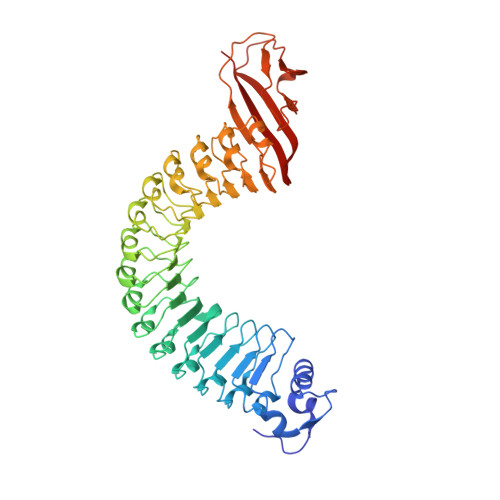
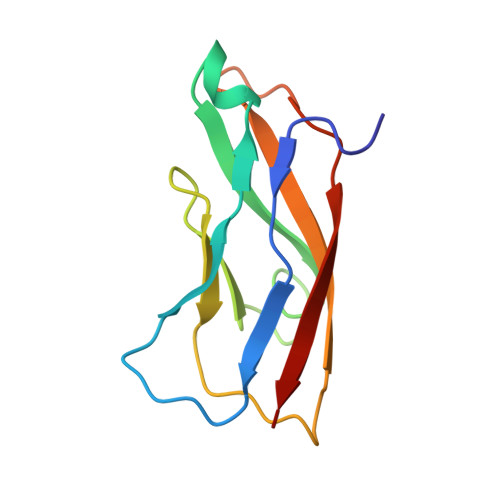
Internalin (Listeria monocytogenes) / E-Cadherin (human) Recognition Complex


Experimental Data Snapshot

  • Method: X-RAY DIFFRACTION
  • Resolution: 1.80 Å
  • R-Value Free: 
    0.221 (Depositor), 0.223 (DCC) 
  • R-Value Work: 
    0.168 (Depositor) 
  • R-Value Observed: 
    0.171 (Depositor) 

wwPDB Validation 3D Report Full Report

Validation slider image for 1O6S

This is version 1.4 of the entry. See complete history

Literature

Structure of Internalin, a Major Invasion Protein of Listeria Monocytogenes, in Complex with its Human Receptor E-Cadherin

Schubert, W.-D.Urbanke, C.Ziehm, T.Beier, V.Machner, M.P.Domann, E.Wehland, J.Chakraborty, T.Heinz, D.W.

(2002) Cell 111: 825

  • DOI: https://doi.org/10.1016/s0092-8674(02)01136-4
  • Primary Citation Related Structures: 
    1O6S, 1O6T, 1O6V

  • PubMed Abstract: 

    Listeria monocytogenes, a food-borne bacterial pathogen, enters mammalian cells by inducing its own phagocytosis. The listerial protein internalin (InlA) mediates bacterial adhesion and invasion of epithelial cells in the human intestine through specific interaction with its host cell receptor E-cadherin. We present the crystal structures of the functional domain of InlA alone and in a complex with the extracellular, N-terminal domain of human E-cadherin (hEC1). The leucine rich repeat (LRR) domain of InlA surrounds and specifically recognizes hEC1. Individual interactions were probed by mutagenesis and analytical ultracentrifugation. These include Pro16 of hEC1, a major determinant for human susceptibility to L. monocytogenes infection that is essential for intermolecular recognition. Our studies reveal the structural basis for host tro-pism of this bacterium and the molecular deception L. monocytogenes employs to exploit the E-cadherin system.


  • Organizational Affiliation
    • Department of Structural Biology, German Research Center for Biotechnology (GBF), Mascheroder Weg 1, D-38124, Braunschweig, Germany.

Macromolecule Content 

  • Total Structure Weight: 61.95 kDa 
  • Atom Count: 5,117 
  • Modeled Residue Count: 566 
  • Deposited Residue Count: 571 
  • Unique protein chains: 2

Macromolecules

Find similar proteins by:|  3D Structure
Entity ID: 1
MoleculeChains  Sequence LengthOrganismDetailsImage
INTERNALIN A466Listeria monocytogenes EGD-eMutation(s): 0 
UniProt
Find proteins for P0DJM0 (Listeria monocytogenes serovar 1/2a (strain ATCC BAA-679 / EGD-e))
Explore P0DJM0 
Go to UniProtKB:  P0DJM0
Entity Groups
Sequence Clusters30% Identity50% Identity70% Identity90% Identity95% Identity100% Identity
UniProt GroupP0DJM0
Sequence Annotations
Expand
Reference Sequence
Find similar proteins by:|  3D Structure
Entity ID: 2
MoleculeChains  Sequence LengthOrganismDetailsImage
E-CADHERIN105Homo sapiensMutation(s): 0 
UniProt & NIH Common Fund Data Resources
Find proteins for P12830 (Homo sapiens)
Explore P12830 
Go to UniProtKB:  P12830
PHAROS:  P12830
GTEx:  ENSG00000039068 
Entity Groups
Sequence Clusters30% Identity50% Identity70% Identity90% Identity95% Identity100% Identity
UniProt GroupP12830
Sequence Annotations
Expand
Reference Sequence

Experimental Data & Validation

Experimental Data

  • Method: X-RAY DIFFRACTION
  • Resolution: 1.80 Å
  • R-Value Free:  0.221 (Depositor), 0.223 (DCC) 
  • R-Value Work:  0.168 (Depositor) 
  • R-Value Observed: 0.171 (Depositor) 
Space Group: P 21 21 21
Unit Cell:
Length ( Å )Angle ( ˚ )
a = 55.378α = 90
b = 86.859β = 90
c = 110.723γ = 90
Software Package:
Software NamePurpose
REFMACrefinement
DENZOdata reduction
SCALEPACKdata scaling
EPMRphasing

Structure Validation

View Full Validation Report


Entry History 

Deposition Data

Revision History  (Full details and data files)

  • Version 1.0: 2002-12-13
    Type: Initial release
  • Version 1.1: 2011-05-08
    Changes: Version format compliance
  • Version 1.2: 2011-07-13
    Changes: Version format compliance
  • Version 1.3: 2019-05-08
    Changes: Data collection, Experimental preparation, Other
  • Version 1.4: 2024-05-08
    Changes: Data collection, Database references, Derived calculations, Other