1NL9 | pdb_00001nl9

Potent, Selective Protein Tyrosine Phosphatase 1B Inhibitor Compound 12 Using a Linked-Fragment Strategy


Experimental Data Snapshot

  • Method: X-RAY DIFFRACTION
  • Resolution: 2.40 Å
  • R-Value Free: 
    0.247 (Depositor) 
  • R-Value Work: 
    0.192 (Depositor) 
  • R-Value Observed: 
    0.208 (Depositor) 

Starting Model: experimental
View more details

wwPDB Validation 3D Report Full Report

Validation slider image for 1NL9

This is version 1.4 of the entry. See complete history

Literature

Discovery of a Potent, Selective Protein Tyrosine Phosphatase 1B Inhibitor Using a Linked-Fragment Strategy

Szczepankiewicz, B.G.Liu, G.Hajduk, P.J.Abad-Zapatero, C.Pei, Z.Xin, Z.Lubben, T.Trevillyan, J.M.Stashko, M.A.Ballaron, S.J.Liang, H.Huang, F.Hutchins, C.W.Fesik, S.W.Jirousek, M.R.

(2003) J Am Chem Soc 125: 4087-4096

  • DOI: https://doi.org/10.1021/ja0296733
  • Primary Citation Related Structures: 
    1NL9, 1NNY, 1NO6

  • PubMed Abstract: 

    Protein tyrosine phosphatase 1B (PTP1B) is an enzyme that downregulates the insulin receptor. Inhibition of PTP1B is expected to improve insulin action, and the design of small molecule PTP1B inhibitors to treat type II diabetes has received considerable attention. In this work, NMR-based screening identified a nonselective competitive inhibitor of PTP1B. A second site ligand was also identified by NMR-based screening and then linked to the catalytic site ligand by rational design. X-ray data confirmed that the inhibitor bound with the catalytic site in the native, "open" conformation. The final compound displayed excellent potency and good selectivity over many other phosphatases. The modular approach to drug design described in this work should be applicable for the design of potent and selective inhibitors of other therapeutically relevant protein tyrosine phosphatases.


  • Organizational Affiliation
    • Metabolic Disease Research, Global Pharmaceutical Research and Development Organization, Abbott Laboratories, 100 Abbott Park Road, Abbott Park, Illinois 60064, USA. bruce.szczepankiewicz@abbott.com

Macromolecule Content 

  • Total Structure Weight: 37.9 kDa 
  • Atom Count: 2,625 
  • Modeled Residue Count: 283 
  • Deposited Residue Count: 321 
  • Unique protein chains: 1

Macromolecules

Find similar proteins by:|  3D Structure
Entity ID: 1
MoleculeChains  Sequence LengthOrganismDetailsImage
Protein-tyrosine phosphatase, non-receptor type 1321Homo sapiensMutation(s): 0 
Gene Names: PTPN1 OR PTP1B
EC: 3.1.3.48
UniProt & NIH Common Fund Data Resources
Find proteins for P18031 (Homo sapiens)
Explore P18031 
Go to UniProtKB:  P18031
PHAROS:  P18031
GTEx:  ENSG00000196396 
Entity Groups
Sequence Clusters30% Identity50% Identity70% Identity90% Identity95% Identity100% Identity
UniProt GroupP18031
Sequence Annotations
Expand
Reference Sequence

Small Molecules

Ligands 1 Unique
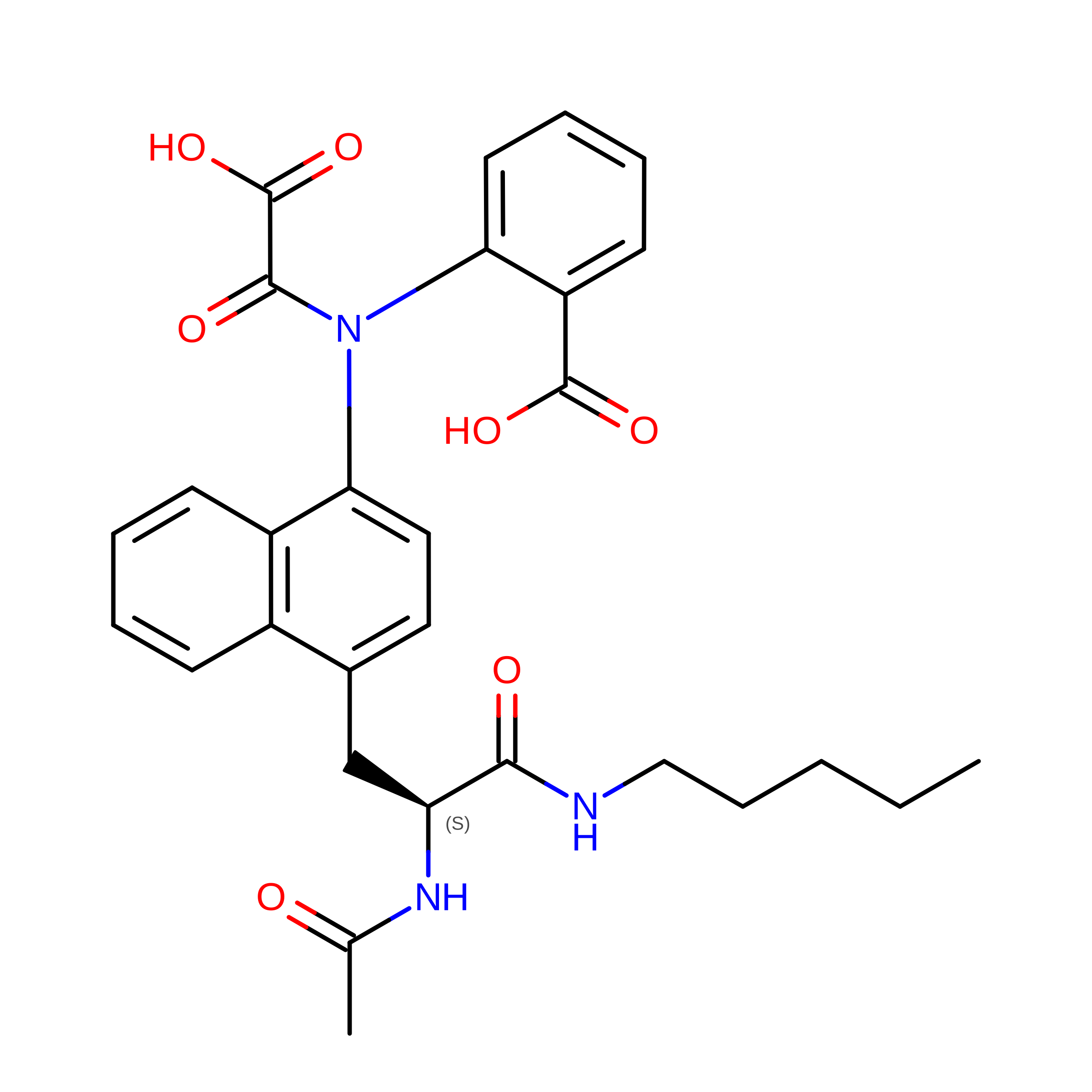
IDChains Name / Formula / InChI Key2D Diagram3D Interactions
989

Query on 989


Download:Ideal Coordinates CCD File
B [auth A]2-{[4-(2-ACETYLAMINO-2-PENTYLCARBAMOYL-ETHYL)-NAPHTHALEN-1-YL]-OXALYL-AMINO}-BENZOIC ACID
C29 H31 N3 O7
UESXELNYBIOROE-QHCPKHFHSA-N
Binding Affinity Annotations 
IDSourceBinding Affinity
989 BindingDB:  1NL9 Ki: min: 631, max: 1100 (nM) from 2 assay(s)

Experimental Data & Validation

Experimental Data

  • Method: X-RAY DIFFRACTION
  • Resolution: 2.40 Å
  • R-Value Free:  0.247 (Depositor) 
  • R-Value Work:  0.192 (Depositor) 
  • R-Value Observed: 0.208 (Depositor) 
Space Group: P 31 2 1
Unit Cell:
Length ( Å )Angle ( ˚ )
a = 88.73α = 90
b = 88.73β = 90
c = 105.91γ = 120
Software Package:
Software NamePurpose
CNXrefinement
MAR345data collection
HKL-2000data scaling
CNXphasing

Structure Validation

View Full Validation Report


Entry History 

Revision History  (Full details and data files)

  • Version 1.0: 2003-04-08
    Type: Initial release
  • Version 1.1: 2008-04-29
    Changes: Version format compliance
  • Version 1.2: 2011-07-13
    Changes: Version format compliance
  • Version 1.3: 2017-10-11
    Changes: Refinement description
  • Version 1.4: 2023-08-16
    Changes: Data collection, Database references, Derived calculations, Refinement description, Structure summary