Download Mendeley
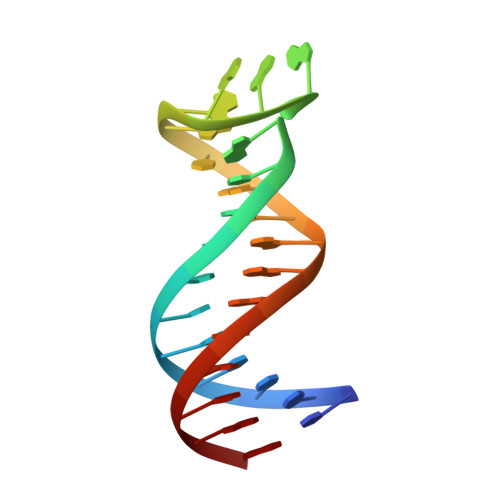
Structural Studies on the Hairpins at the 3' Untranslated Region of an Anthrax Toxin Gene
Shiflett, P.R., Taylor-McCabe, K.J., Michalczyk, R., Silks, L.A., Gupta, G.(2003) Biochemistry 42: 6078-6089
- PubMed: 12755609 Search on PubMed
- DOI: https://doi.org/10.1021/bi034128f
- Primary Citation Related Structures:
1NGO, 1NGU - PubMed Abstract:
Three proteins, namely, protective antigen (PA), edema factor (EF), and lethal factor (LF), encoded by the pX01 plasmid of Bacillus anthracis play a major role in the pathogenesis of target host cells. PA combines with EF and LF to form bipartite PA-EF and PA-LF toxins and facilitates intracellular delivery of EF and LF both of which cause cytotoxicity to the host. Since the level of PA is crucial to pathogenesis by anthrax toxins, it is important to understand how the host environment regulates the expression of the PA (or pagA) gene by utilizing the 5' and 3' untranslated regions (UTR). The 5' UTR sequence determines the initiation of transcription, whereas the 3' UTR sequence determines the efficient termination and stability of the transcript. Although, the role of the 5'UTR sequence of pagA has been investigated, little is known about the role of the 3' UTR. Since hairpin formation at the 3'UTR of a gene is an established mechanism for efficient termination and stability of the transcript, we carried out structural studies, including gel electrophoresis, circular dichroism, and two-dimensional nuclear magnetic resonance spectroscopy, to determine whether the 3' UTR sequences of pagA also form hairpin structures. Our results unequivocally demonstrate that both the coding and the noncoding 3' UTR sequences form stable hairpin structures. It is quite likely that the hairpins at the 3'UTR may contribute to efficient termination and stability of the pagA transcript.
- McClintock Resource, Group B1, Bioscience Division, Mail Stop M888, Los Alamos National Laboratory, New Mexico 87545, USA.
Organizational Affiliation: