1LKQ | pdb_00001lkq

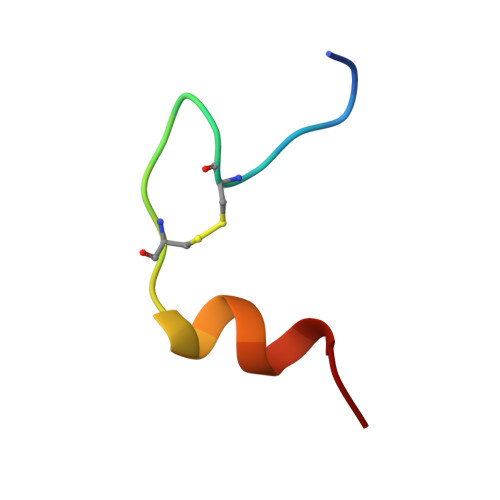
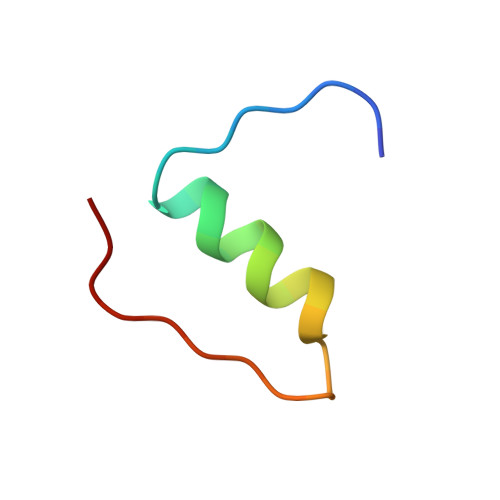
NMR STRUCTURE OF HUMAN INSULIN MUTANT ILE-A2-GLY, VAL-A3-GLY, HIS-B10-ASP, PRO-B28-LYS, LYS-B29-PRO, 20 STRUCTURES


Experimental Data Snapshot

  • Method: SOLUTION NMR
  • Conformers Calculated: 35 
  • Conformers Submitted: 20 
  • Selection Criteria: structures with the lowest energy 

wwPDB Validation 3D Report Full Report

Validation slider image for 1LKQ

This is version 1.4 of the entry. See complete history

Literature

Mechanism of insulin chain combination. Asymmetric roles of A-chain alpha-helices in disulfide pairing

Hua, Q.X.Chu, Y.C.Jia, W.Phillips, N.F.Wang, R.Y.Katsoyannis, P.G.Weiss, M.A.

(2002) J Biological Chem 277: 43443-43453

  • DOI: https://doi.org/10.1074/jbc.M206107200
  • Primary Citation Related Structures: 
    1LKQ

  • PubMed Abstract: 

    The A and B chains of insulin combine to form native disulfide bridges without detectable isomers. The fidelity of chain combination thus recapitulates the folding of proinsulin, a precursor protein in which the two chains are tethered by a disordered connecting peptide. We have recently shown that chain combination is blocked by seemingly conservative substitutions in the C-terminal alpha-helix of the A chain. Such analogs, once formed, nevertheless retain high biological activity. By contrast, we demonstrate here that chain combination is robust to non-conservative substitutions in the N-terminal alpha-helix. Introduction of multiple glycine substitutions into the N-terminal segment of the A chain (residues A1-A5) yields analogs that are less stable than native insulin and essentially without biological activity. (1)H NMR studies of a representative analog lacking invariant side chains Ile(A2) and Val(A3) (A chain sequence GGGEQCCTSICSLYQLENYCN; substitutions are italicized and cysteines are underlined) demonstrate local unfolding of the A1-A5 segment in an otherwise native-like structure. That this and related partial folds retain efficient disulfide pairing suggests that the native N-terminal alpha-helix does not participate in the transition state of the reaction. Implications for the hierarchical folding mechanisms of proinsulin and insulin-like growth factors are discussed.


  • Organizational Affiliation
    • Department of Biochemistry, Case Western Reserve School of Medicine, Cleveland, Ohio 44106-4935, USA.

Macromolecule Content 

  • Total Structure Weight: 5.7 kDa 
  • Atom Count: 396 
  • Modeled Residue Count: 51 
  • Deposited Residue Count: 51 
  • Unique protein chains: 2

Macromolecules

Find similar proteins by:  Sequence   |   3D Structure  
Entity ID: 1
MoleculeChains  Sequence LengthOrganismDetailsImage
INSULIN21N/AMutation(s): 2 
UniProt & NIH Common Fund Data Resources
Find proteins for P01308 (Homo sapiens)
Explore P01308 
Go to UniProtKB:  P01308
PHAROS:  P01308
GTEx:  ENSG00000254647 
Entity Groups
Sequence Clusters30% Identity50% Identity70% Identity90% Identity95% Identity100% Identity
UniProt GroupP01308
Sequence Annotations
Expand
Reference Sequence
Find similar proteins by:|  3D Structure
Entity ID: 2
MoleculeChains  Sequence LengthOrganismDetailsImage
INSULIN30N/AMutation(s): 3 
UniProt & NIH Common Fund Data Resources
Find proteins for P01308 (Homo sapiens)
Explore P01308 
Go to UniProtKB:  P01308
PHAROS:  P01308
GTEx:  ENSG00000254647 
Entity Groups
Sequence Clusters30% Identity50% Identity70% Identity90% Identity95% Identity100% Identity
UniProt GroupP01308
Sequence Annotations
Expand
Reference Sequence

Experimental Data & Validation

Experimental Data

  • Method: SOLUTION NMR
  • Conformers Calculated: 35 
  • Conformers Submitted: 20 
  • Selection Criteria: structures with the lowest energy 

Structure Validation

View Full Validation Report


Entry History 

Deposition Data

Revision History  (Full details and data files)

  • Version 1.0: 2002-05-22
    Type: Initial release
  • Version 1.1: 2008-04-28
    Changes: Version format compliance
  • Version 1.2: 2011-07-13
    Changes: Version format compliance
  • Version 1.3: 2021-10-27
    Changes: Database references, Derived calculations
  • Version 1.4: 2024-10-30
    Changes: Data collection, Structure summary