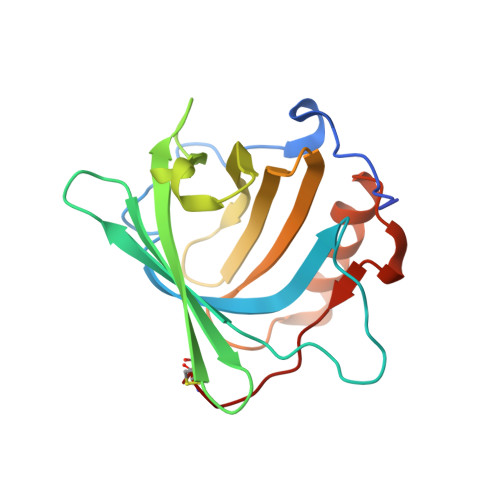
1L6M | pdb_00001l6m

Neutrophil Gelatinase-associated Lipocalin is a Novel Bacteriostatic Agent that Interferes with Siderophore-mediated Iron Acquisition


Experimental Data Snapshot

  • Method: X-RAY DIFFRACTION
  • Resolution: 2.40 Å
  • R-Value Free: 
    0.258 (Depositor) 
  • R-Value Work: 
    0.232 (Depositor) 
  • R-Value Observed: 
    0.234 (Depositor) 

Starting Model: experimental
View more details

wwPDB Validation 3D Report Full Report

Validation slider image for 1L6M

This is version 1.5 of the entry. See complete history

Literature

The Neutrophil Lipocalin NGAL is a Bacteriostatic Agent that Interferes with Siderophore-mediated Iron Acquisition

Goetz, D.H.Borregaard, N.Bluhm, M.E.Raymond, K.N.Strong, R.K.

(2002) Mol Cell 10: 1033-1043

  • DOI: https://doi.org/10.1016/s1097-2765(02)00708-6
  • Primary Citation Related Structures: 
    1L6M

  • PubMed Abstract: 

    First identified as a neutrophil granule component, neutrophil gelatinase-associated lipocalin (NGAL; also called human neutrophil lipocalin, 24p3, uterocalin, or neu-related lipocalin) is a member of the lipocalin family of binding proteins. Putative NGAL ligands, including neutrophil chemotactic agents such as N-formylated tripeptides, have all been refuted by recent biochemical and structural results. NGAL has subsequently been implicated in diverse cellular processes, but without a characterized ligand, the molecular basis of these functions remained mysterious. Here we report that NGAL tightly binds bacterial catecholate-type ferric siderophores through a cyclically permuted, hybrid electrostatic/cation-pi interaction and is a potent bacteriostatic agent in iron-limiting conditions. We therefore propose that NGAL participates in the antibacterial iron depletion strategy of the innate immune system.


  • Organizational Affiliation
    • Molecular and Cellular Biology Program, Fred Hutchinson Cancer Research Center, Box 357275, University of Washington, Seattle, WA 98105, USA.

Macromolecule Content 

  • Total Structure Weight: 64.05 kDa 
  • Atom Count: 4,318 
  • Modeled Residue Count: 515 
  • Deposited Residue Count: 540 
  • Unique protein chains: 1

Macromolecules

Find similar proteins by:|  3D Structure
Entity ID: 1
MoleculeChains  Sequence LengthOrganismDetailsImage
Neutrophil gelatinase-associated lipocalin
A, B, C
180Homo sapiensMutation(s): 1 
UniProt & NIH Common Fund Data Resources
Find proteins for P80188 (Homo sapiens)
Explore P80188 
Go to UniProtKB:  P80188
PHAROS:  P80188
GTEx:  ENSG00000148346 
Entity Groups
Sequence Clusters30% Identity50% Identity70% Identity90% Identity95% Identity100% Identity
UniProt GroupP80188
Sequence Annotations
Expand
Reference Sequence

Small Molecules

Ligands 4 Unique
IDChains Name / Formula / InChI Key2D Diagram3D Interactions
DBS

Query on DBS


Download:Ideal Coordinates CCD File
H [auth A],
L [auth B],
Q [auth C]
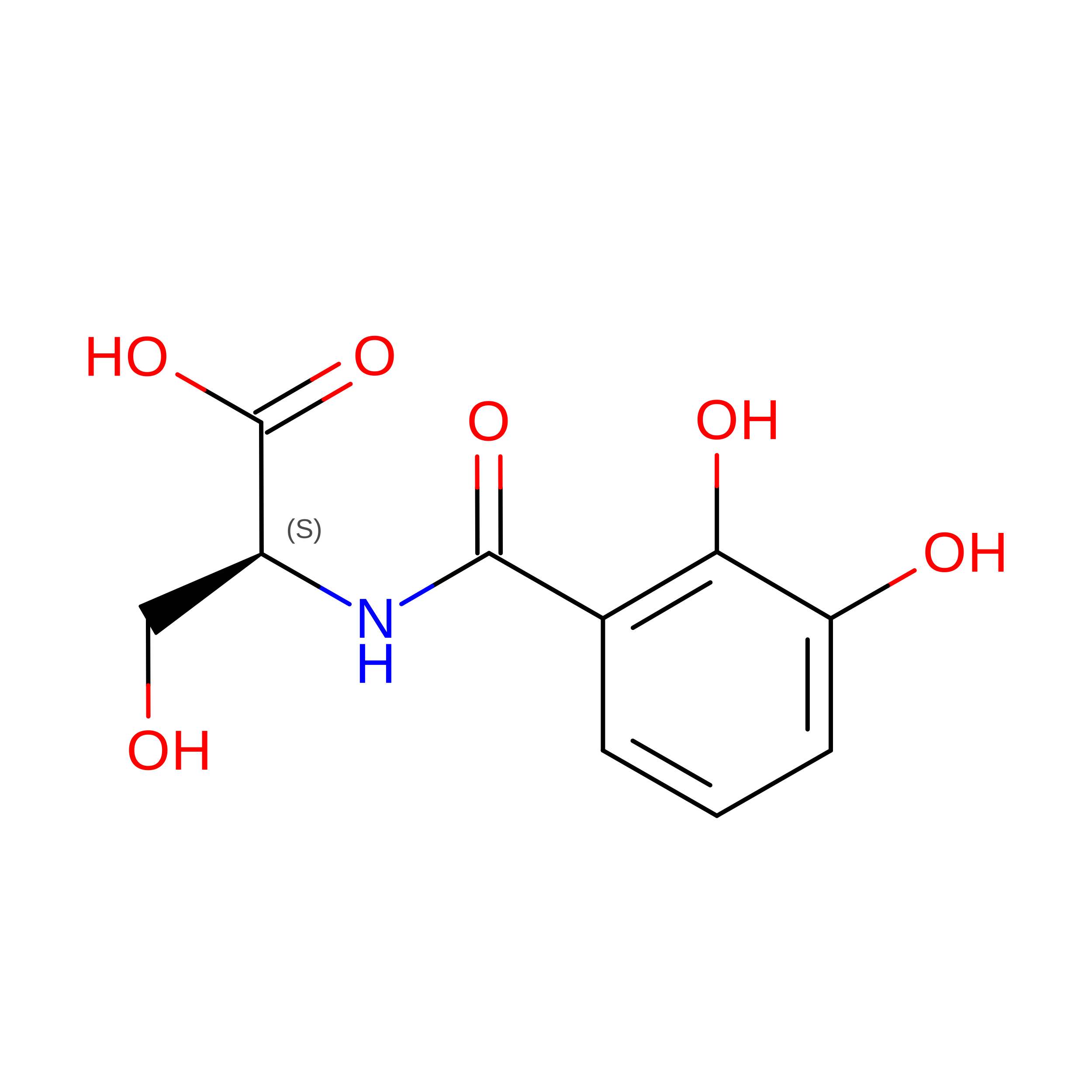
2-(2,3-DIHYDROXY-BENZOYLAMINO)-3-HYDROXY-PROPIONIC ACID
C10 H11 N O6
VDTYHTVHFIIEIL-LURJTMIESA-N
DBH

Query on DBH


Download:Ideal Coordinates CCD File
F [auth A],
G [auth A],
J [auth B],
K [auth B],
P [auth C]
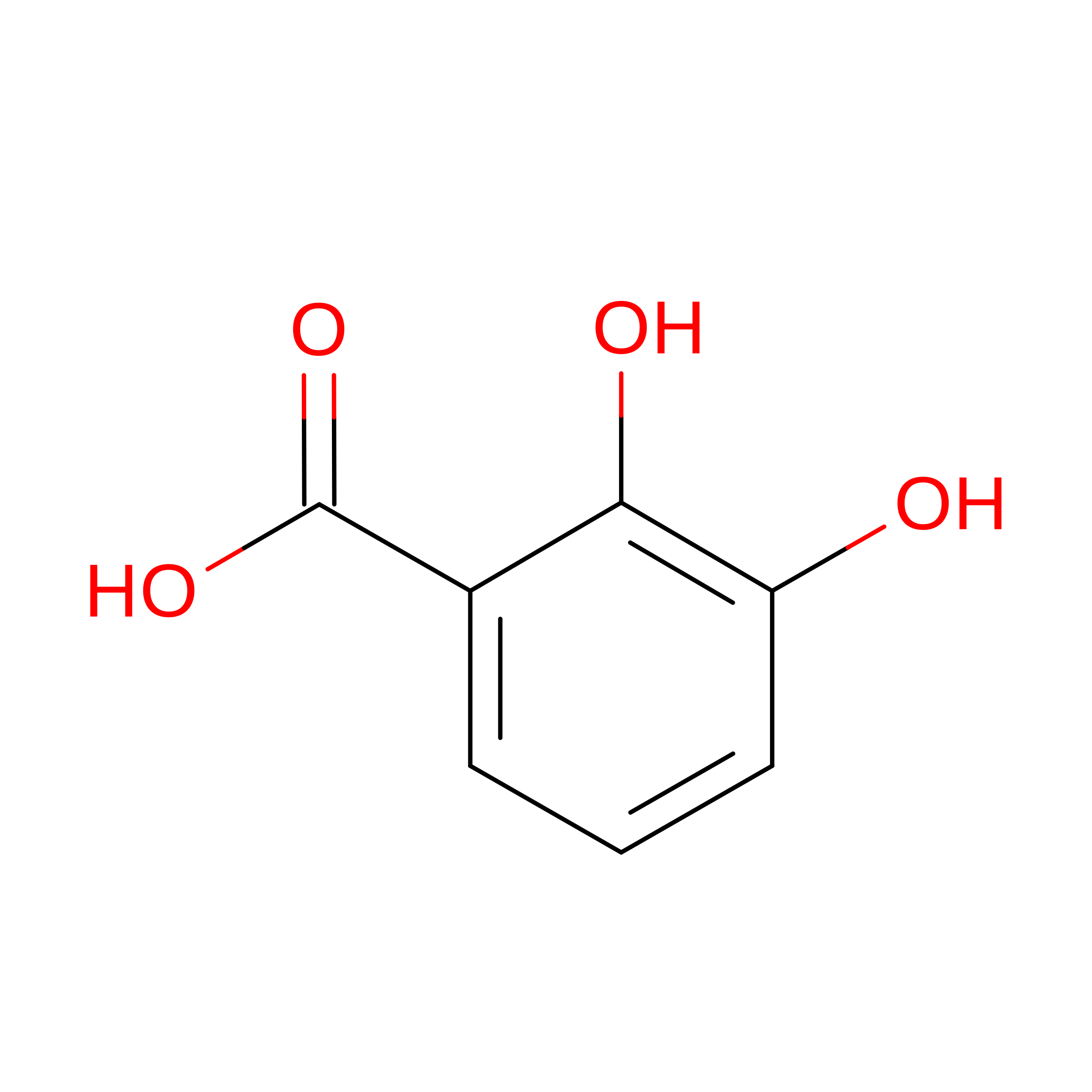
2,3-DIHYDROXY-BENZOIC ACID
C7 H6 O4
GLDQAMYCGOIJDV-UHFFFAOYSA-N
SO4

Query on SO4


Download:Ideal Coordinates CCD File
E [auth A],
N [auth C],
O [auth C]
SULFATE ION
O4 S
QAOWNCQODCNURD-UHFFFAOYSA-L
FE

Query on FE


Download:Ideal Coordinates CCD File
D [auth A],
I [auth B],
M [auth C]
FE (III) ION
Fe
VTLYFUHAOXGGBS-UHFFFAOYSA-N

Experimental Data & Validation

Experimental Data

  • Method: X-RAY DIFFRACTION
  • Resolution: 2.40 Å
  • R-Value Free:  0.258 (Depositor) 
  • R-Value Work:  0.232 (Depositor) 
  • R-Value Observed: 0.234 (Depositor) 
Space Group: P 41 21 2
Unit Cell:
Length ( Å )Angle ( ˚ )
a = 115.078α = 90
b = 115.078β = 90
c = 115.221γ = 90
Software Package:
Software NamePurpose
DENZOdata reduction
HKL-2000data reduction
EPMRphasing
REFMACrefinement
HKL-2000data scaling

Structure Validation

View Full Validation Report


Entry History 

Deposition Data

Revision History  (Full details and data files)

  • Version 1.0: 2003-03-11
    Type: Initial release
  • Version 1.1: 2008-04-28
    Changes: Version format compliance
  • Version 1.2: 2011-07-13
    Changes: Version format compliance
  • Version 1.3: 2021-10-27
    Changes: Database references, Derived calculations
  • Version 1.4: 2023-08-16
    Changes: Data collection, Refinement description
  • Version 1.5: 2024-10-16
    Changes: Structure summary