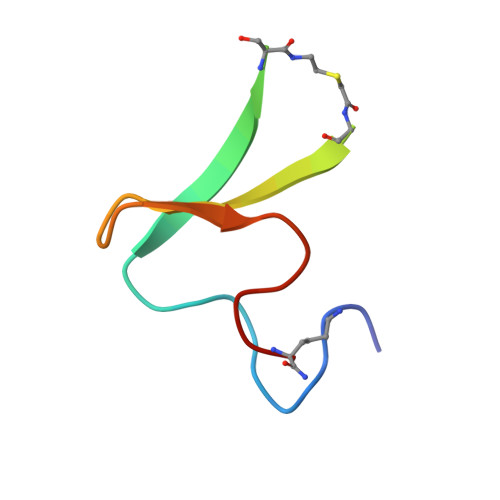
1K5R | pdb_00001k5r

YAP65 WW domain S24-Amino-Ethylsulfanyl-Acetic Acid mutant


Experimental Data Snapshot

  • Method: SOLUTION NMR
  • Conformers Calculated: 200 
  • Conformers Submitted: 10 
  • Selection Criteria: structures with the lowest energy 

wwPDB Validation 3D Report Full Report

Validation slider image for 1K5R

This is version 2.1 of the entry. See complete history

Literature

Using flexible loop mimetics to extend phi-value analysis to secondary structure interactions.

Ferguson, N.Pires, J.R.Toepert, F.Johnson, C.M.Pan, Y.P.Volkmer-Engert, R.Schneider-Mergener, J.Daggett, V.Oschkinat, H.Fersht, A.

(2001) Proc Natl Acad Sci U S A 98: 13008-13013

  • DOI: https://doi.org/10.1073/pnas.221467398
  • Primary Citation Related Structures: 
    1K5R

  • PubMed Abstract: 

    Chemical synthesis allows the incorporation of nonnatural amino acids into proteins that may provide previously untried probes of their folding pathway and thermodynamic stability. We have used a flexible thioether linker as a loop mimetic in the human yes kinase-associated protein (YAP 65) WW domain, a three-stranded, 44-residue, beta-sheet protein. This linkage avoids problems of incorporating sequences that constrain loops to the extent that they significantly change the nature of the denatured state with concomitant effects on the folding kinetics. An NMR solution structure shows that the thioether linker had little effect on the global fold of the domain, although the loop is apparently more dynamic. The thioether variants are destabilized by up to 1.4 kcal/mol (1 cal = 4.18 J). Preliminary Phi-value analysis showed that the first loop is highly structured in the folding transition state, and the second loop is essentially unstructured. These data are consistent with results from simulated unfolding and detailed protein-engineering studies of structurally homologous WW domains. Previously, Phi-value analysis was limited to studying side-chain interactions. The linkers used here extend the protein engineering method directly to secondary-structure interactions.


  • Organizational Affiliation
    • Medical Research Council, Centre for Protein Engineering, Hills Road, Cambridge CB2 2QH, United Kingdom.

Macromolecule Content 

  • Total Structure Weight: 5.7 kDa 
  • Atom Count: 402 
  • Modeled Residue Count: 51 
  • Deposited Residue Count: 51 
  • Unique protein chains: 2

Macromolecules

Find similar proteins by:|  3D Structure
Entity ID: 1
MoleculeChains  Sequence LengthOrganismDetailsImage
65 KDA YES-ASSOCIATED PROTEIN41N/AMutation(s): 1 
UniProt & NIH Common Fund Data Resources
Find proteins for P46937 (Homo sapiens)
Explore P46937 
Go to UniProtKB:  P46937
PHAROS:  P46937
GTEx:  ENSG00000137693 
Entity Groups
Sequence Clusters30% Identity50% Identity70% Identity90% Identity95% Identity100% Identity
UniProt GroupP46937
Sequence Annotations
Expand
Reference Sequence
Find similar proteins by:  Sequence   |   3D Structure  
Entity ID: 2
MoleculeChains  Sequence LengthOrganismDetailsImage
Fragment of WBP-110N/AMutation(s): 0 
UniProt & NIH Common Fund Data Resources
Find proteins for Q96G27 (Homo sapiens)
Explore Q96G27 
Go to UniProtKB:  Q96G27
GTEx:  ENSG00000239779 
Entity Groups
Sequence Clusters30% Identity50% Identity70% Identity90% Identity95% Identity100% Identity
UniProt GroupQ96G27
Sequence Annotations
Expand
Reference Sequence

Experimental Data & Validation

Experimental Data

  • Method: SOLUTION NMR
  • Conformers Calculated: 200 
  • Conformers Submitted: 10 
  • Selection Criteria: structures with the lowest energy 

Structure Validation

View Full Validation Report


Entry History 

Revision History  (Full details and data files)

  • Version 1.0: 2001-11-02
    Type: Initial release
  • Version 1.1: 2008-04-27
    Changes: Version format compliance
  • Version 1.2: 2011-07-13
    Changes: Version format compliance
  • Version 1.3: 2022-02-23
    Changes: Data collection, Database references, Derived calculations
  • Version 2.0: 2023-11-15
    Changes: Atomic model, Data collection, Derived calculations
  • Version 2.1: 2024-10-30
    Changes: Structure summary