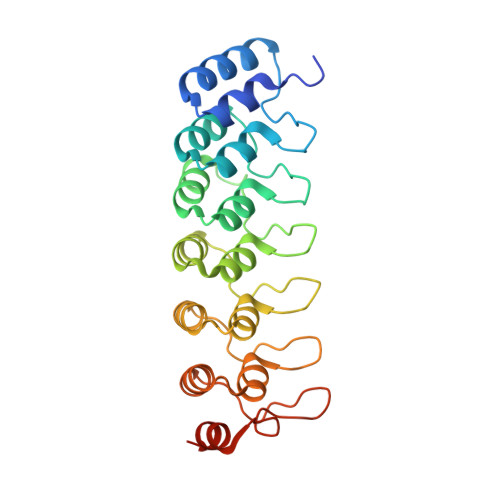
1K1A | pdb_00001k1a

Crystal structure of the ankyrin repeat domain of Bcl-3: a unique member of the IkappaB protein family


Experimental Data Snapshot

  • Method: X-RAY DIFFRACTION
  • Resolution: 1.86 Å
  • R-Value Free: 
    0.229 (Depositor) 
  • R-Value Work: 
    0.199 (Depositor) 
  • R-Value Observed: 
    0.200 (Depositor) 

Starting Model: experimental
View more details

wwPDB Validation 3D Report Full Report

Validation slider image for 1K1A

This is version 1.3 of the entry. See complete history

Literature

Crystal structure of the ankyrin repeat domain of Bcl-3: a unique member of the IkappaB protein family.

Michel, F.Soler-Lopez, M.Petosa, C.Cramer, P.Siebenlist, U.Muller, C.W.

(2001) EMBO J 20: 6180-6190

  • DOI: https://doi.org/10.1093/emboj/20.22.6180
  • Primary Citation Related Structures: 
    1K1A, 1K1B

  • PubMed Abstract: 

    IkappaB proteins associate with the transcription factor NF-kappaB via their ankyrin repeat domain. Bcl-3 is an unusual IkappaB protein because it is primarily nucleoplasmic and can lead to enhanced NF-kappaB-dependent transcription, unlike the prototypical IkappaB protein IkappaBalpha, which inhibits NF-kappaB activity by retaining it in the cytoplasm. Here we report the 1.9 A crystal structure of the ankyrin repeat domain of human Bcl-3 and compare it with that of IkappaBalpha bound to NF-kappaB. The two structures are highly similar over the central ankyrin repeats but differ in the N-terminal repeat and at the C-terminus, where Bcl-3 contains a seventh repeat in place of the acidic PEST region of IkappaBalpha. Differences between the two structures suggest why Bcl-3 differs from IkappaBalpha in selectivity towards various NF-kappaB species, why Bcl-3 but not IkappaBalpha can associate with its NF-kappaB partner bound to DNA, and why two molecules of Bcl-3 but only one of IkappaBalpha can bind to its NF-kappaB partner. Comparison of the two structures thus provides an insight into the functional diversity of IkappaB proteins.


  • Organizational Affiliation
    • European Molecular Biology Laboratory, Grenoble Outstation BP 181, 38042 Grenoble, Cedex 9, France.

Macromolecule Content 

  • Total Structure Weight: 25.83 kDa 
  • Atom Count: 1,924 
  • Modeled Residue Count: 228 
  • Deposited Residue Count: 241 
  • Unique protein chains: 1

Macromolecules

Find similar proteins by:|  3D Structure
Entity ID: 1
MoleculeChains  Sequence LengthOrganismDetailsImage
B-cell lymphoma 3-encoded protein241Homo sapiensMutation(s): 0 
UniProt & NIH Common Fund Data Resources
Find proteins for P20749 (Homo sapiens)
Explore P20749 
Go to UniProtKB:  P20749
PHAROS:  P20749
GTEx:  ENSG00000069399 
Entity Groups
Sequence Clusters30% Identity50% Identity70% Identity90% Identity95% Identity100% Identity
UniProt GroupP20749
Sequence Annotations
Expand
Reference Sequence

Experimental Data & Validation

Experimental Data

  • Method: X-RAY DIFFRACTION
  • Resolution: 1.86 Å
  • R-Value Free:  0.229 (Depositor) 
  • R-Value Work:  0.199 (Depositor) 
  • R-Value Observed: 0.200 (Depositor) 
Space Group: P 1 21 1
Unit Cell:
Length ( Å )Angle ( ˚ )
a = 31.703α = 90
b = 51.218β = 102.01
c = 64.68γ = 90
Software Package:
Software NamePurpose
AMoREphasing
REFMACrefinement
DENZOdata reduction
SCALEPACKdata scaling

Structure Validation

View Full Validation Report


Entry History 

Deposition Data

Revision History  (Full details and data files)

  • Version 1.0: 2001-11-21
    Type: Initial release
  • Version 1.1: 2008-04-27
    Changes: Version format compliance
  • Version 1.2: 2011-07-13
    Changes: Version format compliance
  • Version 1.3: 2023-08-16
    Changes: Data collection, Database references, Refinement description