1K09 | pdb_00001k09

Solution structure of BetaCore, A Designed Water Soluble Four-Stranded Antiparallel b-sheet Protein


Experimental Data Snapshot

  • Method: SOLUTION NMR
  • Conformers Calculated: 200 
  • Conformers Submitted: 20 
  • Selection Criteria: The submitted conformers are those with no constraint violations greater than 0.5 angstroms for NOEs and 5 degrees for dihedrals. They are also the ones with best covalent geometry. 

wwPDB Validation 3D Report Full Report

Validation slider image for 1K09

This is version 3.0 of the entry. See complete history

Literature

BetaCore, a designed water soluble four-stranded antiparallel beta-sheet protein.

Carulla, N.Woodward, C.Barany, G.

(2002) Protein Sci 11: 1539-1551

  • DOI: https://doi.org/10.1110/ps.4440102
  • Primary Citation Related Structures: 
    1K09

  • PubMed Abstract: 

    BetaCore is a designed approximately 50-residue protein in which two BPTI-derived core modules, CM I and CM II, are connected by a 22-atom cross-link. At low temperature and pH 3, homo- and heteronuclear NMR data report a dominant folded ('f') conformation with well-dispersed chemical shifts, i, i+1 periodicity, numerous long-range NOEs, and slowed amide hydrogen isotope exchange patterns that is a four-stranded antiparallel beta-sheet with nonsymmetrical and specific association of CM I and CM II. BetaCore 'f' conformations undergo reversible, global, moderately cooperative, non-two-state thermal transitions to an equilibrium ensemble of unfolded 'u' conformations. There is a significant energy barrier between 'f' and 'u' conformations. This is the first designed four-stranded antiparallel beta-sheet that folds in water.


  • Organizational Affiliation
    • Department of Chemistry, University of Minnesota, Minneapolis, Minnesota 55455, USA.

Macromolecule Content 

  • Total Structure Weight: 5.97 kDa 
  • Atom Count: 417 
  • Modeled Residue Count: 52 
  • Deposited Residue Count: 52 
  • Unique protein chains: 2

Macromolecules

Find similar proteins by:|  3D Structure
Entity ID: 1
MoleculeChains  Sequence LengthOrganismDetailsImage
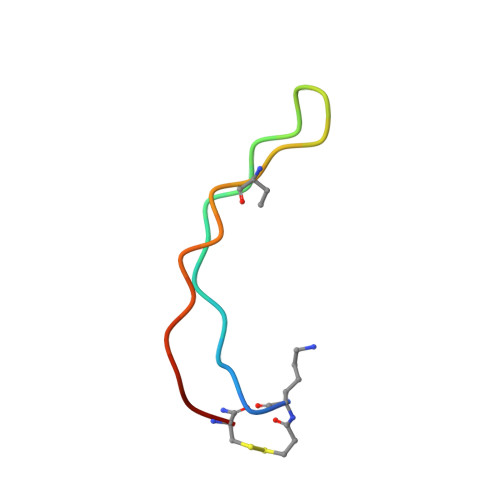
Core Module I26Bos taurusMutation(s): 5 
UniProt
Find proteins for P00974 (Bos taurus)
Explore P00974 
Go to UniProtKB:  P00974
Entity Groups
Sequence Clusters30% Identity50% Identity70% Identity90% Identity95% Identity100% Identity
UniProt GroupP00974
Sequence Annotations
Expand
Reference Sequence
Find similar proteins by:|  3D Structure
Entity ID: 2
MoleculeChains  Sequence LengthOrganismDetailsImage
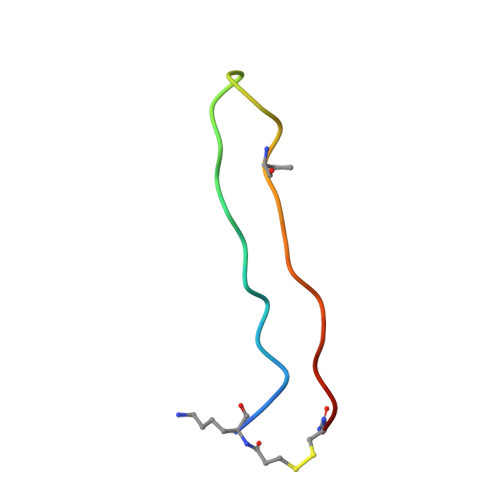
Core Module II26Bos taurusMutation(s): 5 
UniProt
Find proteins for P00974 (Bos taurus)
Explore P00974 
Go to UniProtKB:  P00974
Entity Groups
Sequence Clusters30% Identity50% Identity70% Identity90% Identity95% Identity100% Identity
UniProt GroupP00974
Sequence Annotations
Expand
Reference Sequence

Small Molecules

Ligands 1 Unique
IDChains Name / Formula / InChI Key2D Diagram3D Interactions
C55

Query on C55


Download:Ideal Coordinates CCD File
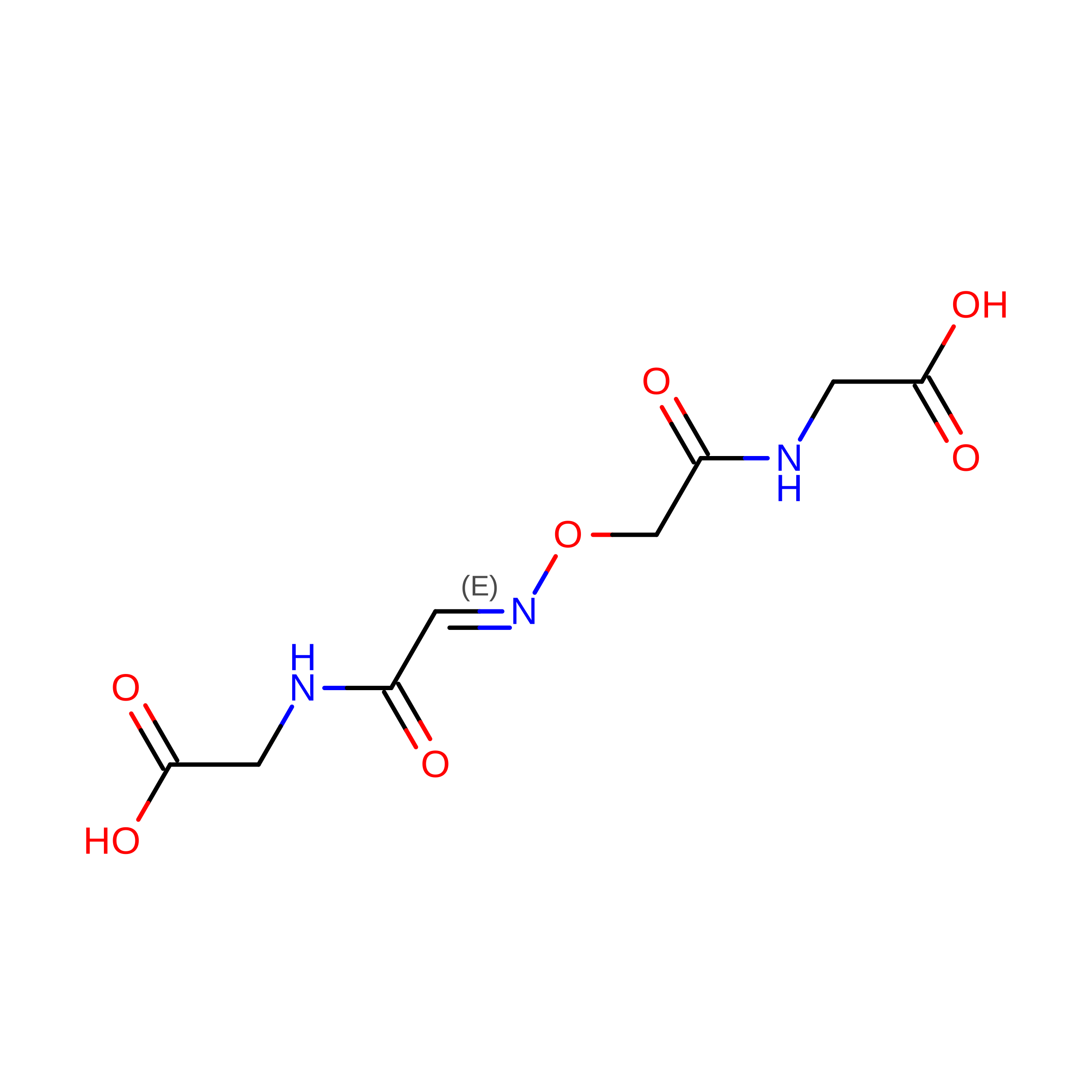
C [auth A](7E)-4,9-dioxo-6-oxa-3,7,10-triazadodec-7-ene-1,12-dioic acid
C8 H11 N3 O7
XMSCOUQNHLJSRL-QQDOKKFESA-N
Modified Residues  1 Unique
IDChains TypeFormula2D DiagramParent
ABA
Query on ABA
A
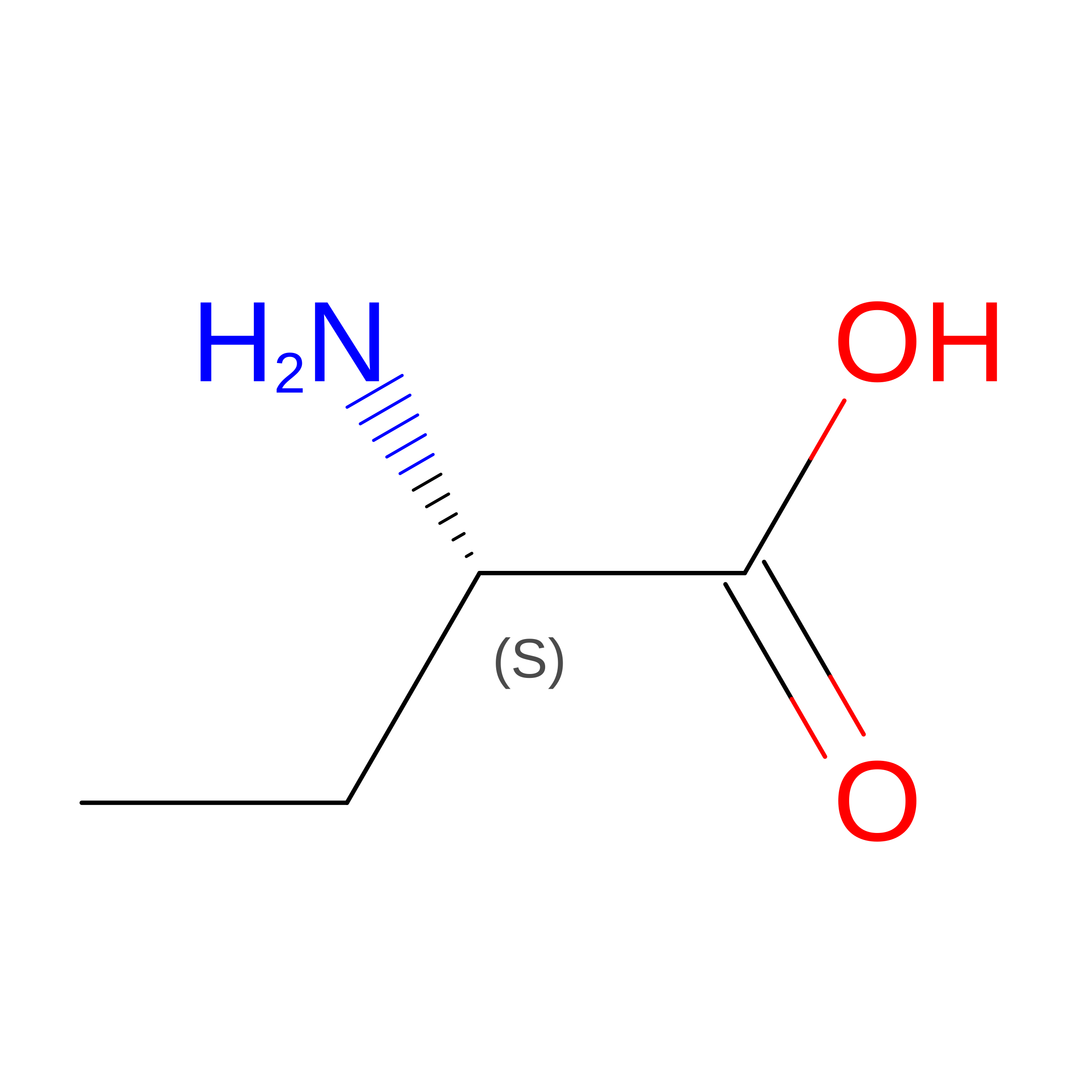
L-PEPTIDE LINKINGC4 H9 N O2ALA

Experimental Data & Validation

Experimental Data

  • Method: SOLUTION NMR
  • Conformers Calculated: 200 
  • Conformers Submitted: 20 
  • Selection Criteria: The submitted conformers are those with no constraint violations greater than 0.5 angstroms for NOEs and 5 degrees for dihedrals. They are also the ones with best covalent geometry. 

Structure Validation

View Full Validation Report


Entry History 

Deposition Data

Revision History  (Full details and data files)

  • Version 1.0: 2002-07-10
    Type: Initial release
  • Version 1.1: 2008-04-27
    Changes: Version format compliance
  • Version 1.2: 2011-07-13
    Changes: Version format compliance
  • Version 1.3: 2022-02-23
    Changes: Database references, Derived calculations
  • Version 2.0: 2023-11-15
    Changes: Advisory, Atomic model, Data collection
  • Version 3.0: 2024-02-21
    Changes: Advisory, Atomic model, Data collection, Database references, Derived calculations, Non-polymer description, Polymer sequence, Source and taxonomy, Structure summary