1JU9 | pdb_00001ju9

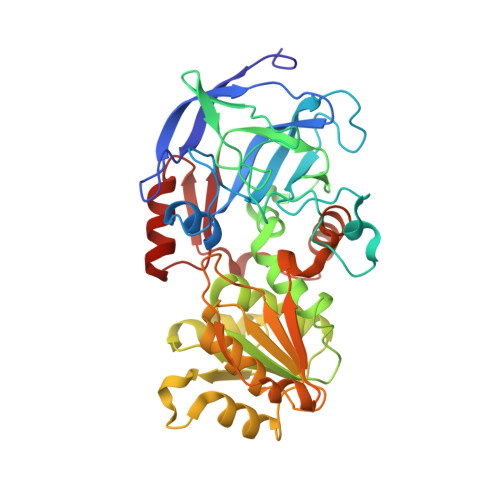
HORSE LIVER ALCOHOL DEHYDROGENASE VAL292SER MUTANT


Experimental Data Snapshot

  • Method: X-RAY DIFFRACTION
  • Resolution: 2.00 Å
  • R-Value Free: 
    0.232 (Depositor), 0.236 (DCC) 
  • R-Value Work: 
    0.196 (Depositor), 0.201 (DCC) 
  • R-Value Observed: 
    0.197 (Depositor) 

Starting Model: experimental
View more details

wwPDB Validation 3D Report Full Report

Validation slider image for 1JU9

Ligand Structure Quality Assessment 


This is version 1.4 of the entry. See complete history

Literature

Contributions of valine-292 in the nicotinamide binding site of liver alcohol dehydrogenase and dynamics to catalysis.

Rubach, J.K.Ramaswamy, S.Plapp, B.V.

(2001) Biochemistry 40: 12686-12694

  • DOI: https://doi.org/10.1021/bi011540r
  • Primary Citation Related Structures: 
    1JU9

  • PubMed Abstract: 

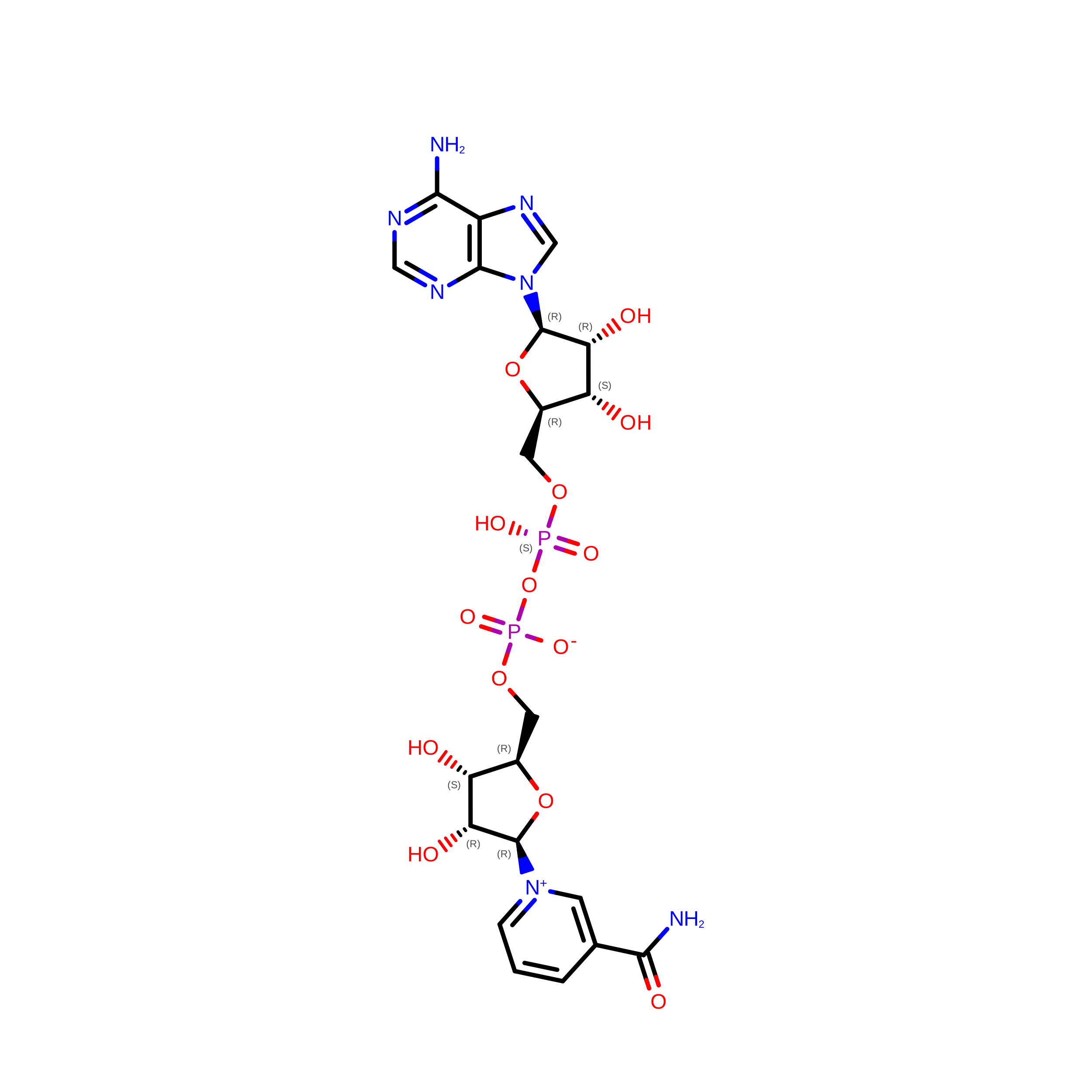
    The participation of Val-292 in catalysis by alcohol dehydrogenase and the involvement of dynamics were investigated. Val-292 interacts with the nicotinamide ring of the bound coenzyme and may facilitate hydride transfer. The substitution of Val-292 with Ser (V292S) increases the dissociation constants for the coenzymes (NAD(+) by 50-fold, NADH by 75-fold) and the turnover numbers by 3-7-fold. The V292S enzyme crystallized in the presence of NAD(+) and 2,3,4,5,6-pentafluorobenzyl alcohol has an open conformation similar to the structure of the wild-type apo-enzyme, rather than the closed conformation observed for ternary complexes with wild-type enzyme. The V292S substitution perturbs the conformational equilibrium of the enzyme and decreases the kinetic complexity, which permits study of the hydride transfer step with steady-state kinetics. Eyring plots show that the DeltaH for the oxidation (V(1)) of the protio and deuterio benzyl alcohols is 13 kcal/mol and that the kinetic isotope effect of 4.1 is essentially temperature-independent. Eyring plots for the catalytic efficiency for reduction of benzaldehyde (V(2)/K(p)) with NADH or NADD are distinctly convex, being temperature-dependent from 5 to 25 degrees C and temperature-independent from 25 to 50 degrees C; the kinetic isotope effect of 3.2 for V(2)/K(p) is essentially independent of the temperature. The temperature dependencies and isotope effects for V(1) and V(2)/K(p) are not adequately explained by semiclassical transition state theory and are better explained by hydride transfer occurring through vibrationally assisted tunneling.


  • Organizational Affiliation
    • Department of Biochemistry, The University of Iowa, Iowa City, Iowa 52242, USA.

Macromolecule Content 

  • Total Structure Weight: 81.27 kDa 
  • Atom Count: 5,788 
  • Modeled Residue Count: 748 
  • Deposited Residue Count: 748 
  • Unique protein chains: 1

Macromolecules

Find similar proteins by:|  3D Structure
Entity ID: 1
MoleculeChains  Sequence LengthOrganismDetailsImage
ALCOHOL DEHYDROGENASE
A, B
374Equus caballusMutation(s): 1 
Gene Names: M64864
EC: 1.1.1.1
UniProt
Find proteins for P00327 (Equus caballus)
Explore P00327 
Go to UniProtKB:  P00327
Entity Groups
Sequence Clusters30% Identity50% Identity70% Identity90% Identity95% Identity100% Identity
UniProt GroupP00327
Sequence Annotations
Expand
Reference Sequence

Experimental Data & Validation

Experimental Data

  • Method: X-RAY DIFFRACTION
  • Resolution: 2.00 Å
  • R-Value Free:  0.232 (Depositor), 0.236 (DCC) 
  • R-Value Work:  0.196 (Depositor), 0.201 (DCC) 
  • R-Value Observed: 0.197 (Depositor) 
Space Group: P 1 21 1
Unit Cell:
Length ( Å )Angle ( ˚ )
a = 46.271α = 90
b = 180.398β = 106.65
c = 46.176γ = 90
Software Package:
Software NamePurpose
AMoREphasing
REFMACrefinement
CrystalCleardata reduction
CCP4data scaling

Structure Validation

View Full Validation Report


Ligand Structure Quality Assessment 


Entry History 

Deposition Data

Revision History  (Full details and data files)

  • Version 1.0: 2001-09-19
    Type: Initial release
  • Version 1.1: 2008-04-27
    Changes: Version format compliance
  • Version 1.2: 2011-07-13
    Changes: Version format compliance
  • Version 1.3: 2021-10-27
    Changes: Database references, Derived calculations
  • Version 1.4: 2023-08-16
    Changes: Data collection, Refinement description