1ISS | pdb_00001iss

Crystal Structure of Metabotropic Glutamate Receptor Subtype 1 Complexed with an antagonist


Experimental Data Snapshot

  • Method: X-RAY DIFFRACTION
  • Resolution: 3.30 Å
  • R-Value Free: 
    0.314 (Depositor), 0.314 (DCC) 
  • R-Value Work: 
    0.257 (Depositor), 0.266 (DCC) 

Starting Model: experimental
View more details

wwPDB Validation 3D Report Full Report

Validation slider image for 1ISS

Ligand Structure Quality Assessment 


This is version 1.4 of the entry. See complete history

Literature

Structural views of the ligand-binding cores of a metabotropic glutamate receptor complexed with an antagonist and both glutamate and Gd3+.

Tsuchiya, D.Kunishima, N.Kamiya, N.Jingami, H.Morikawa, K.

(2002) Proc Natl Acad Sci U S A 99: 2660-2665

  • DOI: https://doi.org/10.1073/pnas.052708599
  • Primary Citation Related Structures: 
    1ISR, 1ISS

  • PubMed Abstract: 

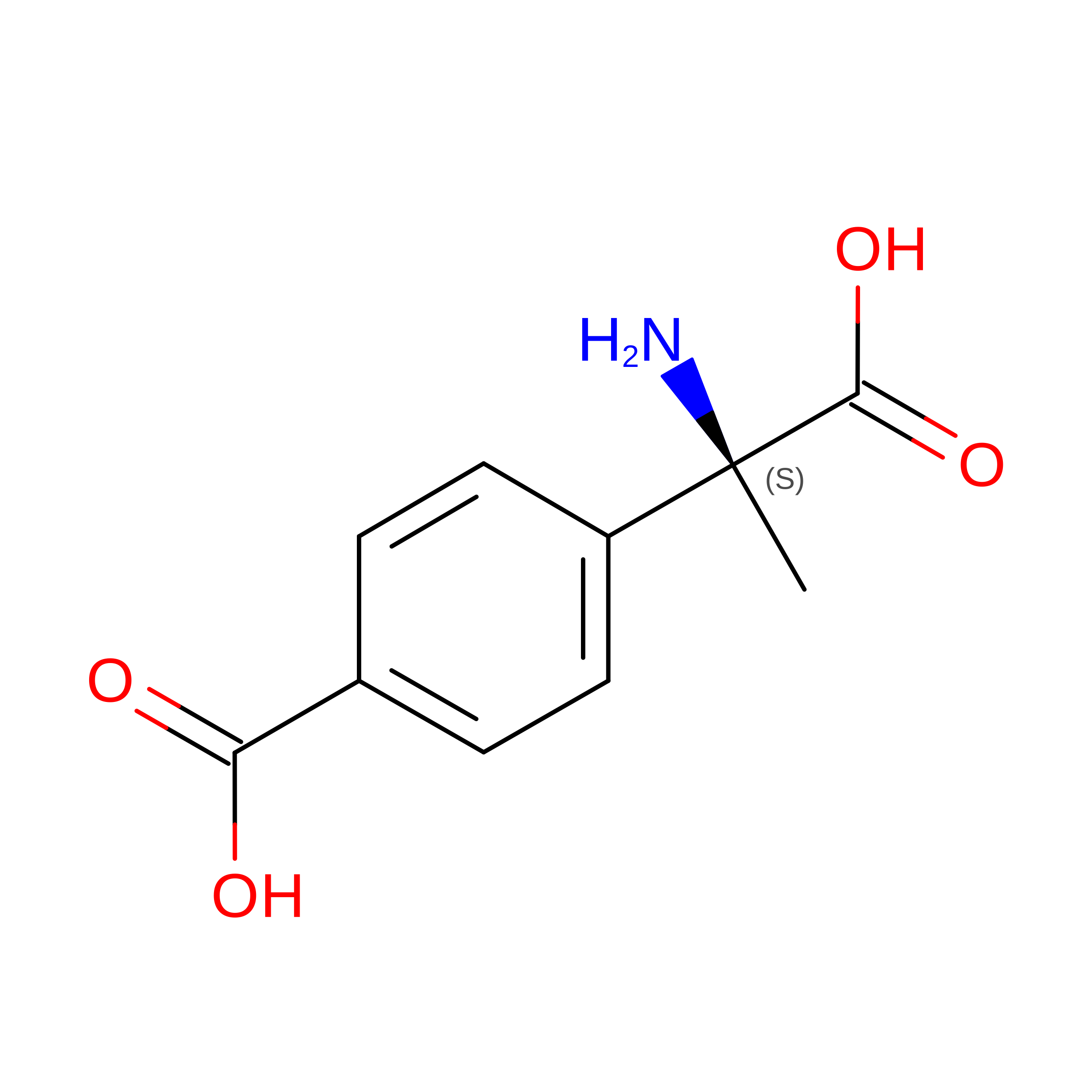
    Crystal structures of the extracellular ligand-binding region of the metabotropic glutamate receptor, complexed with an antagonist, (S)-(alpha)-methyl-4-carboxyphenylglycine, and with both glutamate and Gd3+ ion, have been determined by x-ray crystallographic analyses. The structure of the complex with the antagonist is similar to that of the unliganded resting dimer. The antagonist wedges the protomer to maintain an inactive open form. The glutamate/Gd3+ complex is an exact 2-fold symmetric dimer, where each bi-lobed protomer adopts the closed conformation. The surface of the C-terminal domain contains an acidic patch, whose negative charges are alleviated by the metal cation to stabilize the active dimeric structure. The structural comparison between the active and resting dimers suggests that glutamate binding tends to induce domain closing and a small shift of a helix in the dimer interface. Furthermore, an interprotomer contact including the acidic patch inhibited dimer formation by the two open protomers in the active state. These findings provide a structural basis to describe the link between ligand binding and the dimer interface.


  • Organizational Affiliation
    • Department of Structural Biology, Biomolecular Engineering Research Institute, 6-2-3 Furuedai, Suita, Osaka 565-0874, Japan.

Macromolecule Content 

  • Total Structure Weight: 110.94 kDa 
  • Atom Count: 7,124 
  • Modeled Residue Count: 904 
  • Deposited Residue Count: 980 
  • Unique protein chains: 1

Macromolecules

Find similar proteins by:|  3D Structure
Entity ID: 1
MoleculeChains  Sequence LengthOrganismDetailsImage
Metabotropic Glutamate Receptor subtype 1
A, B
490Rattus norvegicusMutation(s): 0 
UniProt
Find proteins for P23385 (Rattus norvegicus)
Explore P23385 
Go to UniProtKB:  P23385
Entity Groups
Sequence Clusters30% Identity50% Identity70% Identity90% Identity95% Identity100% Identity
UniProt GroupP23385
Sequence Annotations
Expand
Reference Sequence

Small Molecules

Binding Affinity Annotations 
IDSourceBinding Affinity
MCG BindingDB:  1ISS Ki: min: 165, max: 5.40e+5 (nM) from 5 assay(s)
IC50: min: 1.55e+5, max: 7.00e+5 (nM) from 2 assay(s)

Experimental Data & Validation

Experimental Data

  • Method: X-RAY DIFFRACTION
  • Resolution: 3.30 Å
  • R-Value Free:  0.314 (Depositor), 0.314 (DCC) 
  • R-Value Work:  0.257 (Depositor), 0.266 (DCC) 
Space Group: P 41 21 2
Unit Cell:
Length ( Å )Angle ( ˚ )
a = 112.142α = 90
b = 112.142β = 90
c = 289.905γ = 90
Software Package:
Software NamePurpose
MOSFLMdata reduction
SCALAdata scaling
AMoREphasing
CNSrefinement
CCP4data scaling

Structure Validation

View Full Validation Report


Ligand Structure Quality Assessment 


Entry History 

Deposition Data

Revision History  (Full details and data files)

  • Version 1.0: 2002-03-13
    Type: Initial release
  • Version 1.1: 2008-04-01
    Changes: Version format compliance
  • Version 1.2: 2011-07-13
    Changes: Version format compliance
  • Version 1.3: 2023-10-25
    Changes: Data collection, Database references, Derived calculations, Refinement description
  • Version 1.4: 2024-10-30
    Changes: Structure summary