1IRJ | pdb_00001irj

Crystal Structure of the MRP14 complexed with CHAPS


Experimental Data Snapshot

  • Method: X-RAY DIFFRACTION
  • Resolution: 2.10 Å
  • R-Value Free: 
    0.274 (Depositor) 
  • R-Value Work: 
    0.245 (Depositor) 

wwPDB Validation 3D Report Full Report

Validation slider image for 1IRJ

This is version 1.3 of the entry. See complete history

Literature

The crystal structure of human MRP14 (S100A9), a Ca(2+)-dependent regulator protein in inflammatory process.

Itou, H.Yao, M.Fujita, I.Watanabe, N.Suzuki, M.Nishihira, J.Tanaka, I.

(2002) J Mol Biology 316: 265-276

  • DOI: https://doi.org/10.1006/jmbi.2001.5340
  • Primary Citation Related Structures: 
    1IRJ

  • PubMed Abstract: 

    Human MRP14 (hMRP14) is a Ca(2+)-binding protein from the S100 family of proteins. This protein is co-expressed with human MRP8 (hMRP8), a homologue protein in myeloid cells, and plays an indispensable role in Ca(2+)-dependent functions during inflammation. This role includes the activation of Mac-1, the beta(2) integrin which is involved in neutrophil adhesion to endothelial cells. The crystal structure of the holo form of hMRP14 was analyzed at 2.1 A resolution. hMRP14 is distinguished from other S100 member proteins by its long C-terminal region, and its structure shows that the region is extensively flexible. In this crystal structure of hMRP14, Chaps molecules bind to the hinge region that connects two EF-hand motifs, which suggests that this region is a target-binding site of this protein. Based on a structural comparison of hMRP14 with hMRP8 and human S100A12 (hS100A12) that is another homologue protein, the character of MRP8/14 hetero-complex and the functional significance of the flexibility of the C-terminal region of hMRP14 are discussed.


  • Organizational Affiliation
    • Division of Biological Sciences, Graduate School of Science, Hokkaido University, Sapporo 060-0810, Japan.

Macromolecule Content 

  • Total Structure Weight: 108.16 kDa 
  • Atom Count: 5,871 
  • Modeled Residue Count: 670 
  • Deposited Residue Count: 904 
  • Unique protein chains: 1

Macromolecules

Find similar proteins by:|  3D Structure
Entity ID: 1
MoleculeChains  Sequence LengthOrganismDetailsImage
Migration Inhibitory Factor-Related Protein 14
A, B, C, D, E
A, B, C, D, E, F, G, H
113Homo sapiensMutation(s): 0 
UniProt & NIH Common Fund Data Resources
Find proteins for P06702 (Homo sapiens)
Explore P06702 
Go to UniProtKB:  P06702
PHAROS:  P06702
GTEx:  ENSG00000163220 
Entity Groups
Sequence Clusters30% Identity50% Identity70% Identity90% Identity95% Identity100% Identity
UniProt GroupP06702
Sequence Annotations
Expand
Reference Sequence

Small Molecules

Ligands 2 Unique
IDChains Name / Formula / InChI Key2D Diagram3D Interactions
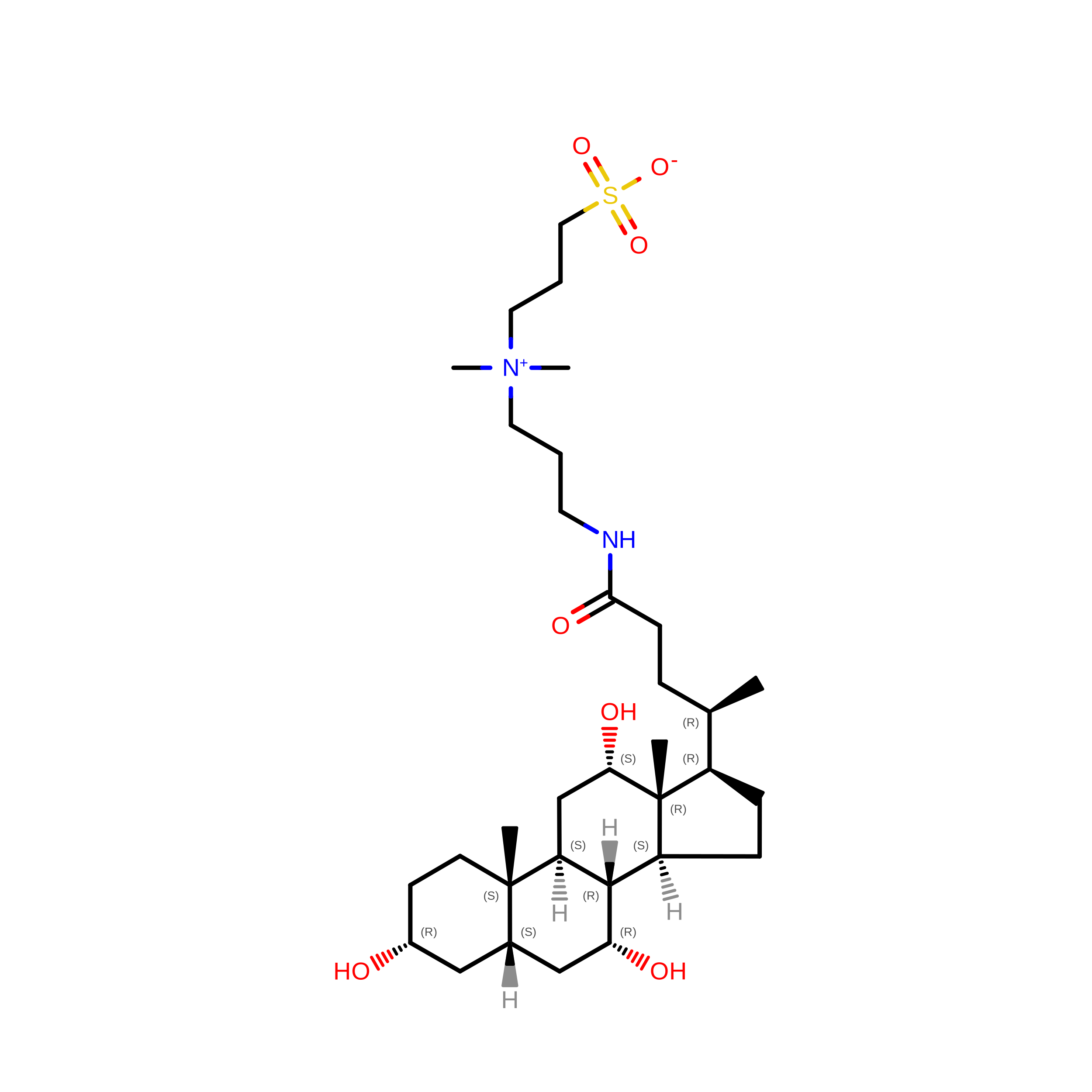
CPS

Query on CPS


Download:Ideal Coordinates CCD File
M [auth B],
R [auth D],
S [auth D],
Z [auth G]
3-[(3-CHOLAMIDOPROPYL)DIMETHYLAMMONIO]-1-PROPANESULFONATE
C32 H58 N2 O7 S
UMCMPZBLKLEWAF-BCTGSCMUSA-N
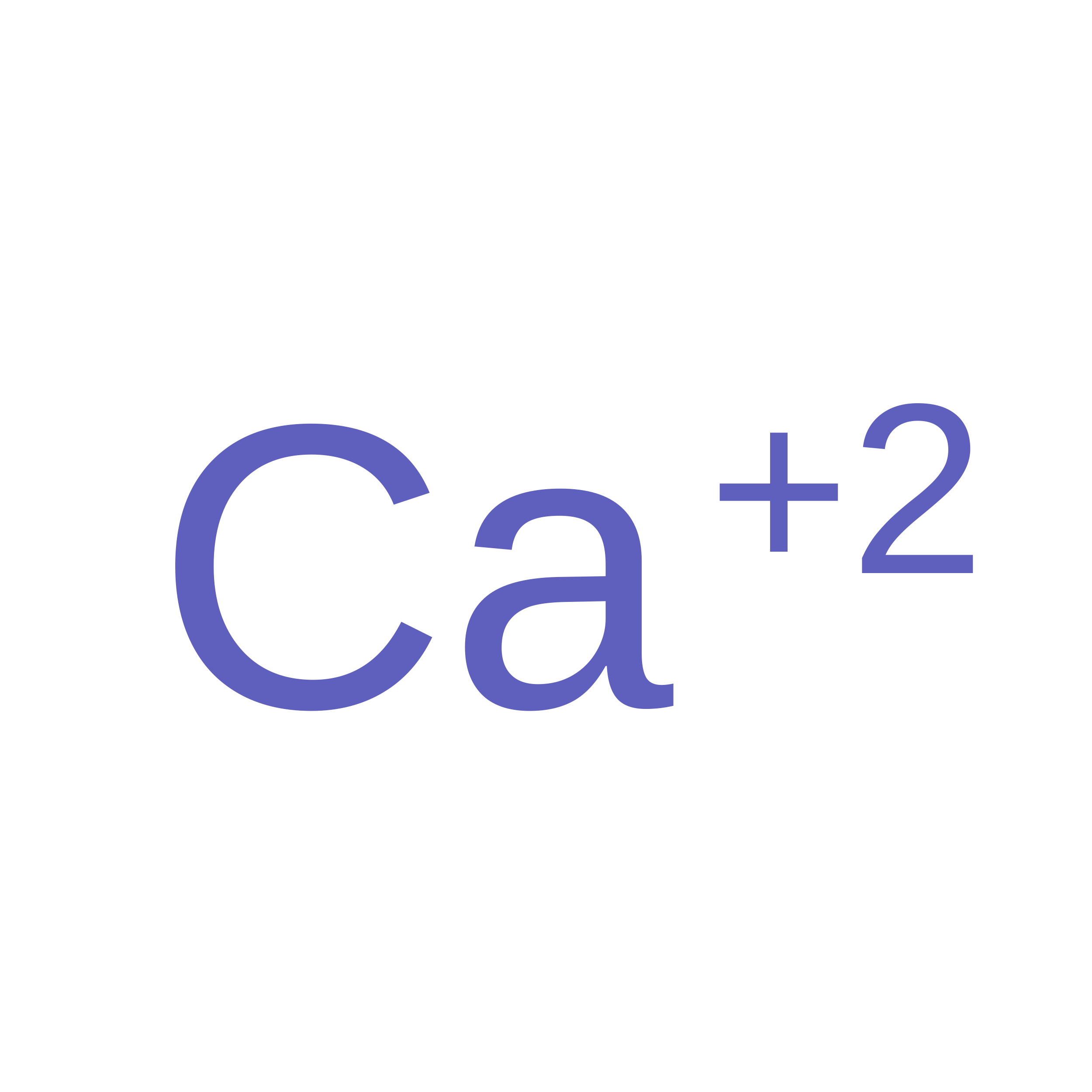
CA

Query on CA


Download:Ideal Coordinates CCD File
AA [auth H]
BA [auth H]
I [auth A]
J [auth A]
K [auth B]
AA [auth H],
BA [auth H],
I [auth A],
J [auth A],
K [auth B],
L [auth B],
N [auth C],
O [auth C],
P [auth D],
Q [auth D],
T [auth E],
U [auth E],
V [auth F],
W [auth F],
X [auth G],
Y [auth G]
CALCIUM ION
Ca
BHPQYMZQTOCNFJ-UHFFFAOYSA-N

Experimental Data & Validation

Experimental Data

  • Method: X-RAY DIFFRACTION
  • Resolution: 2.10 Å
  • R-Value Free:  0.274 (Depositor) 
  • R-Value Work:  0.245 (Depositor) 
Space Group: P 1 21 1
Unit Cell:
Length ( Å )Angle ( ˚ )
a = 57.59α = 90
b = 178.44β = 113.17
c = 61.23γ = 90
Software Package:
Software NamePurpose
SHELXSphasing
SHARPphasing
CNSrefinement
MOSFLMdata reduction
CCP4data scaling

Structure Validation

View Full Validation Report


Entry History 

Deposition Data

Revision History  (Full details and data files)

  • Version 1.0: 2002-02-27
    Type: Initial release
  • Version 1.1: 2008-04-27
    Changes: Version format compliance
  • Version 1.2: 2011-07-13
    Changes: Version format compliance
  • Version 1.3: 2023-12-27
    Changes: Data collection, Database references, Derived calculations