1I40 | pdb_00001i40

STRUCTURE OF INORGANIC PYROPHOSPHATASE


Experimental Data Snapshot

  • Method: X-RAY DIFFRACTION
  • Resolution: 1.10 Å
  • R-Value Free: 
    0.153 (Depositor) 
  • R-Value Work: 
    0.117 (Depositor), 0.126 (DCC) 
  • R-Value Observed: 
    0.117 (Depositor) 

wwPDB Validation 3D Report Full Report

Validation slider image for 1I40

This is version 1.3 of the entry. See complete history

Literature

The structures of Escherichia coli inorganic pyrophosphatase complexed with Ca(2+) or CaPP(i) at atomic resolution and their mechanistic implications.

Samygina, V.R.Popov, A.N.Rodina, E.V.Vorobyeva, N.N.Lamzin, V.S.Polyakov, K.M.Kurilova, S.A.Nazarova, T.I.Avaeva, S.M.

(2001) J Mol Biology 314: 633-645

  • DOI: https://doi.org/10.1006/jmbi.2001.5149
  • Primary Citation Related Structures: 
    1I40, 1I6T

  • PubMed Abstract: 

    Two structures of Escherichia coli soluble inorganic pyrophosphatase (EPPase) complexed with calcium pyrophosphate (CaPP(i)-EPPase) and with Ca(2+) (Ca(2+)-EPPase) have been solved at 1.2 and 1.1 A resolution, respectively. In the presence of Mg(2+), this enzyme cleaves pyrophosphate (PP(i)) into two molecules of orthophosphate (P(i)). This work has enabled us to locate PP(i) in the active site of the inorganic pyrophosphatases family in the presence of Ca(2+), which is an inhibitor of EPPase.Upon PP(i) binding, two Ca(2+) at M1 and M2 subsites move closer together and one of the liganded water molecules becomes bridging. The mutual location of PP(i) and the bridging water molecule in the presence of inhibitor cation is catalytically incompetent. To make a favourable PP(i) attack by this water molecule, modelling of a possible hydrolysable conformation of PP(i) in the CaPP(i)-EPPase active site has been performed. The reasons for Ca(2+) being the strong PPase inhibitor and the role in catalysis of each of four metal ions are the mechanistic aspects discussed on the basis of the structures described.


  • Organizational Affiliation
    • A.V. Shubnikov Institute of Crystallography, Russian Academy of Sciences, Leninski pr. 59, Moscow, 117333, Russia.

Macromolecule Content 

  • Total Structure Weight: 19.92 kDa 
  • Atom Count: 1,813 
  • Modeled Residue Count: 175 
  • Deposited Residue Count: 175 
  • Unique protein chains: 1

Macromolecules

Find similar proteins by:|  3D Structure
Entity ID: 1
MoleculeChains  Sequence LengthOrganismDetailsImage
INORGANIC PYROPHOSPHATASE175Escherichia coliMutation(s): 0 
EC: 3.6.1.1
UniProt
Find proteins for P0A7A9 (Escherichia coli (strain K12))
Explore P0A7A9 
Go to UniProtKB:  P0A7A9
Entity Groups
Sequence Clusters30% Identity50% Identity70% Identity90% Identity95% Identity100% Identity
UniProt GroupP0A7A9
Sequence Annotations
Expand
Reference Sequence

Small Molecules

Ligands 3 Unique
IDChains Name / Formula / InChI Key2D Diagram3D Interactions
CA

Query on CA


Download:Ideal Coordinates CCD File
C [auth A],
D [auth A],
E [auth A],
F [auth A],
G [auth A]
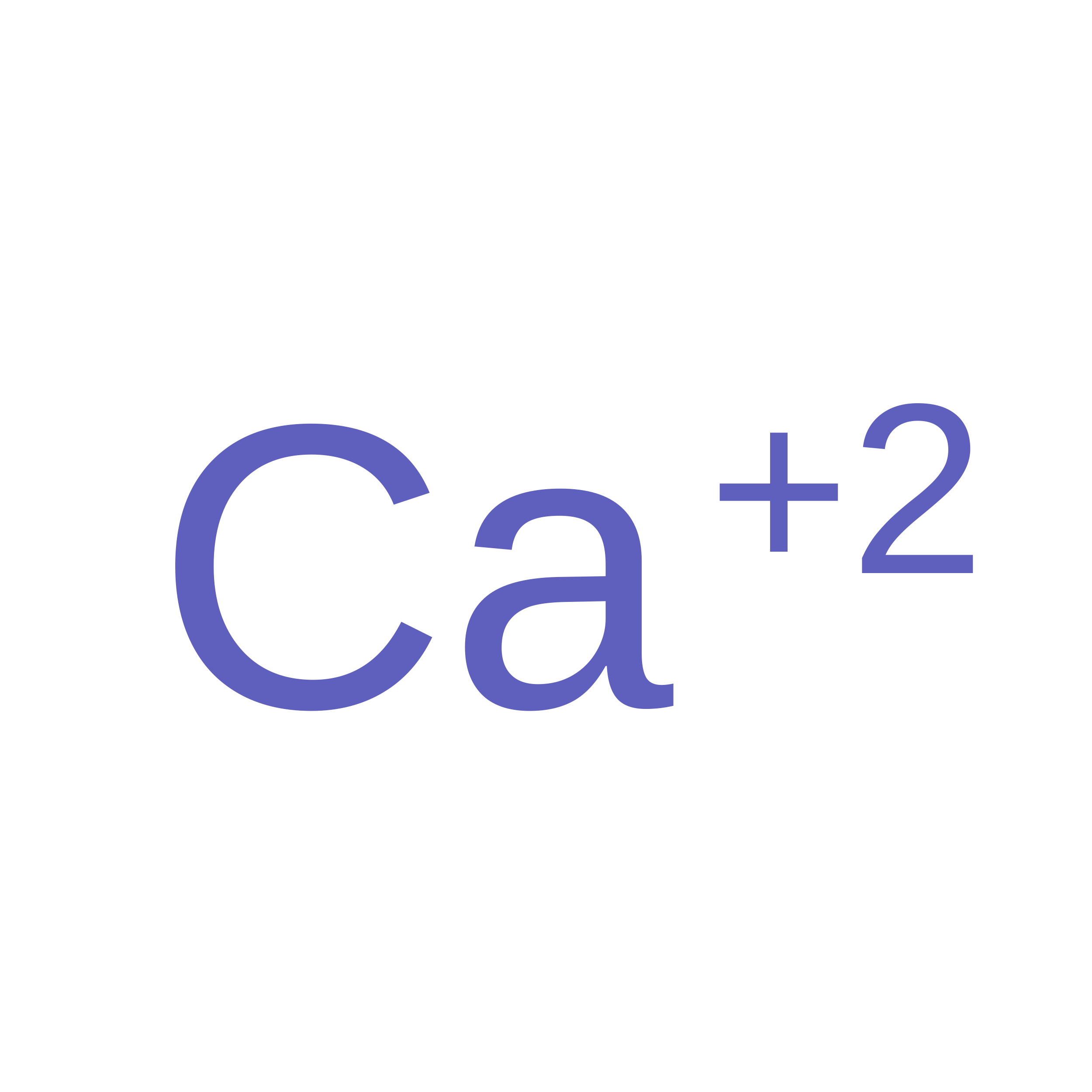
CALCIUM ION
Ca
BHPQYMZQTOCNFJ-UHFFFAOYSA-N
CL

Query on CL


Download:Ideal Coordinates CCD File
H [auth A],
I [auth A],
J [auth A]
CHLORIDE ION
Cl
VEXZGXHMUGYJMC-UHFFFAOYSA-M
NA

Query on NA


Download:Ideal Coordinates CCD File
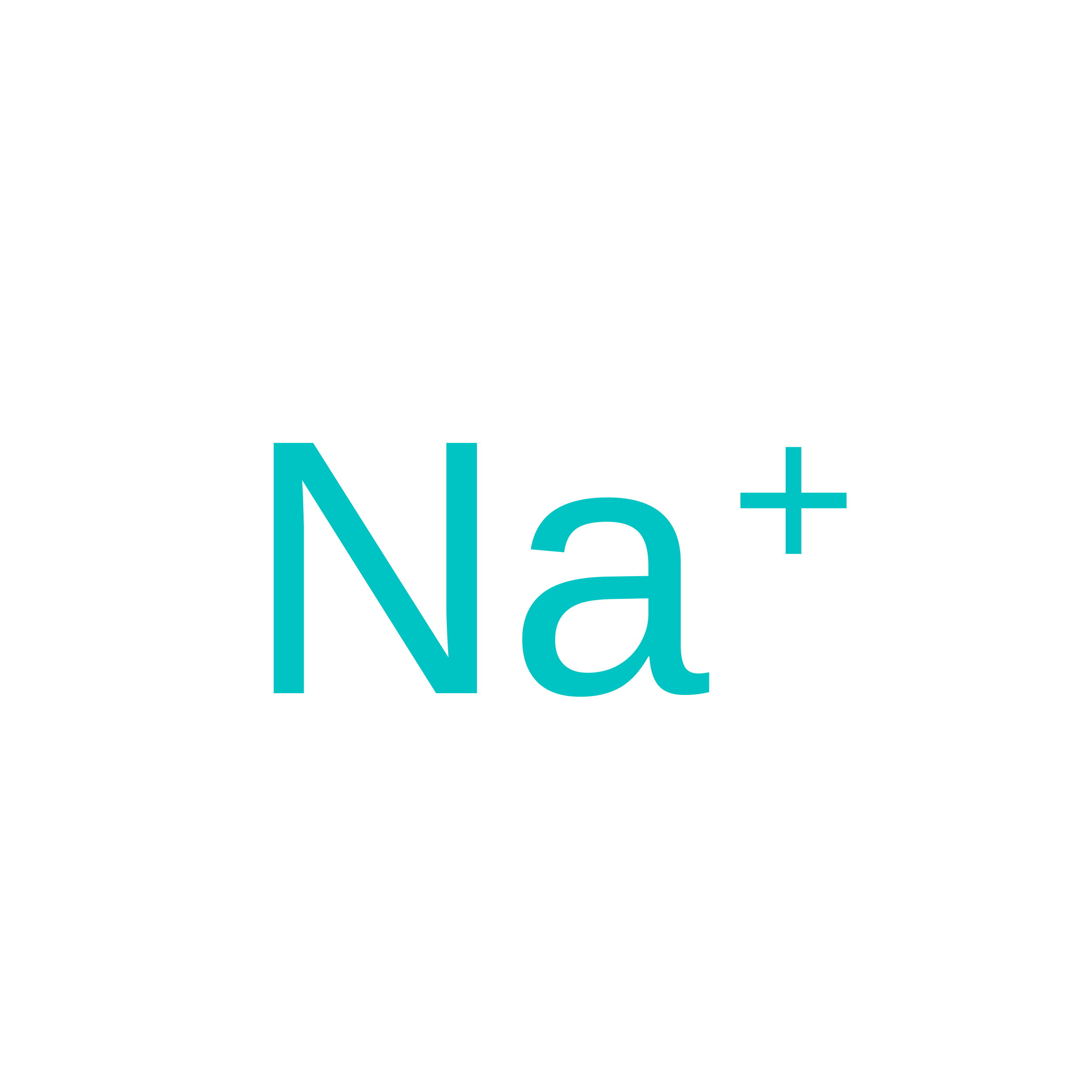
B [auth A]SODIUM ION
Na
FKNQFGJONOIPTF-UHFFFAOYSA-N

Experimental Data & Validation

Experimental Data

  • Method: X-RAY DIFFRACTION
  • Resolution: 1.10 Å
  • R-Value Free:  0.153 (Depositor) 
  • R-Value Work:  0.117 (Depositor), 0.126 (DCC) 
  • R-Value Observed: 0.117 (Depositor) 
Space Group: H 3 2
Unit Cell:
Length ( Å )Angle ( ˚ )
a = 109.52α = 90
b = 109.52β = 90
c = 75.08γ = 120
Software Package:
Software NamePurpose
SHELXL-97model building
SHELXL-97refinement
DENZOdata reduction
SCALEPACKdata scaling
SHELXL-97phasing

Structure Validation

View Full Validation Report


Entry History 

Deposition Data

Revision History  (Full details and data files)

  • Version 1.0: 2001-12-05
    Type: Initial release
  • Version 1.1: 2008-04-27
    Changes: Version format compliance
  • Version 1.2: 2011-07-13
    Changes: Derived calculations, Version format compliance
  • Version 1.3: 2024-02-07
    Changes: Data collection, Database references, Derived calculations