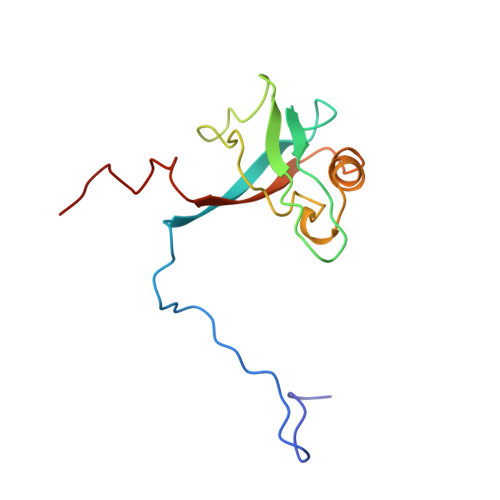
1I16 | pdb_00001i16

STRUCTURE OF INTERLEUKIN 16: IMPLICATIONS FOR FUNCTION, NMR, 20 STRUCTURES


Experimental Data Snapshot

  • Method: SOLUTION NMR
  • Conformers Calculated: 100 
  • Conformers Submitted: 20 
  • Selection Criteria: LEAST RESTRAINT VIOLATION, LEAST TOTAL ENERGY 

wwPDB Validation 3D Report Full Report

Validation slider image for 1I16

This is version 1.4 of the entry. See complete history

Literature

Structure of interleukin 16 resembles a PDZ domain with an occluded peptide binding site.

Muhlhahn, P.Zweckstetter, M.Georgescu, J.Ciosto, C.Renner, C.Lanzendorfer, M.Lang, K.Ambrosius, D.Baier, M.Kurth, R.Holak, T.A.

(1998) Nat Struct Biol 5: 682-686

  • DOI: https://doi.org/10.1038/1376
  • Primary Citation Related Structures: 
    1I16

  • PubMed Abstract: 

    The structure of a folded core of IL-16 is similar to that of intracellular protein modules called PDZ domains. IL-16 is thus the first extracellular protein found to have a PDZ-like fold. However, it does not exhibit normal peptide binding properties of PDZ domains. This is due to alterations of the structure at the 'PDZ-like binding site' of IL-16 (the GLGF cleft): the GLGF cleft of IL-16 is much smaller than those of PDZ-domains and is additionally blocked with a tryptophan side chain at its center. Our experiments indicate also that IL-16 nonspecifically aggregates in solution; but formation of a homo-tetrameric protein is not required, in contrast to previous suggestions, for its chemo-attractant activity.


  • Organizational Affiliation
    • Max Planck Institute for Biochemistry, Martinsried, F.R.G., Germany.

Macromolecule Content 

  • Total Structure Weight: 13.39 kDa 
  • Atom Count: 936 
  • Modeled Residue Count: 130 
  • Deposited Residue Count: 130 
  • Unique protein chains: 1

Macromolecules

Find similar proteins by:|  3D Structure
Entity ID: 1
MoleculeChains  Sequence LengthOrganismDetailsImage
INTERLEUKIN 16130Homo sapiensMutation(s): 0 
UniProt & NIH Common Fund Data Resources
Find proteins for Q14005 (Homo sapiens)
Explore Q14005 
Go to UniProtKB:  Q14005
PHAROS:  Q14005
GTEx:  ENSG00000172349 
Entity Groups
Sequence Clusters30% Identity50% Identity70% Identity90% Identity95% Identity100% Identity
UniProt GroupQ14005
Sequence Annotations
Expand
Reference Sequence

Experimental Data & Validation

Experimental Data

  • Method: SOLUTION NMR
  • Conformers Calculated: 100 
  • Conformers Submitted: 20 
  • Selection Criteria: LEAST RESTRAINT VIOLATION, LEAST TOTAL ENERGY 

Structure Validation

View Full Validation Report


Entry History 

Deposition Data

Revision History  (Full details and data files)

  • Version 1.0: 1999-05-25
    Type: Initial release
  • Version 1.1: 2008-03-24
    Changes: Version format compliance
  • Version 1.2: 2011-07-13
    Changes: Version format compliance
  • Version 1.3: 2022-02-23
    Changes: Database references, Derived calculations, Other
  • Version 1.4: 2024-05-22
    Changes: Data collection