1HB1 | pdb_00001hb1

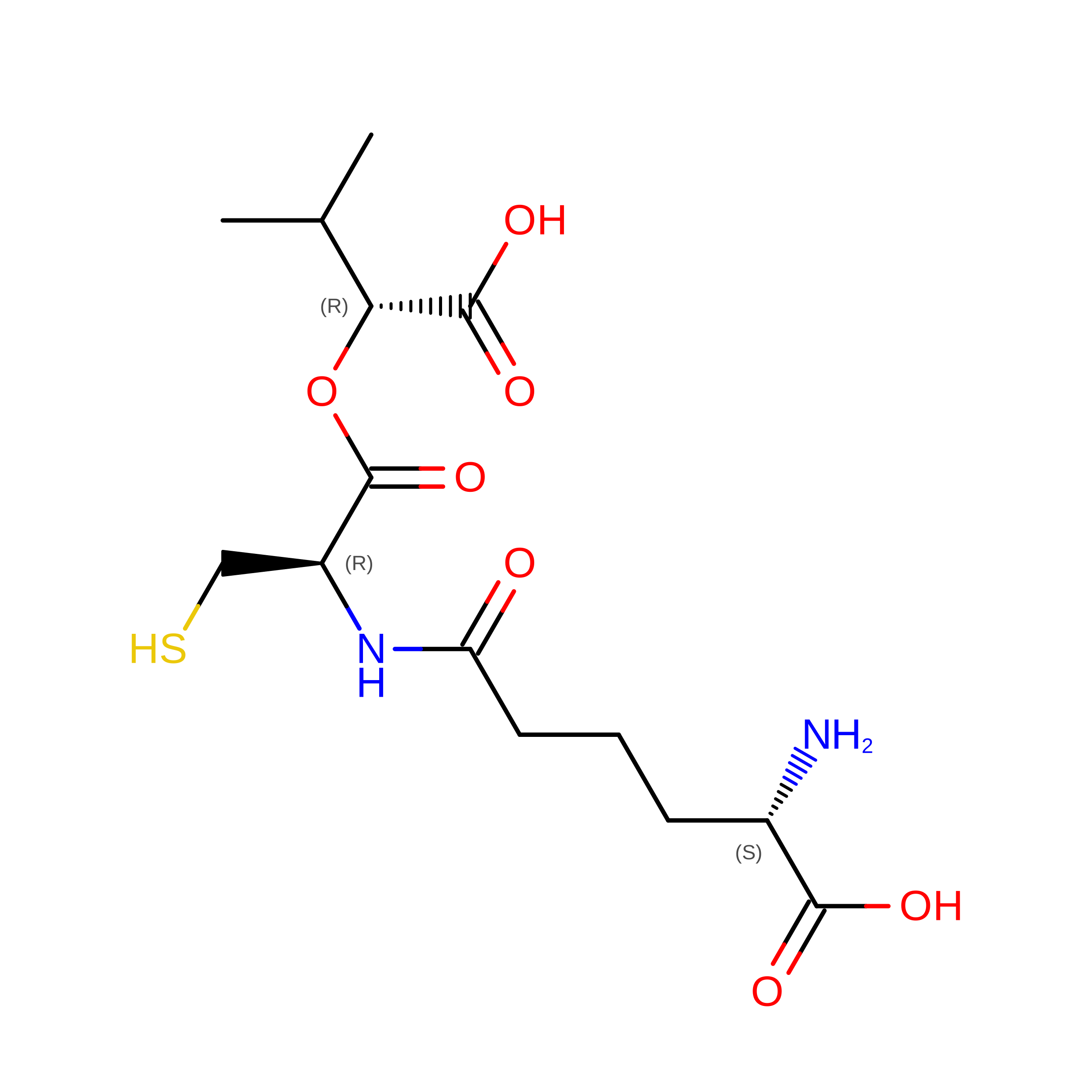
ISOPENICILLIN N SYNTHASE FROM ASPERGILLUS NIDULANS (ANAEROBIC ACOV FE COMPLEX)


Experimental Data Snapshot

  • Method: X-RAY DIFFRACTION
  • Resolution: 1.55 Å
  • R-Value Free: 
    0.204 (Depositor), 0.193 (DCC) 
  • R-Value Work: 
    0.184 (Depositor) 

Starting Model: experimental
View more details

wwPDB Validation 3D Report Full Report

Validation slider image for 1HB1

Ligand Structure Quality Assessment 


This is version 1.6 of the entry. See complete history

Literature

Alternative Oxidation by Isopenicillin N Synthase Observed by X-Ray Diffraction.

Ogle, J.M.Clifton, I.J.Rutledge, P.J.Elkins, J.M.Burzlaff, N.I.M Adlington, R.Roach, P.L.Baldwin, J.E.

(2001) Chem Biol 8: 1231

  • DOI: https://doi.org/10.1016/s1074-5521(01)00090-4
  • Primary Citation Related Structures: 
    1HB1, 1HB2, 1HB3, 1HB4

  • PubMed Abstract: 

    Isopenicillin N synthase (IPNS) catalyses formation of bicyclic isopenicillin N, precursor to all penicillin and cephalosporin antibiotics, from the linear tripeptide delta-(L-alpha-aminoadipoyl)-L-cysteinyl-D-valine. IPNS is a non-haem iron(II)-dependent enzyme which utilises the full oxidising potential of molecular oxygen in catalysing the bicyclisation reaction. The reaction mechanism is believed to involve initial formation of the beta-lactam ring (via a thioaldehyde intermediate) to give an iron(IV)-oxo species, which then mediates closure of the 5-membered thiazolidine ring. Here we report experiments employing time-resolved crystallography to observe turnover of an isosteric substrate analogue designed to intercept the catalytic pathway at an early stage. Reaction in the crystalline enzyme-substrate complex was initiated by the application of high-pressure oxygen, and subsequent flash freezing allowed an oxygenated product to be trapped, bound at the iron centre. A mechanism for formation of the observed thiocarboxylate product is proposed. In the absence of its natural reaction partner (the N-H proton of the L-cysteinyl-D-valine amide bond), the proposed hydroperoxide intermediate appears to attack the putative thioaldehyde species directly. These results shed light on the events preceding beta-lactam closure in the IPNS reaction cycle, and enhance our understanding of the mechanism for reaction of the enzyme with its natural substrate.


  • Organizational Affiliation
    • The Dyson Perrins Laboratory, University of Oxford, UK.

Macromolecule Content 

  • Total Structure Weight: 38.08 kDa 
  • Atom Count: 2,952 
  • Modeled Residue Count: 328 
  • Deposited Residue Count: 331 
  • Unique protein chains: 1

Macromolecules

Find similar proteins by:|  3D Structure
Entity ID: 1
MoleculeChains  Sequence LengthOrganismDetailsImage
ISOPENICILLIN N SYNTHASE331Aspergillus nidulans FGSC A4Mutation(s): 0 
Gene Names: PCB C
EC: 1.21.3.1
UniProt
Find proteins for P05326 (Emericella nidulans (strain FGSC A4 / ATCC 38163 / CBS 112.46 / NRRL 194 / M139))
Explore P05326 
Go to UniProtKB:  P05326
Entity Groups
Sequence Clusters30% Identity50% Identity70% Identity90% Identity95% Identity100% Identity
UniProt GroupP05326
Sequence Annotations
Expand
Reference Sequence

Small Molecules

Experimental Data & Validation

Experimental Data

  • Method: X-RAY DIFFRACTION
  • Resolution: 1.55 Å
  • R-Value Free:  0.204 (Depositor), 0.193 (DCC) 
  • R-Value Work:  0.184 (Depositor) 
Space Group: P 21 21 21
Unit Cell:
Length ( Å )Angle ( ˚ )
a = 46.75α = 90
b = 71.121β = 90
c = 100.927γ = 90
Software Package:
Software NamePurpose
REFMACrefinement
MOSFLMdata reduction
SCALAdata scaling

Structure Validation

View Full Validation Report


Ligand Structure Quality Assessment 


Entry History 

Deposition Data

Revision History  (Full details and data files)

  • Version 1.0: 2001-11-23
    Type: Initial release
  • Version 1.1: 2011-05-07
    Changes: Version format compliance
  • Version 1.2: 2011-07-13
    Changes: Version format compliance
  • Version 1.3: 2017-07-05
    Changes: Refinement description
  • Version 1.4: 2018-10-24
    Changes: Data collection, Source and taxonomy
  • Version 1.5: 2023-12-13
    Changes: Data collection, Database references, Derived calculations, Other, Refinement description
  • Version 1.6: 2024-05-08
    Changes: Source and taxonomy