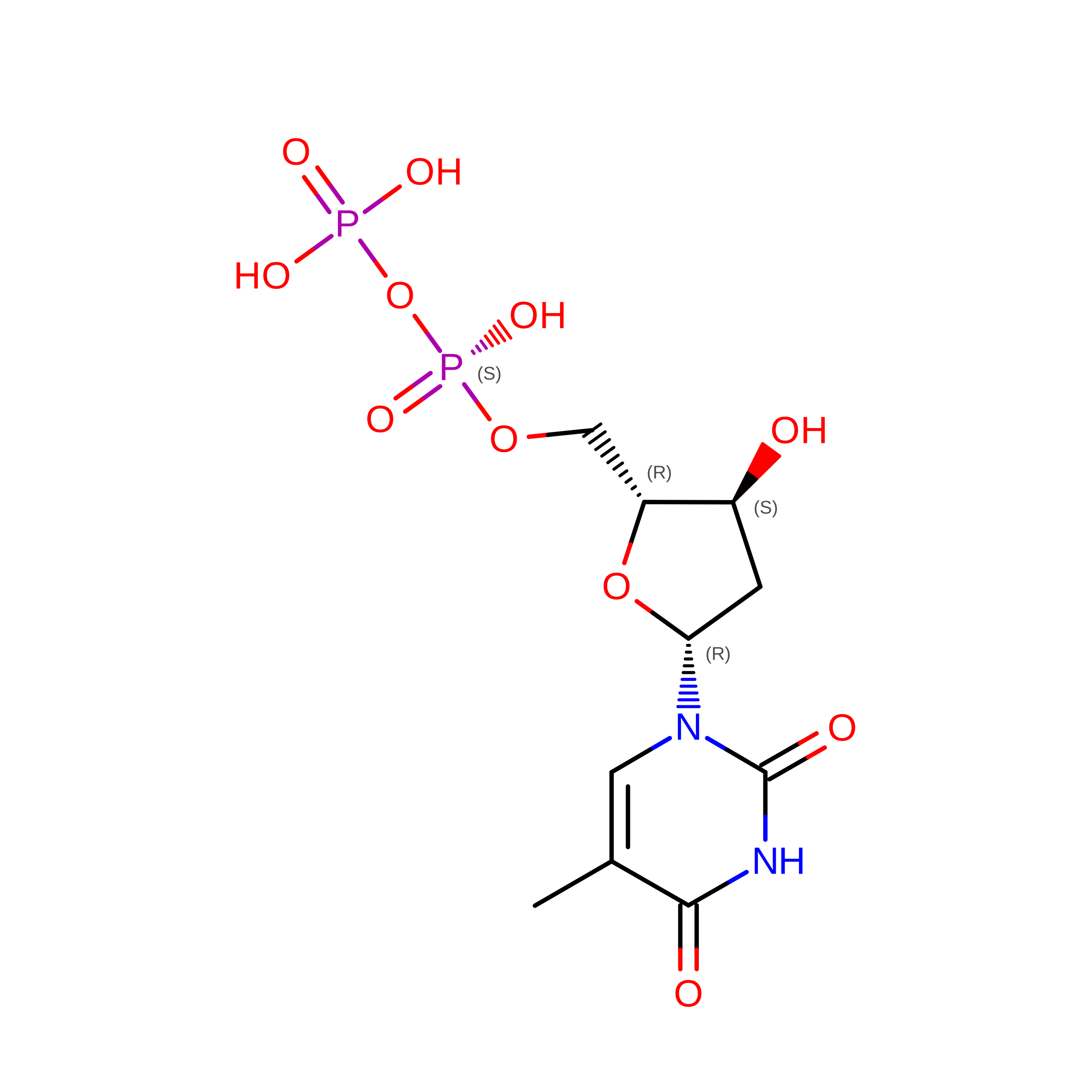
1H7Q | pdb_00001h7q

dTDP-MANGANESE COMPLEX OF SPSA FROM BACILLUS SUBTILIS


Experimental Data Snapshot

  • Method: X-RAY DIFFRACTION
  • Resolution: 2.00 Å
  • R-Value Free: 
    0.237 (Depositor), 0.238 (DCC) 
  • R-Value Work: 
    0.191 (Depositor), 0.203 (DCC) 
  • R-Value Observed: 
    0.193 (Depositor) 

Starting Model: experimental
View more details

wwPDB Validation 3D Report Full Report

Validation slider image for 1H7Q

Ligand Structure Quality Assessment 


This is version 1.4 of the entry. See complete history

Literature

Three-Dimensional Structures of the Mn and Mg Dtdp Complexes of the Family Gt-2 Glycosyltransferase Spsa: A Comparison with Related Ndp-Sugar Glycosyltransferases.

Tarbouriech, N.Charnock, S.J.Davies, G.J.

(2001) J Mol Biology 314: 655

  • DOI: https://doi.org/10.1006/jmbi.2001.5159
  • Primary Citation Related Structures: 
    1H7L, 1H7Q

  • PubMed Abstract: 

    The vast majority of glycosidic-bond synthesis in nature is performed by glycosyltransferases, which use activated glycosides as the sugar donor. Typically, the activated leaving group is a nucleoside phosphate, lipid phosphate or phosphate. The nucleotide-sugar-dependent glycosyltransferases fall into over 50 sequence-based families, with the largest and most widespread family of inverting transferases named family GT-2. Here, we present the three-dimensional crystal structure of SpsA, the first and currently the only structural representative from family GT-2, in complex with both Mn-dTDP and Mg-dTDP at a resolution of 2 A. These structures reveal how SpsA and related enzymes may display nucleotide plasticity and permit a comparison of the catalytic centre of this enzyme with those from related sequence families whose three-dimensional structures have recently been determined. Family GT-2 enzymes, together with enzymes from families 7, 13 and 43, appear to form a clan of related structures with identical catalytic apparatus and reaction mechanism.


  • Organizational Affiliation
    • Department of Chemistry, Structural Biology Laboratory, Heslington, Y010 5DD, UK.

Macromolecule Content 

  • Total Structure Weight: 30.6 kDa 
  • Atom Count: 2,207 
  • Modeled Residue Count: 240 
  • Deposited Residue Count: 255 
  • Unique protein chains: 1

Macromolecules

Find similar proteins by:|  3D Structure
Entity ID: 1
MoleculeChains  Sequence LengthOrganismDetailsImage
SPORE COAT POLYSACCHARIDE BIOSYNTHESIS PROTEIN SPSA255Bacillus subtilisMutation(s): 0 
UniProt
Find proteins for P39621 (Bacillus subtilis (strain 168))
Explore P39621 
Go to UniProtKB:  P39621
Entity Groups
Sequence Clusters30% Identity50% Identity70% Identity90% Identity95% Identity100% Identity
UniProt GroupP39621
Sequence Annotations
Expand
Reference Sequence

Experimental Data & Validation

Experimental Data

  • Method: X-RAY DIFFRACTION
  • Resolution: 2.00 Å
  • R-Value Free:  0.237 (Depositor), 0.238 (DCC) 
  • R-Value Work:  0.191 (Depositor), 0.203 (DCC) 
  • R-Value Observed: 0.193 (Depositor) 
Space Group: C 2 2 21
Unit Cell:
Length ( Å )Angle ( ˚ )
a = 47.372α = 90
b = 142.06β = 90
c = 81.425γ = 90
Software Package:
Software NamePurpose
REFMACrefinement
DENZOdata reduction
SCALEPACKdata scaling
AMoREphasing

Structure Validation

View Full Validation Report


Ligand Structure Quality Assessment 


Entry History 

Deposition Data

Revision History  (Full details and data files)

  • Version 1.0: 2001-12-13
    Type: Initial release
  • Version 1.1: 2011-05-08
    Changes: Version format compliance
  • Version 1.2: 2011-07-13
    Changes: Version format compliance
  • Version 1.3: 2023-12-13
    Changes: Data collection, Database references, Derived calculations, Other, Refinement description
  • Version 1.4: 2024-11-20
    Changes: Structure summary