1GZZ | pdb_00001gzz

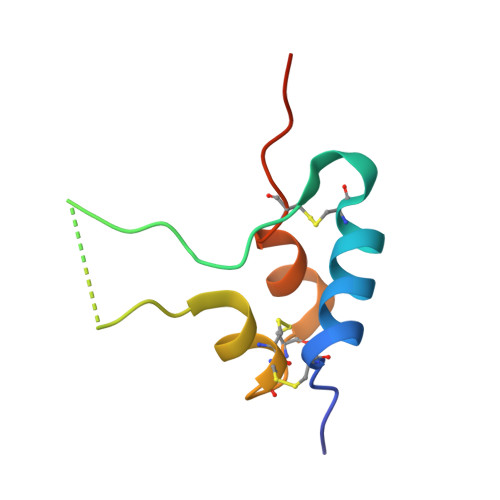
Human Insulin-like growth factor; Hamburg data


Experimental Data Snapshot

  • Method: X-RAY DIFFRACTION
  • Resolution: 2.30 Å
  • R-Value Free: 
    0.275 (Depositor) 
  • R-Value Work: 
    0.234 (Depositor) 
  • R-Value Observed: 
    0.238 (Depositor) 

Starting Model: experimental
View more details

wwPDB Validation 3D Report Full Report

Validation slider image for 1GZZ

This is version 1.5 of the entry. See complete history

Literature

Structural Origins of the Functional Divergence of Human Insulin-Like Growth Factor-I and Insulin

Brzozowski, A.M.Dodson, E.J.Dodson, G.G.Murshudov, G.Verma, C.Turkenburg, J.P.De Bree, F.M.Dauter, Z.

(2002) Biochemistry 41: 9389

  • DOI: https://doi.org/10.1021/bi020084j
  • Primary Citation Related Structures: 
    1GZR, 1GZY, 1GZZ, 1H02

  • PubMed Abstract: 

    Human insulin-like growth factors I and II (hIGF-I, hIGF-II) are potent stimulators of cell and growth processes. They display high sequence similarity to both the A and B chains of insulin but contain an additional connecting C-domain, which reflects their secretion without specific packaging or precursor conversion. IGFs also have an extension at the C-terminus known as the D-domain. This paper describes four homologous hIGF-1 structures, obtained from crystals grown in the presence of the detergent SB12, which reveal additional detail in the C- and D-domains. Two different detergent binding modes observed in the crystals may reflect different hIGF-I biological properties such as the interaction with IGF binding proteins and self-aggregation. While the helical core of hIGF-I is very similar to that in insulin, there are distinct differences in the region of hIGF-I corresponding to the insulin B chain C-terminus, residues B25-B30. In hIGF-I, these residues (24-29) and the following C-domain form an extensive loop protruding 20 A from the core, which results in a substantially different conformation for the receptor binding epitope in hIGF-I compared to insulin. One notable feature of the structures presented here is demonstration of peptide-bond cleavage between Ser35 and Arg36 resulting in an apparent gap between residues 35 and 39. The equivalent region of proinsulin is involved in hormone processing demanding a reassessment of the structural integrity of hIGF-I in relation to its biological function.


  • Organizational Affiliation
    • Structural Biology Laboratory, Chemistry Department, University of York, Heslington, York YO10 5DD, United Kingdom. marek@ysbl.york.ac.uk

Macromolecule Content 

  • Total Structure Weight: 8 kDa 
  • Atom Count: 496 
  • Modeled Residue Count: 60 
  • Deposited Residue Count: 70 
  • Unique protein chains: 1

Macromolecules

Find similar proteins by:|  3D Structure
Entity ID: 1
MoleculeChains  Sequence LengthOrganismDetailsImage
INSULIN-LIKE GROWTH FACTOR IA [auth B]70Homo sapiensMutation(s): 0 
UniProt & NIH Common Fund Data Resources
Find proteins for P05019 (Homo sapiens)
Explore P05019 
Go to UniProtKB:  P05019
PHAROS:  P05019
GTEx:  ENSG00000017427 
Entity Groups
Sequence Clusters30% Identity50% Identity70% Identity90% Identity95% Identity100% Identity
UniProt GroupP05019
Sequence Annotations
Expand
Reference Sequence

Small Molecules

Ligands 1 Unique
IDChains Name / Formula / InChI Key2D Diagram3D Interactions
C15

Query on C15


Download:Ideal Coordinates CCD File
B
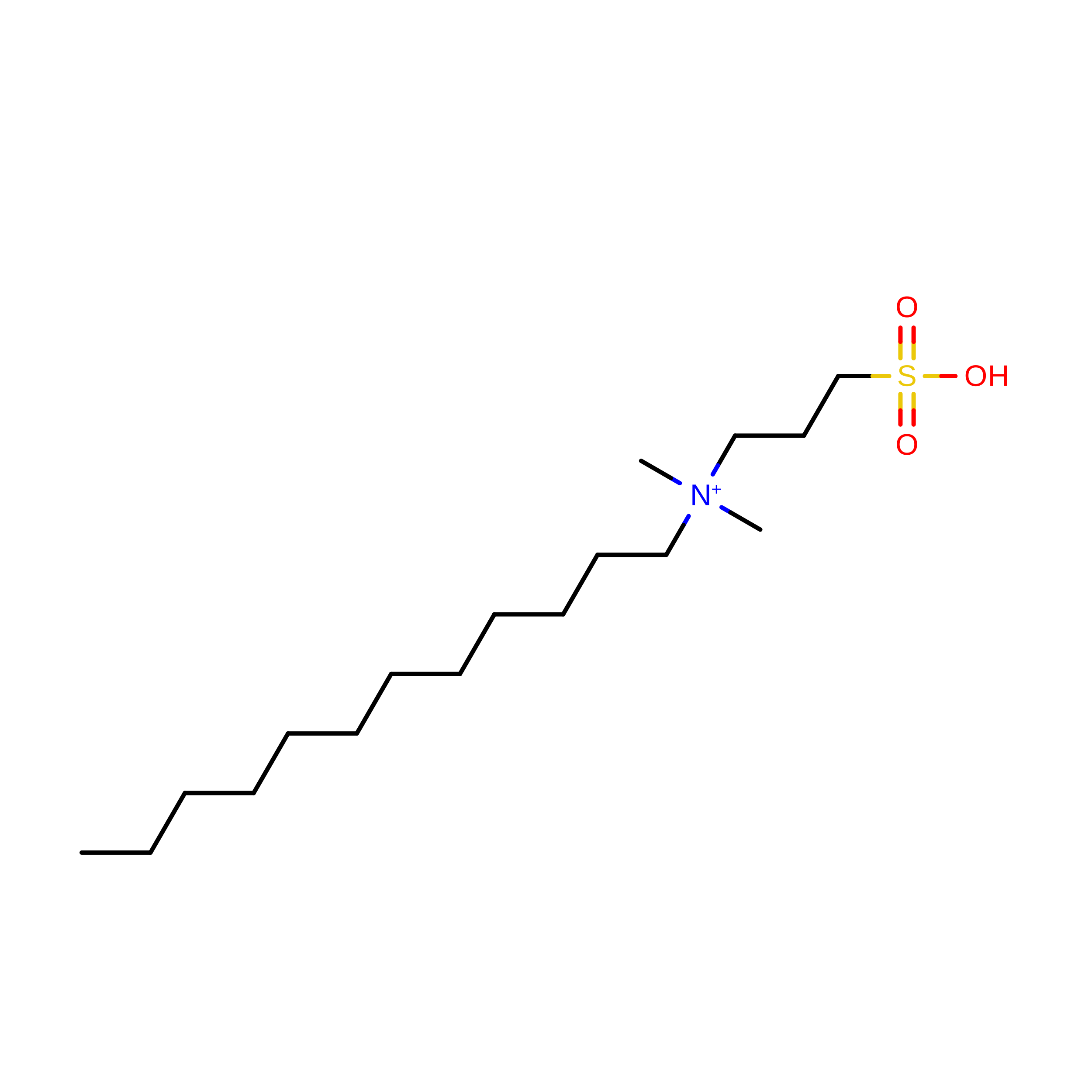
N-DODECYL-N,N-DIMETHYL-3-AMMONIO-1-PROPANESULFONATE
C17 H38 N O3 S
IZWSFJTYBVKZNK-UHFFFAOYSA-O

Experimental Data & Validation

Experimental Data

  • Method: X-RAY DIFFRACTION
  • Resolution: 2.30 Å
  • R-Value Free:  0.275 (Depositor) 
  • R-Value Work:  0.234 (Depositor) 
  • R-Value Observed: 0.238 (Depositor) 
Space Group: C 2 2 21
Unit Cell:
Length ( Å )Angle ( ˚ )
a = 30.723α = 90
b = 69.282β = 90
c = 64.528γ = 90
Software Package:
Software NamePurpose
REFMACrefinement
DENZOdata reduction
SCALEPACKdata scaling
AMoREphasing

Structure Validation

View Full Validation Report


Entry History 

Deposition Data

Revision History  (Full details and data files)

  • Version 1.0: 2002-07-25
    Type: Initial release
  • Version 1.1: 2011-07-13
    Changes: Advisory, Version format compliance
  • Version 1.2: 2019-05-08
    Changes: Advisory, Data collection, Experimental preparation, Other
  • Version 1.3: 2019-07-24
    Changes: Data collection
  • Version 1.4: 2023-12-13
    Changes: Advisory, Data collection, Database references, Refinement description
  • Version 1.5: 2024-11-20
    Changes: Structure summary