1GT6 | pdb_00001gt6

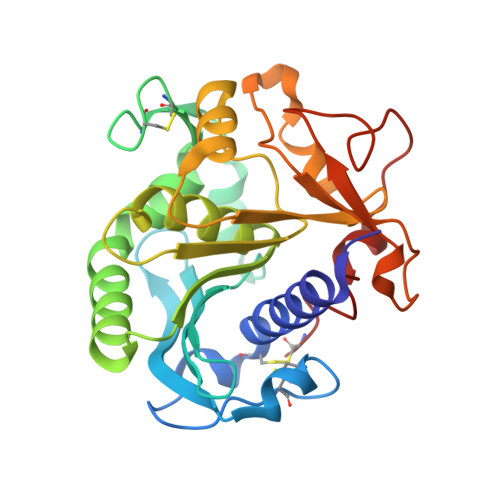
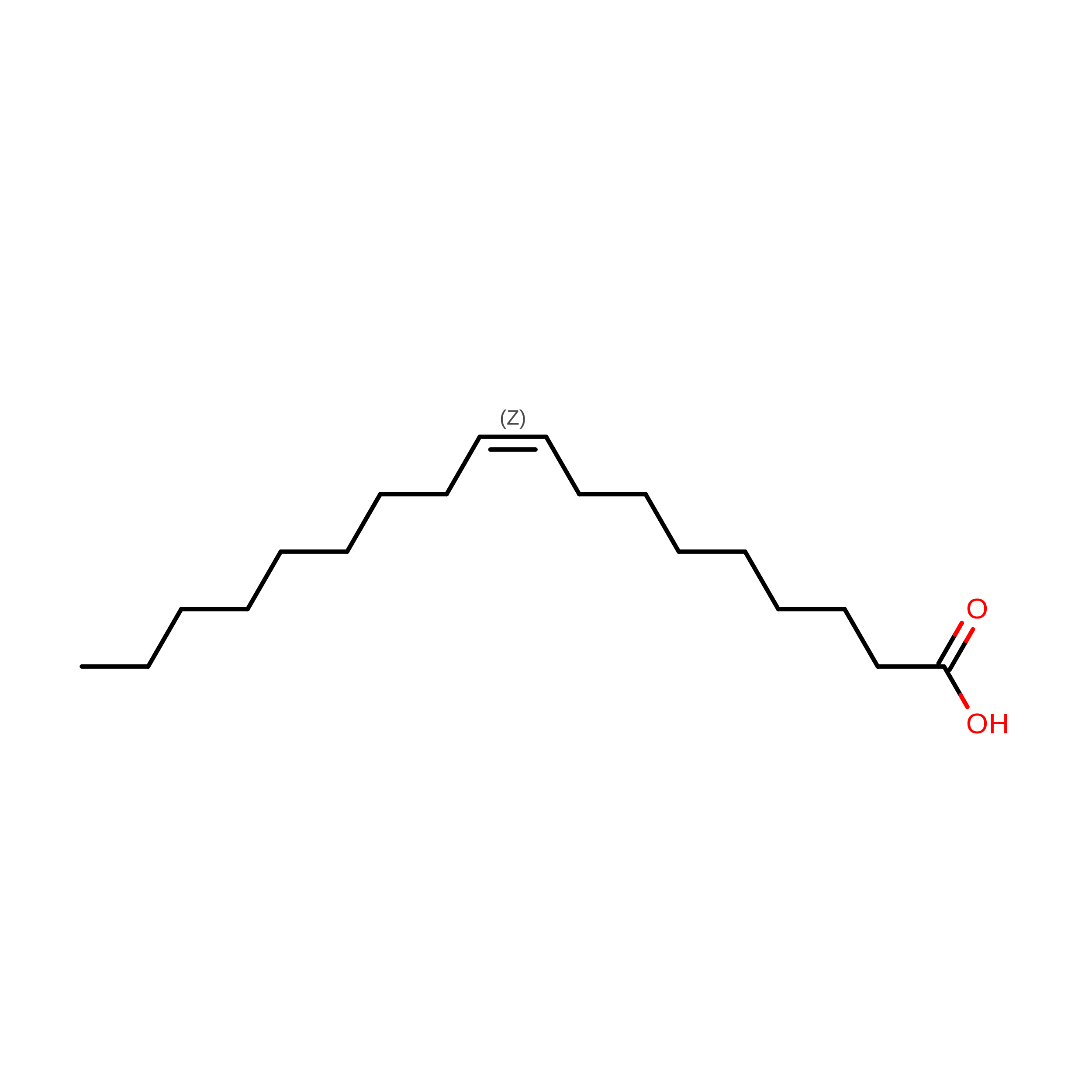
S146A mutant of Thermomyces (Humicola) lanuginosa lipase complex with oleic acid


Experimental Data Snapshot

  • Method: X-RAY DIFFRACTION
  • Resolution: 2.20 Å
  • R-Value Free: 
    0.239 (Depositor) 
  • R-Value Work: 
    0.214 (Depositor) 
  • R-Value Observed: 
    0.216 (Depositor) 

Starting Model: experimental
View more details

wwPDB Validation 3D Report Full Report

Validation slider image for 1GT6

This is version 1.6 of the entry. See complete history

Literature

Binding of Thermomyces (Humicola) lanuginosa lipase to the mixed micelles of cis-parinaric acid/NaTDC.

Yapoudjian, S.Ivanova, M.G.Brzozowski, A.M.Patkar, S.A.Vind, J.Svendsen, A.Verger, R.

(2002) Eur J Biochem 269: 1613-1621

  • DOI: https://doi.org/10.1046/j.1432-1327.2002.02786.x
  • Primary Citation Related Structures: 
    1GT6

  • PubMed Abstract: 

    The binding of Thermomyces lanuginosa lipase and its mutants [TLL(S146A), TLL(W89L), TLL(W117F, W221H, W260H)] to the mixed micelles of cis-parinaric acid/sodium taurodeoxycholate at pH 5.0 led to the quenching of the intrinsic tryptophan fluorescence emission (300-380 nm) and to a simultaneous increase in the cis-parinaric acid fluorescence emission (380-500 nm). These findings were used to characterize the Thermomyces lanuginosa lipase/cis-parinaric acid interactions occurring in the presence of sodium taurodeoxycholate. The fluorescence resonance energy transfer and Stern-Volmer quenching constant values obtained were correlated with the accessibility of the tryptophan residues to the cis-parinaric acid and with the lid opening ability of Thermomyces lanuginosa lipase (and its mutants). TLL(S146A) was found to have the highest fluorescence resonance energy transfer. In addition, a TLL(S146A)/oleic acid complex was crystallised and its three-dimensional structure was solved. Surprisingly, two possible binding modes (sn-1 and antisn1) were found to exist between oleic acid and the catalytic cleft of the open conformation of TLL(S146A). Both binding modes involved an interaction with tryptophan 89 of the lipase lid, in agreement with fluorescence resonance energy transfer experiments. As a consequence, we concluded that TLL(S146A) mutant is not an appropriate substitute for the wild-type Thermomyces lanuginosa lipase for mimicking the interaction between the wild-type enzyme and lipids.


  • Organizational Affiliation
    • Laboratoire de Lipolyse Enzymatique CNRS-IFR1, Marseille, France.

Macromolecule Content 

  • Total Structure Weight: 59.22 kDa 
  • Atom Count: 4,349 
  • Modeled Residue Count: 538 
  • Deposited Residue Count: 538 
  • Unique protein chains: 1

Macromolecules

Find similar proteins by:|  3D Structure
Entity ID: 1
MoleculeChains  Sequence LengthOrganismDetailsImage
Lipase
A, B
269Thermomyces lanuginosusMutation(s): 1 
Gene Names: LIP
EC: 3.1.1.3
UniProt
Find proteins for O59952 (Thermomyces lanuginosus)
Explore O59952 
Go to UniProtKB:  O59952
Entity Groups
Sequence Clusters30% Identity50% Identity70% Identity90% Identity95% Identity100% Identity
UniProt GroupO59952
Sequence Annotations
Expand
Reference Sequence

Small Molecules

Experimental Data & Validation

Experimental Data

  • Method: X-RAY DIFFRACTION
  • Resolution: 2.20 Å
  • R-Value Free:  0.239 (Depositor) 
  • R-Value Work:  0.214 (Depositor) 
  • R-Value Observed: 0.216 (Depositor) 
Space Group: P 21 21 2
Unit Cell:
Length ( Å )Angle ( ˚ )
a = 117.101α = 90
b = 97.304β = 90
c = 55.508γ = 90
Software Package:
Software NamePurpose
REFMACrefinement
DENZOdata reduction
SCALEPACKdata scaling
AMoREphasing

Structure Validation

View Full Validation Report


Entry History 

Deposition Data

Revision History  (Full details and data files)

  • Version 1.0: 2003-01-23
    Type: Initial release
  • Version 1.1: 2011-05-08
    Changes: Version format compliance
  • Version 1.2: 2011-07-13
    Changes: Version format compliance
  • Version 1.3: 2018-11-14
    Changes: Advisory, Data collection, Database references, Source and taxonomy, Structure summary
  • Version 1.4: 2019-10-09
    Changes: Data collection, Database references
  • Version 1.5: 2023-12-13
    Changes: Advisory, Data collection, Database references, Refinement description
  • Version 1.6: 2024-10-16
    Changes: Structure summary