1GNS | pdb_00001gns

SUBTILISIN BPN'


Experimental Data Snapshot

  • Method: X-RAY DIFFRACTION
  • Resolution: 1.80 Å
  • R-Value Free: 
    0.141 (DCC) 
  • R-Value Work: 
    0.165 (Depositor) 
  • R-Value Observed: 
    0.165 (Depositor) 

Starting Model: experimental
View more details

wwPDB Validation 3D Report Full Report

Validation slider image for 1GNS

This is version 1.3 of the entry. See complete history

Literature

Structural Basis of Thermostability. Analysis of Stabilizing Mutations in Subtilisin Bpn'.

Almog, O.Gallagher, D.T.Ladner, J.E.Strausberg, S.Alexander, P.Bryan, P.Gilliland, G.L.

(2002) J Biological Chem 277: 27553

  • DOI: https://doi.org/10.1074/jbc.M111777200
  • Primary Citation Related Structures: 
    1GNS, 1GNV

  • PubMed Abstract: 

    The crystal structures of two thermally stabilized subtilisin BPN' variants, S63 and S88, are reported here at 1.8 and 1.9 A resolution, respectively. The micromolar affinity calcium binding site (site A) has been deleted (Delta75-83) in these variants, enabling the activity and thermostability measurements in chelating conditions. Each of the variants includes mutations known previously to increase the thermostability of calcium-independent subtilisin in addition to new stabilizing mutations. S63 has eight amino acid replacements: D41A, M50F, A73L, Q206W, Y217K, N218S, S221C, and Q271E. S63 has 75-fold greater stability than wild type subtilisin in chelating conditions (10 mm EDTA). The other variant, S88, has ten site-specific changes: Q2K, S3C, P5S, K43N, M50F, A73L, Q206C, Y217K, N218S, and Q271E. The two new cysteines form a disulfide bond, and S88 has 1000 times greater stability than wild type subtilisin in chelating conditions. Comparisons of the two new crystal structures (S63 in space group P2(1) with A cell constants 41.2, 78.1, 36.7, and beta = 114.6 degrees and S88 in space group P2(1)2(1)2(1) with cell constants 54.2, 60.4, and 82.7) with previous structures of subtilisin BPN' reveal that the principal changes are in the N-terminal region. The structural bases of the stabilization effects of the new mutations Q2K, S3C, P5S, D41A, Q206C, and Q206W are generally apparent. The effects are attributed to the new disulfide cross-link and to improved hydrophobic packing, new hydrogen bonds, and other rearrangements in the N-terminal region.


  • Organizational Affiliation
    • Department of Clinical Biochemistry, Faculty of Health Sciences, Ben-Gurion University, Beer-Sheva 84105, Israel.

Macromolecule Content 

  • Total Structure Weight: 26.46 kDa 
  • Atom Count: 2,017 
  • Modeled Residue Count: 263 
  • Deposited Residue Count: 263 
  • Unique protein chains: 1

Macromolecules

Find similar proteins by:|  3D Structure
Entity ID: 1
MoleculeChains  Sequence LengthOrganismDetailsImage
SUBTILISIN BPN'263Bacillus amyloliquefaciensMutation(s): 8 
EC: 3.4.21.62
UniProt
Find proteins for P00782 (Bacillus amyloliquefaciens)
Explore P00782 
Go to UniProtKB:  P00782
Entity Groups
Sequence Clusters30% Identity50% Identity70% Identity90% Identity95% Identity100% Identity
UniProt GroupP00782
Sequence Annotations
Expand
Reference Sequence

Small Molecules

Ligands 1 Unique
IDChains Name / Formula / InChI Key2D Diagram3D Interactions
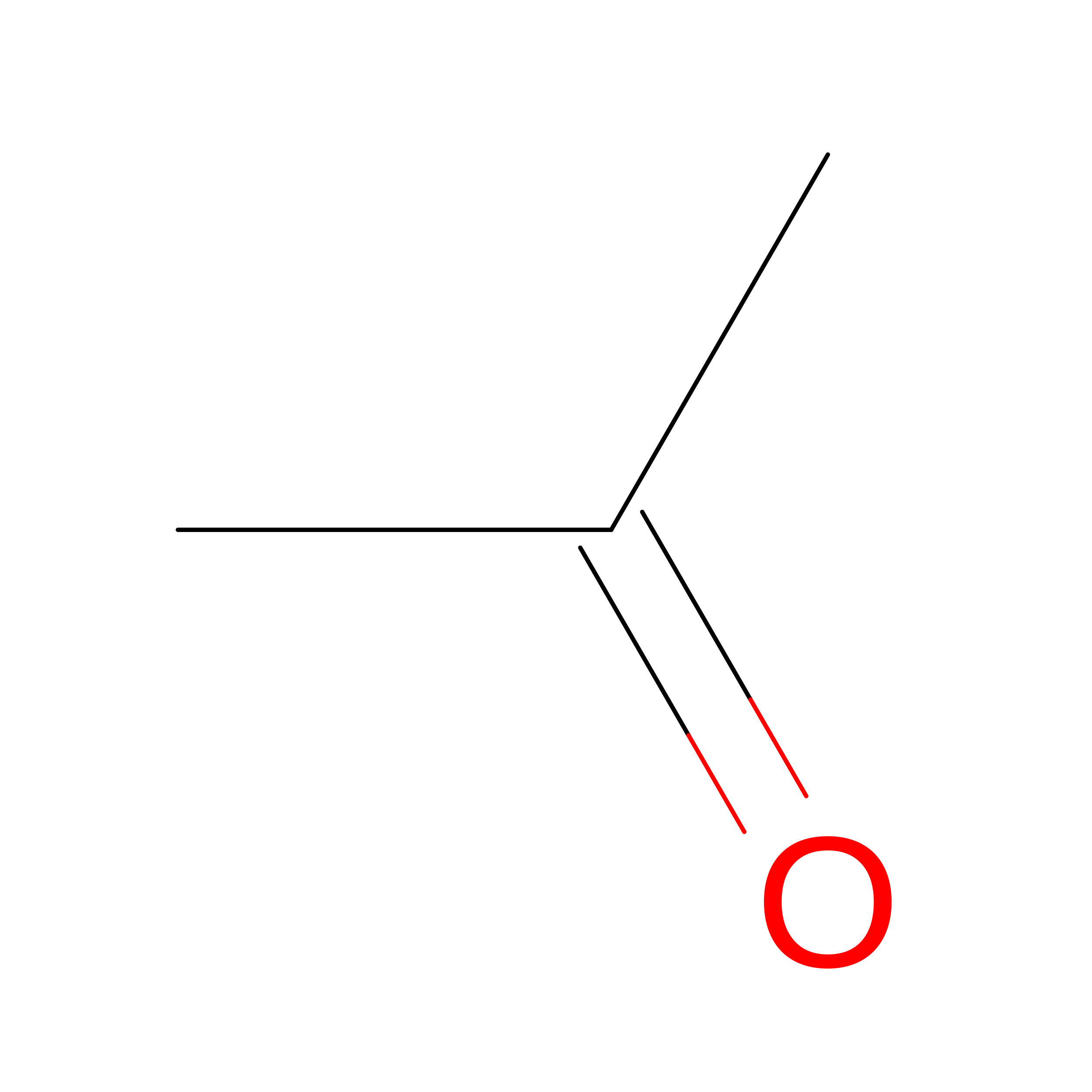
ACN

Query on ACN


Download:Ideal Coordinates CCD File
B [auth A]ACETONE
C3 H6 O
CSCPPACGZOOCGX-UHFFFAOYSA-N
Modified Residues  1 Unique
IDChains TypeFormula2D DiagramParent
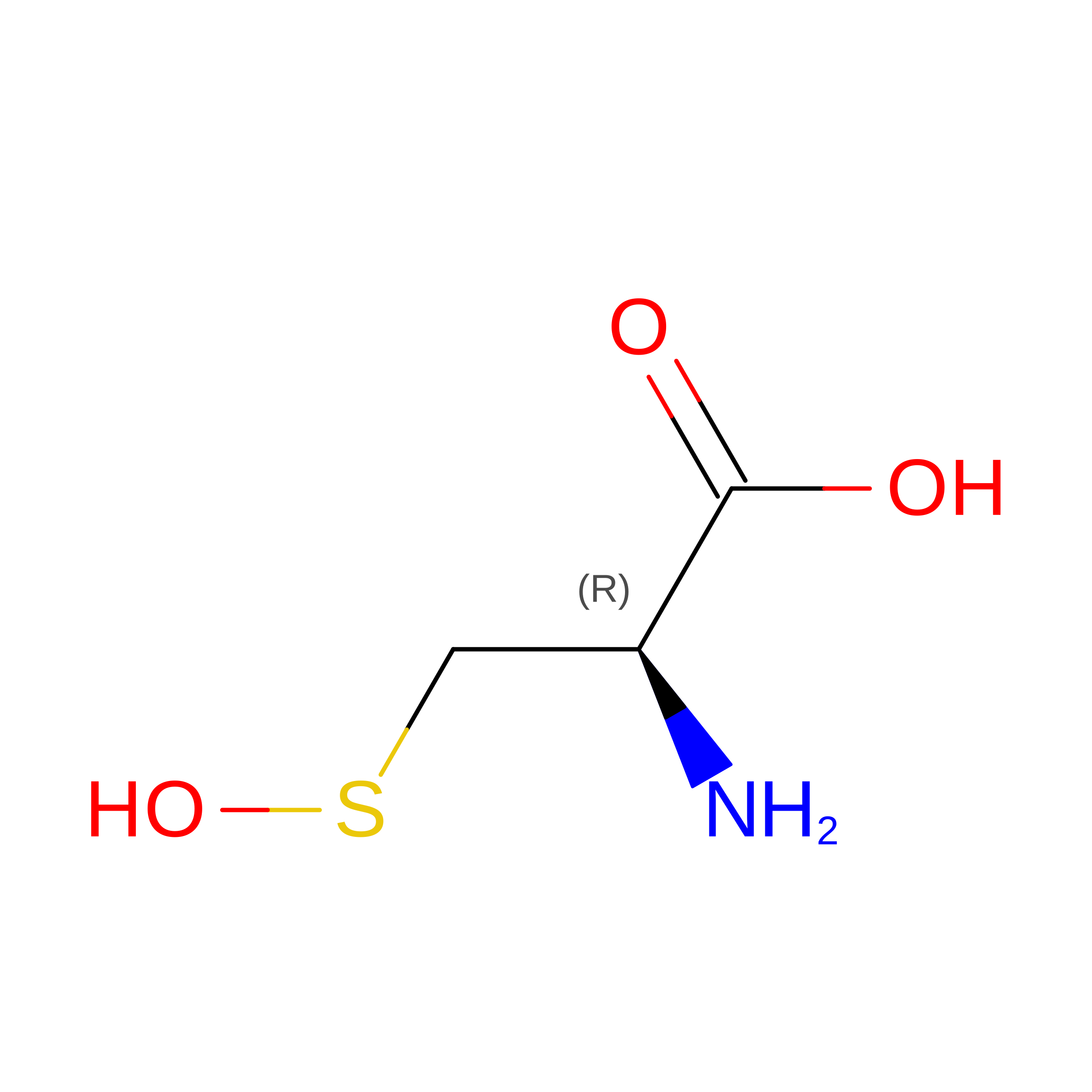
CSO
Query on CSO
A
L-PEPTIDE LINKINGC3 H7 N O3 SCYS

Experimental Data & Validation

Experimental Data

  • Method: X-RAY DIFFRACTION
  • Resolution: 1.80 Å
  • R-Value Free:  0.141 (DCC) 
  • R-Value Work:  0.165 (Depositor) 
  • R-Value Observed: 0.165 (Depositor) 
Space Group: P 1 21 1
Unit Cell:
Length ( Å )Angle ( ˚ )
a = 41.17α = 90
b = 78.06β = 114.6
c = 36.7γ = 90
Software Package:
Software NamePurpose
PROLSQrefinement
XENGENdata reduction
XENGENdata scaling
AMoREphasing

Structure Validation

View Full Validation Report


Entry History 

Deposition Data

Revision History  (Full details and data files)

  • Version 1.0: 2002-06-27
    Type: Initial release
  • Version 1.1: 2015-04-15
    Changes: Database references, Derived calculations, Non-polymer description, Other, Structure summary, Version format compliance
  • Version 1.2: 2023-12-13
    Changes: Data collection, Database references, Derived calculations, Other, Refinement description
  • Version 1.3: 2024-11-06
    Changes: Structure summary