Download Mendeley
Residue 259 is a key determinant of substrate specificity of protein-tyrosine phosphatases 1B and alpha.
Peters, G.H., Iversen, L.F., Branner, S., Andersen, H.S., Mortensen, S.B., Olsen, O.H., Moller, K.B., Moller, N.P.(2000) J Biol Chem 275: 18201-18209
- PubMed: 10748206 Search on PubMed
- DOI: https://doi.org/10.1074/jbc.M910273199
- Primary Citation Related Structures:
1GFY - PubMed Abstract:
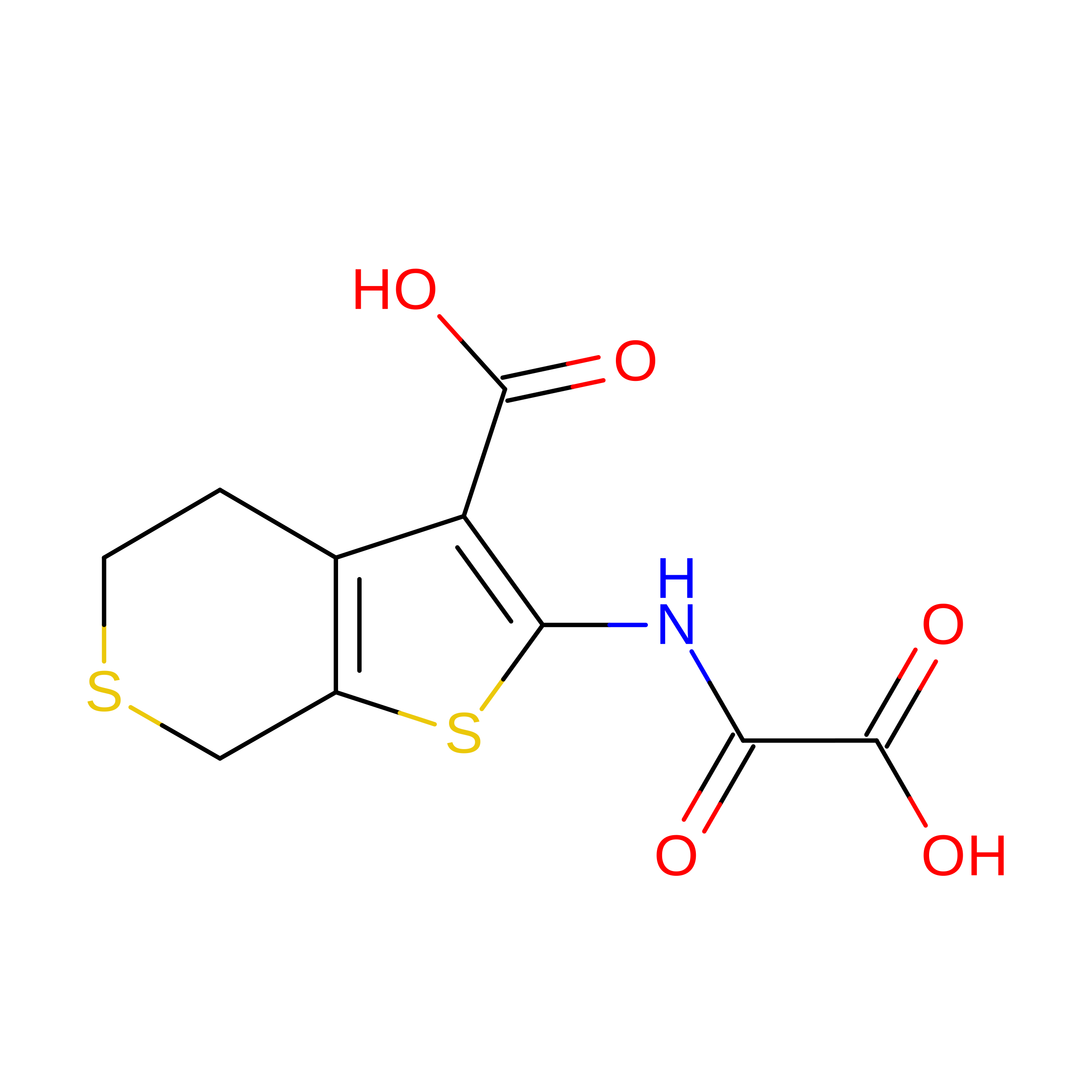
The aim of this study was to define the structural elements that determine the differences in substrate recognition capacity of two protein-tyrosine phosphatases (PTPs), PTP1B and PTPalpha, both suggested to be negative regulators of insulin signaling. Since the Ac-DADE(pY)L-NH(2) peptide is well recognized by PTP1B, but less efficiently by PTPalpha, it was chosen as a tool for these analyses. Calpha regiovariation analyses and primary sequence alignments indicate that residues 47, 48, 258, and 259 (PTP1B numbering) define a selectivity-determining region. By analyzing a set of DADE(pY)L analogs with a series of PTP mutants in which these four residues were exchanged between PTP1B and PTPalpha, either in combination or alone, we here demonstrate that the key selectivity-determining residue is 259. In PTPalpha, this residue is a glutamine causing steric hindrance and in PTP1B a glycine allowing broad substrate recognition. Significantly, replacing Gln(259) with a glycine almost turns PTPalpha into a PTP1B-like enzyme. By using a novel set of PTP inhibitors and x-ray crystallography, we further provide evidence that Gln(259) in PTPalpha plays a dual role leading to restricted substrate recognition (directly via steric hindrance) and reduced catalytic activity (indirectly via Gln(262)). Both effects may indicate that PTPalpha regulates highly selective signal transduction processes.
- Technical University of Denmark, Department of Chemistry, Membrane and Statistical Physics Group (MEMPHYS), DK-2800 Lyngby, Denmark. ghp@kemi.dtu.dk
Organizational Affiliation: