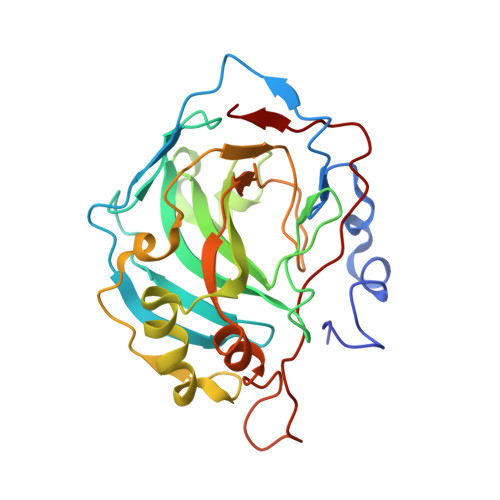
1G6V | pdb_00001g6v

Complex of the camelid heavy-chain antibody fragment CAB-CA05 with bovine carbonic anhydrase


Experimental Data Snapshot

  • Method: X-RAY DIFFRACTION
  • Resolution: 3.50 Å
  • R-Value Free: 
    0.276 (Depositor), 0.263 (DCC) 
  • R-Value Work: 
    0.210 (Depositor), 0.207 (DCC) 
  • R-Value Observed: 
    0.210 (Depositor) 

Starting Models: experimental
View more details

wwPDB Validation 3D Report Full Report

Validation slider image for 1G6V

This is version 1.4 of the entry. See complete history

Literature

Antigen specificity and high affinity binding provided by one single loop of a camel single-domain antibody.

Desmyter, A.Decanniere, K.Muyldermans, S.Wyns, L.

(2001) J Biological Chem 276: 26285-26290

  • DOI: https://doi.org/10.1074/jbc.M102107200
  • Primary Citation Related Structures: 
    1G6V

  • PubMed Abstract: 

    Detailed knowledge on antibody-antigen recognition is scarce given the unlimited antibody specificities of which only few have been investigated at an atomic level. We report the crystal structures of an antibody fragment derived from a camel heavy chain antibody against carbonic anhydrase, free and in complex with antigen. Surprisingly, this single-domain antibody interacts with nanomolar affinity with the antigen through its third hypervariable loop (19 amino acids long), providing a flat interacting surface of 620 A(2). For the first time, a single-domain antibody is observed with its first hypervariable loop adopting a type-1 canonical structure. The second hypervariable loop, of unique size due to a somatic mutation, reveals a regular beta-turn. The third hypervariable loop covers the remaining hypervariable loops and the side of the domain that normally interacts with the variable domain of the light chain. Specific amino acid substitutions and reoriented side chains reshape this side of the domain and increase its hydrophilicity. Of interest is the substitution of the conserved Trp-103 by Arg because it opens new perspectives to 'humanize' a camel variable domain of heavy chain of heavy chain antibody (VHH) or to 'camelize' a human or a mouse variable domain of heavy chain of conventional antibody (VH).


  • Organizational Affiliation
    • Department Ultrastructure, Vlaams Interuniversitair Instituut voor Biotechnologie, Vrije Universiteit Brussel, Paardenstraat 65, B-1640 Sint Genesius Rode, Belgium. aldesmtr@vub.ac.be

Macromolecule Content 

  • Total Structure Weight: 42.89 kDa 
  • Atom Count: 2,989 
  • Modeled Residue Count: 382 
  • Deposited Residue Count: 386 
  • Unique protein chains: 2

Macromolecules

Find similar proteins by:|  3D Structure
Entity ID: 1
MoleculeChains  Sequence LengthOrganismDetailsImage
CARBONIC ANHYDRASE260Bos taurusMutation(s): 0 
EC: 4.2.1.1 (PDB Primary Data), 4.2.1.69 (UniProt)
UniProt
Find proteins for P00921 (Bos taurus)
Explore P00921 
Go to UniProtKB:  P00921
Entity Groups
Sequence Clusters30% Identity50% Identity70% Identity90% Identity95% Identity100% Identity
UniProt GroupP00921
Sequence Annotations
Expand
Reference Sequence
Find similar proteins by:|  3D Structure
Entity ID: 2
MoleculeChains  Sequence LengthOrganismDetailsImage
ANTIBODY HEAVY CHAINB [auth K]126Camelus dromedariusMutation(s): 0 

Small Molecules

Ligands 1 Unique
IDChains Name / Formula / InChI Key2D Diagram3D Interactions
ZN

Query on ZN


Download:Ideal Coordinates CCD File
C [auth A]ZINC ION
Zn
PTFCDOFLOPIGGS-UHFFFAOYSA-N

Experimental Data & Validation

Experimental Data

  • Method: X-RAY DIFFRACTION
  • Resolution: 3.50 Å
  • R-Value Free:  0.276 (Depositor), 0.263 (DCC) 
  • R-Value Work:  0.210 (Depositor), 0.207 (DCC) 
  • R-Value Observed: 0.210 (Depositor) 
Space Group: P 41 21 2
Unit Cell:
Length ( Å )Angle ( ˚ )
a = 83.86α = 90
b = 83.86β = 90
c = 224.05γ = 90
Software Package:
Software NamePurpose
DENZOdata reduction
SCALAdata scaling
AMoREphasing
CNSrefinement
CCP4data scaling

Structure Validation

View Full Validation Report


Entry History 

Deposition Data

Revision History  (Full details and data files)

  • Version 1.0: 2000-11-22
    Type: Initial release
  • Version 1.1: 2008-04-27
    Changes: Version format compliance
  • Version 1.2: 2011-07-13
    Changes: Version format compliance
  • Version 1.3: 2023-08-09
    Changes: Data collection, Database references, Derived calculations, Refinement description
  • Version 1.4: 2024-11-13
    Changes: Structure summary