1FIW | pdb_00001fiw

THREE-DIMENSIONAL STRUCTURE OF BETA-ACROSIN FROM RAM SPERMATOZOA


Experimental Data Snapshot

  • Method: X-RAY DIFFRACTION
  • Resolution: 2.10 Å
  • R-Value Free: 
    0.242 (Depositor), 0.240 (DCC) 
  • R-Value Work: 
    0.197 (Depositor), 0.195 (DCC) 
  • R-Value Observed: 
    0.200 (Depositor) 

wwPDB Validation 3D Report Full Report

Validation slider image for 1FIW

This is version 2.1 of the entry. See complete history

Literature

Effector sites in the three-dimensional structure of mammalian sperm beta-acrosin.

Tranter, R.Read, J.A.Jones, R.Brady, R.L.

(2000) Structure 8: 1179-1188

  • DOI: https://doi.org/10.1016/s0969-2126(00)00523-2
  • Primary Citation Related Structures: 
    1FIW, 1FIZ

  • PubMed Abstract: 

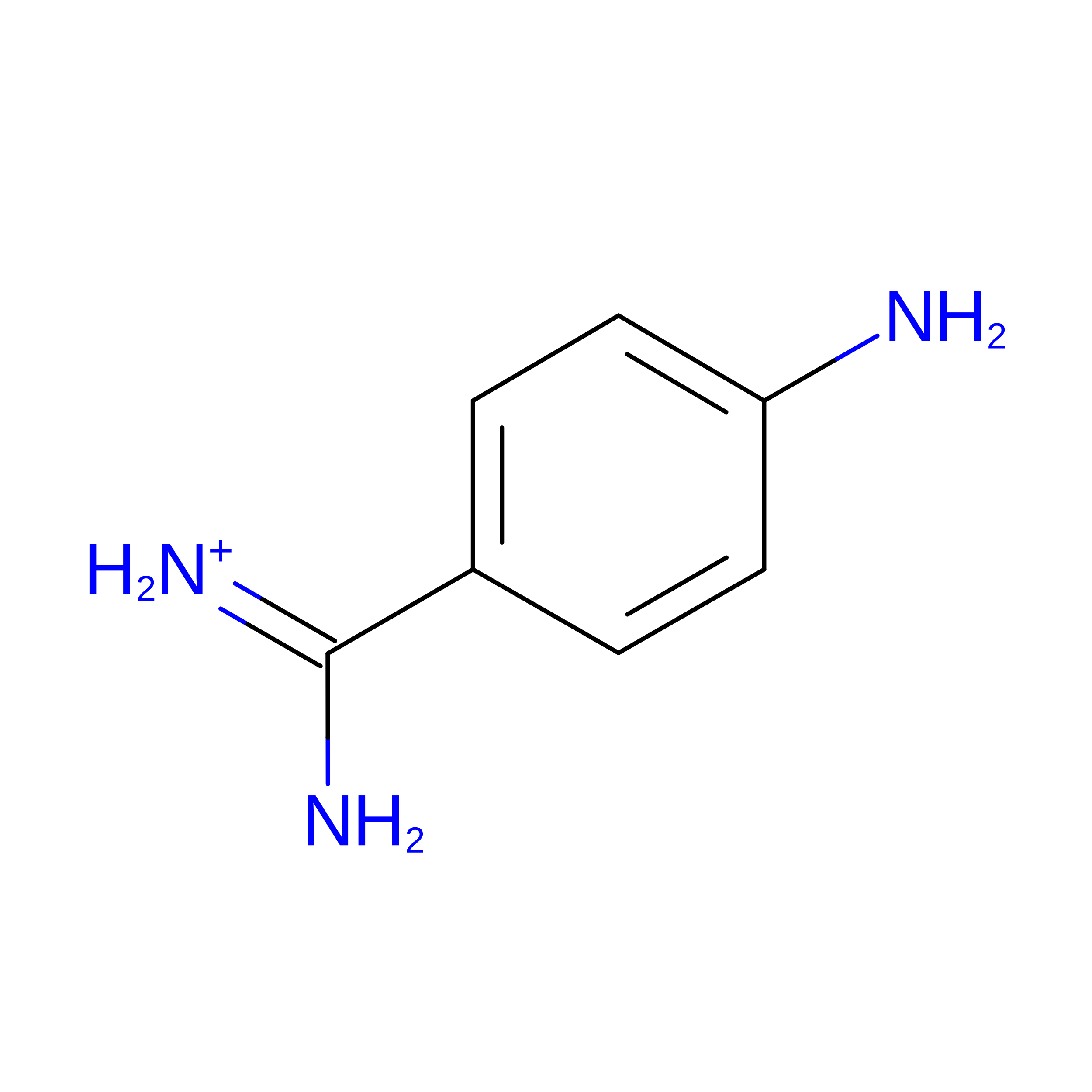
    Proacrosin is a serine protease found specifically within the acrosomal vesicle of all mammalian spermatozoa. During fertilization proacrosin autoactivates to form beta-acrosin, in which there is a "light" chain cross-linked to a "heavy" chain by two disulphide bonds. beta-acrosin is thought to be multifunctional with roles in acrosomal exocytosis, as a receptor for zona pellucida proteins, and as a protease to facilitate penetration of spermatozoa into the egg. The crystal structures of both ram and boar beta-acrosins have been solved in complex with p-aminobenzamidine to 2.1 A and 2.9 A resolution, respectively. Both enzymes comprise a heavy chain with structural homology to trypsin, and a light chain covalently associated in a similar manner to blood coagulation enzymes. In crystals of boar beta-acrosin, the carboxyl terminus of the heavy chain is inserted into the active site of the neighboring molecule. In both enzyme structures, there are distinctive positively charged surface "patches" close to the active site, which associate with carbohydrate from adjacent molecules and also bind sulfate ions. From the three-dimensional structure of beta-acrosin, two separate effector sites are evident. First, proteolytic activity, believed to be important at various stages during fertilization, arises from the trypsin-like active site. Activity of this site may be autoregulated through intermolecular associations. Second, positively charged regions on the surface adjacent to the active site may act as receptors for binding zona pellucida glycoproteins. The spatial proximity of these two effector sites suggests there may be synergy between them.


  • Organizational Affiliation
    • Department of Biochemistry University of Bristol BS8 1TD, Bristol, United Kingdom.

Macromolecule Content 

  • Total Structure Weight: 35.61 kDa 
  • Atom Count: 2,409 
  • Modeled Residue Count: 274 
  • Deposited Residue Count: 312 
  • Unique protein chains: 2

Macromolecules

Find similar proteins by:|  3D Structure
Entity ID: 1
MoleculeChains  Sequence LengthOrganismDetailsImage
BETA-ACROSIN HEAVY CHAIN290Ovis ariesMutation(s): 0 
EC: 3.4.21.10
UniProt
Find proteins for Q9GL10 (Ovis aries)
Explore Q9GL10 
Go to UniProtKB:  Q9GL10
Entity Groups
Sequence Clusters30% Identity50% Identity70% Identity90% Identity95% Identity100% Identity
UniProt GroupQ9GL10
Glycosylation
Glycosylation Sites: 1
Sequence Annotations
Expand
Reference Sequence
Find similar proteins by:  Sequence   |   3D Structure  
Entity ID: 2
MoleculeChains  Sequence LengthOrganismDetailsImage
BETA-ACROSIN LIGHT CHAINB [auth L]22Ovis ariesMutation(s): 0 
EC: 3.4.21.10
UniProt
Find proteins for Q9GL10 (Ovis aries)
Explore Q9GL10 
Go to UniProtKB:  Q9GL10
Entity Groups
Sequence Clusters30% Identity50% Identity70% Identity90% Identity95% Identity100% Identity
UniProt GroupQ9GL10
Sequence Annotations
Expand
Reference Sequence

Oligosaccharides

Help  
Entity ID: 3
MoleculeChains Length2D Diagram GlycosylationD Interactions
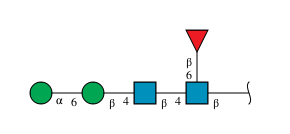
alpha-D-mannopyranose-(1-6)-beta-D-mannopyranose-(1-4)-2-acetamido-2-deoxy-beta-D-glucopyranose-(1-4)-[beta-L-fucopyranose-(1-6)]2-acetamido-2-deoxy-beta-D-glucopyranoseC [auth B]5N-Glycosylation
Glycosylation Resources
GlyTouCan: G27690IM
GlyCosmos: G27690IM
GlyGen: G27690IM

Experimental Data & Validation

Experimental Data

  • Method: X-RAY DIFFRACTION
  • Resolution: 2.10 Å
  • R-Value Free:  0.242 (Depositor), 0.240 (DCC) 
  • R-Value Work:  0.197 (Depositor), 0.195 (DCC) 
  • R-Value Observed: 0.200 (Depositor) 
Space Group: P 65 2 2
Unit Cell:
Length ( Å )Angle ( ˚ )
a = 105.288α = 90
b = 105.288β = 90
c = 120.835γ = 120
Software Package:
Software NamePurpose
DENZOdata reduction
SCALEPACKdata scaling
AMoREphasing
REFMACrefinement

Structure Validation

View Full Validation Report


Entry History 

Deposition Data

Revision History  (Full details and data files)

  • Version 1.0: 2000-11-08
    Type: Initial release
  • Version 1.1: 2008-04-27
    Changes: Version format compliance
  • Version 1.2: 2011-07-13
    Changes: Non-polymer description, Version format compliance
  • Version 1.3: 2018-01-31
    Changes: Advisory, Experimental preparation
  • Version 2.0: 2020-07-29
    Type: Remediation
    Reason: Carbohydrate remediation
    Changes: Advisory, Atomic model, Data collection, Derived calculations, Structure summary
  • Version 2.1: 2024-10-09
    Changes: Advisory, Data collection, Database references, Structure summary