1EPU | pdb_00001epu

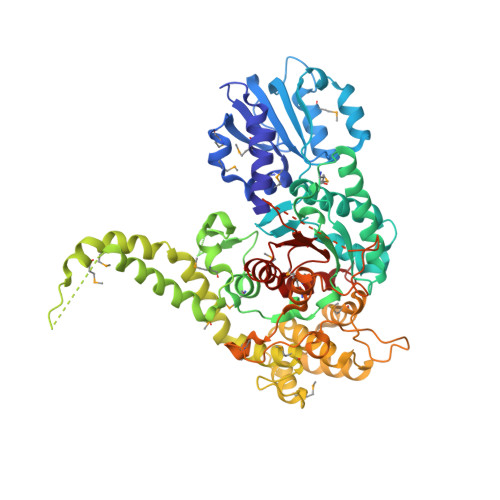
X-RAY crystal structure of neuronal SEC1 from squid


Experimental Data Snapshot

  • Method: X-RAY DIFFRACTION
  • Resolution: 2.40 Å
  • R-Value Free: 
    0.277 (Depositor), 0.277 (DCC) 
  • R-Value Work: 
    0.240 (Depositor), 0.240 (DCC) 
  • R-Value Observed: 
    0.251 (Depositor) 

wwPDB Validation 3D Report Full Report

Validation slider image for 1EPU

This is version 1.5 of the entry. See complete history. 

Literature

The X-ray crystal structure of neuronal Sec1 from squid sheds new light on the role of this protein in exocytosis.

Bracher, A., Perrakis, A., Dresbach, T., Betz, H., Weissenhorn, W.

(2000) Structure 8: 685-694

  • DOI: https://doi.org/10.1016/s0969-2126(00)00156-8
  • Primary Citation Related Structures: 
    1EPU

  • PubMed Abstract: 

    Sec1-like molecules have been implicated in a variety of eukaryotic vesicle transport processes including neurotransmitter release by exocytosis. They regulate vesicle transport by binding to a t-SNARE from the syntaxin family. This process is thought to prevent SNARE complex formation, a protein complex required for membrane fusion. Whereas Sec1 molecules are essential for neurotransmitter release and other secretory events, their interaction with syntaxin molecules seems to represent a negative regulatory step in secretion. Here we report the X-ray crystal structure of a neuronal Sec1 homologue from squid, s-Sec1, at 2.4 A resolution. Neuronal s-Sec1 is a modular protein that folds into a V-shaped three-domain assembly. Peptide and mutagenesis studies are discussed with respect to the mechanism of Sec1 regulation. Comparison of the structure of squid s-Sec1 with the previously determined structure of rat neuronal Sec1 (n-Sec1) bound to syntaxin-1a indicates conformational rearrangements in domain III induced by syntaxin binding. The crystal structure of s-Sec1 provides the molecular scaffold for a number of molecular interactions that have been reported to affect Sec1 function. The structural differences observed between s-Sec1 and the structure of a rat n-Sec1-syntaxin-1a complex suggest that local conformational changes are sufficient to release syntaxin-1a from neuronal Sec1, an active process that is thought to involve additional effector molecule(s).


  • Organizational Affiliation: 
    • European Molecular Biology Laboratory (EMBL), Grenoble, 38000, France.

Macromolecule Content 

  • Total Structure Weight: 68.82 kDa 
  • Atom Count: 4,481 
  • Modeled Residue Count: 546 
  • Deposited Residue Count: 591 
  • Unique protein chains: 1

Macromolecules

Find similar proteins by:|  3D Structure
Entity ID: 1
MoleculeChains  Sequence LengthOrganismDetailsImage
S-SEC1591Doryteuthis pealeiiMutation(s): 0 
UniProt
Find proteins for O62547 (Doryteuthis pealeii)
Explore O62547 
Go to UniProtKB:  O62547
Entity Groups
Sequence Clusters30% Identity50% Identity70% Identity90% Identity95% Identity100% Identity
UniProt GroupO62547
Sequence Annotations
Expand
Reference Sequence

Small Molecules

Modified Residues  1 Unique
IDChains TypeFormula2D DiagramParent
MSE
Query on MSE
A
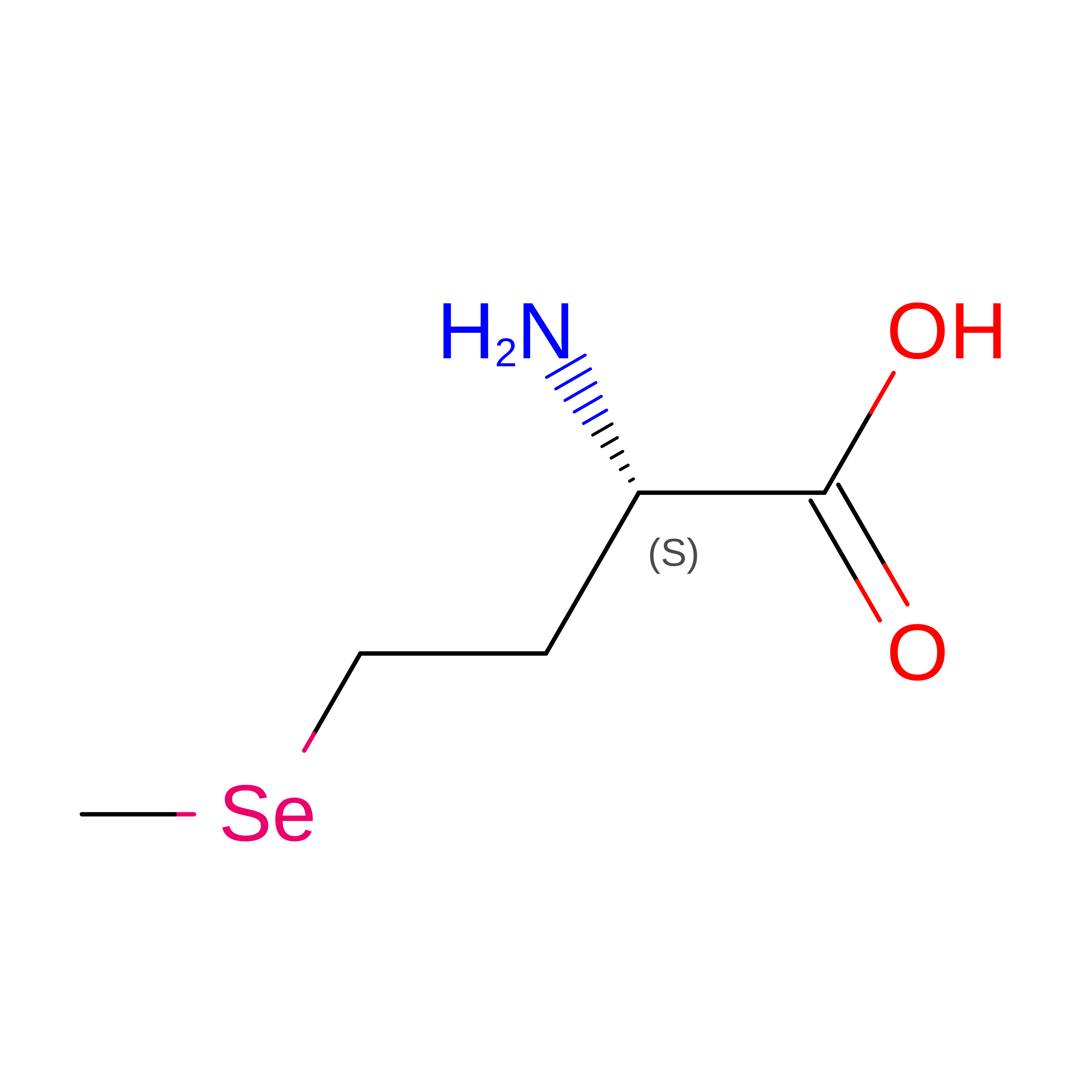
L-PEPTIDE LINKINGC5 H11 N O2 SeMET

Experimental Data & Validation

Experimental Data

  • Method: X-RAY DIFFRACTION
  • Resolution: 2.40 Å
  • R-Value Free:  0.277 (Depositor), 0.277 (DCC) 
  • R-Value Work:  0.240 (Depositor), 0.240 (DCC) 
  • R-Value Observed: 0.251 (Depositor) 
Space Group: P 1 21 1
Unit Cell:
Length ( Å )Angle ( ˚ )
a = 49.063α = 90
b = 121.989β = 104.53
c = 69.046γ = 90
Software Package:
Software NamePurpose
SnBphasing
SHARPphasing
DMMultimodel building
CNSrefinement
DENZOdata reduction
SCALEPACKdata scaling
DMMultiphasing

Structure Validation

View Full Validation Report


Entry History 

Deposition Data

Revision History  (Full details and data files)

  • Version 1.0: 2000-08-09
    Type: Initial release
  • Version 1.1: 2008-04-27
    Changes: Version format compliance
  • Version 1.2: 2011-07-13
    Changes: Version format compliance
  • Version 1.3: 2011-07-27
    Changes: Atomic model, Data collection
  • Version 1.4: 2017-10-04
    Changes: Refinement description
  • Version 1.5: 2024-10-30
    Changes: Data collection, Database references, Derived calculations, Structure summary