1ECE | pdb_00001ece

ACIDOTHERMUS CELLULOLYTICUS ENDOCELLULASE E1 CATALYTIC DOMAIN IN COMPLEX WITH A CELLOTETRAOSE


Experimental Data Snapshot

  • Method: X-RAY DIFFRACTION
  • Resolution: 2.40 Å
  • R-Value Free: 
    0.236 (Depositor), 0.222 (DCC) 
  • R-Value Work: 
    0.179 (Depositor), 0.175 (DCC) 
  • R-Value Observed: 
    0.179 (Depositor) 

wwPDB Validation 3D Report Full Report

Validation slider image for 1ECE

This is version 2.1 of the entry. See complete history

Literature

Crystal structure of thermostable family 5 endocellulase E1 from Acidothermus cellulolyticus in complex with cellotetraose.

Sakon, J.Adney, W.S.Himmel, M.E.Thomas, S.R.Karplus, P.A.

(1996) Biochemistry 35: 10648-10660

  • DOI: https://doi.org/10.1021/bi9604439
  • Primary Citation Related Structures: 
    1ECE

  • PubMed Abstract: 

    The crystal structure of the catalytic domain of the thermostable endocellulase E1 from Acidothermus cellulolyticus in complex with cellotetraose has been solved by multiple isomorphous replacement and refined at 2.4 A resolution to an R-factor of 0.18 (Rfree = 0.24). E1cd is a member of the 4/7 superfamily of hydrolases, and as expected, its structure is an (alpha/beta)8 barrel, which constitutes a prototype for family 5-subfamily 1 cellulases. The cellotetraose molecule binds in a manner consistent with the expected Michaelis complex for the glycosylation half-reaction and reveals that all eight residues conserved in family 5 enzymes are involved in recognition of the glycosyl group attacked during cleavage. Whereas only three residues are conserved in the whole 4/7 superfamily (the Asn/Glu duo and the Glu from which the name is derived), structural comparisons show that all eight residues conserved in family 5 have functional equivalents in the other 4/7 superfamily members, strengthening the case that mechanistic details are conserved throughout the superfamily. On the basis of the structure, a detailed sequence of physical steps of the cleavage mechanism is proposed. A close approach of two key glutamate residues provides an elegant mechanism for the shift in the pKa of the acid/base for the glycosylation and deglycosylation half-reactions. Finally, purely structural based comparisons are used to show that significant differences exist in structural similarity scores resulting from different methods and suggest that caution should be exercised in interpreting such results in terms of implied evolutional relationships.


  • Organizational Affiliation
    • Section of Biochemistry, Molecular and Cell Biology, Cornell University, Ithaca, New York 14853, USA.

Macromolecule Content 

  • Total Structure Weight: 81.86 kDa 
  • Atom Count: 6,167 
  • Modeled Residue Count: 716 
  • Deposited Residue Count: 716 
  • Unique protein chains: 1

Macromolecules

Find similar proteins by:|  3D Structure
Entity ID: 1
MoleculeChains  Sequence LengthOrganismDetailsImage
ENDOCELLULASE E1
A, B
358Acidothermus cellulolyticusMutation(s): 0 
Gene Names: PVU I FRAGMENT OF A.
EC: 3.2.1.4
UniProt
Find proteins for P54583 (Acidothermus cellulolyticus (strain ATCC 43068 / DSM 8971 / 11B))
Explore P54583 
Go to UniProtKB:  P54583
Entity Groups
Sequence Clusters30% Identity50% Identity70% Identity90% Identity95% Identity100% Identity
UniProt GroupP54583
Sequence Annotations
Expand
Reference Sequence

Oligosaccharides

Help  
Entity ID: 2
MoleculeChains Length2D Diagram GlycosylationD Interactions
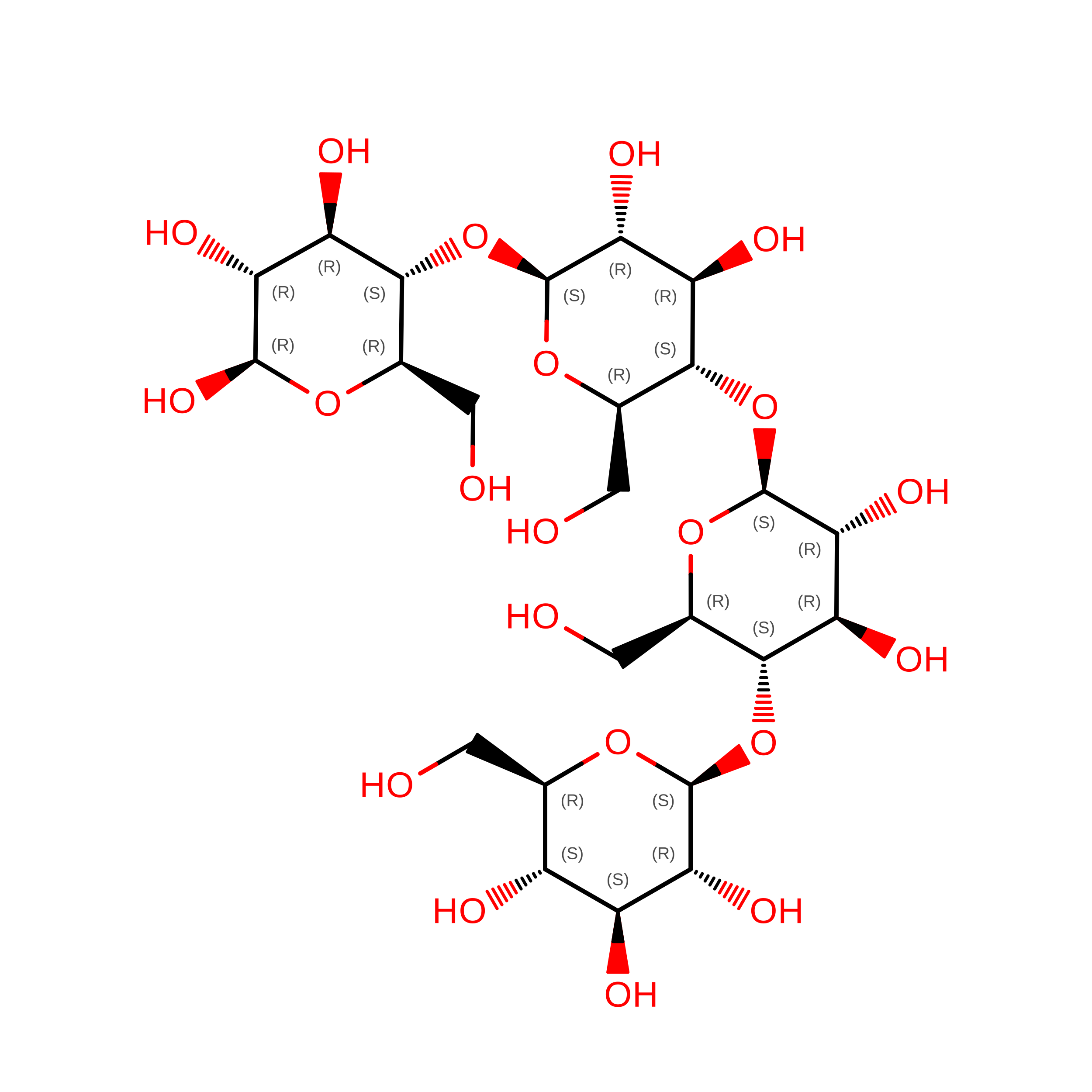
beta-D-glucopyranose-(1-4)-beta-D-glucopyranose-(1-4)-beta-D-glucopyranose-(1-4)-beta-D-glucopyranose
C, D
4N/A
Glycosylation Resources
GlyTouCan: G00025MO
GlyCosmos: G00025MO
GlyGen: G00025MO

Biologically Interesting Molecules (External Reference) 

1 Unique

Experimental Data & Validation

Experimental Data

  • Method: X-RAY DIFFRACTION
  • Resolution: 2.40 Å
  • R-Value Free:  0.236 (Depositor), 0.222 (DCC) 
  • R-Value Work:  0.179 (Depositor), 0.175 (DCC) 
  • R-Value Observed: 0.179 (Depositor) 
Space Group: P 32 2 1
Unit Cell:
Length ( Å )Angle ( ˚ )
a = 97.13α = 90
b = 97.13β = 90
c = 258.71γ = 120
Software Package:
Software NamePurpose
X-PLORmodel building
X-PLORrefinement
X-PLORphasing

Structure Validation

View Full Validation Report


Entry History 

Deposition Data

Revision History  (Full details and data files)

  • Version 1.0: 1996-10-14
    Type: Initial release
  • Version 1.1: 2008-03-24
    Changes: Version format compliance
  • Version 1.2: 2011-07-13
    Changes: Version format compliance
  • Version 2.0: 2020-07-29
    Type: Remediation
    Reason: Carbohydrate remediation
    Changes: Atomic model, Data collection, Derived calculations, Other, Structure summary
  • Version 2.1: 2024-10-16
    Changes: Data collection, Database references, Structure summary