1E87 | pdb_00001e87

Human CD69 - trigonal form


Experimental Data Snapshot

  • Method: X-RAY DIFFRACTION
  • Resolution: 1.50 Å
  • R-Value Free: 
    0.245 (Depositor) 
  • R-Value Work: 
    0.229 (Depositor) 
  • R-Value Observed: 
    0.229 (Depositor) 

Starting Model: experimental
View more details

wwPDB Validation 3D Report Full Report

Validation slider image for 1E87

This is version 1.3 of the entry. See complete history

Literature

Crystal Structure of the C-Type Lectin-Like Domain from the Human Hematopoietic Cell Receptor Cd69

Llera, A.S.Viedma, F.Sanchez-Madrid, F.Tormo, J.

(2001) J Biological Chem 276: 7312

  • DOI: https://doi.org/10.1074/jbc.M008573200
  • Primary Citation Related Structures: 
    1E87, 1E8I

  • PubMed Abstract: 

    CD69, one of the earliest specific antigens acquired during lymphoid activation, acts as a signal-transducing receptor involved in cellular activation events, including proliferation and induction of specific genes. CD69 belongs to a family of receptors that modulate the immune response and whose genes are clustered in the natural killer (NK) gene complex. The extracellular portion of these receptors represent a subfamily of C-type lectin-like domains (CTLDs), which are divergent from true C-type lectins and are referred to as NK-cell domains (NKDs). We have determined the three-dimensional structure of human CD69 NKD in two different crystal forms. CD69 NKD adopts the canonical CTLD fold but lacks the features involved in Ca(2+) and carbohydrate binding by C-type lectins. CD69 NKD dimerizes noncovalently, both in solution and in crystalline state. The dimer interface consists of a hydrophobic, loosely packed core, surrounded by polar interactions, including an interdomain beta sheet. The intersubunit core shows certain structural plasticity that may facilitate conformational rearrangements for binding to ligands. The surface equivalent to the binding site of other members of the CTLD superfamily reveals a hydrophobic patch surrounded by conserved charged residues that probably constitutes the CD69 ligand-binding site.


  • Organizational Affiliation
    • Department of Macromolecular Structure, Centro Nacional de Biotecnologia, Universidad Autónoma de Madrid, 28049 Madrid, Spain.

Macromolecule Content 

  • Total Structure Weight: 13.96 kDa 
  • Atom Count: 1,143 
  • Modeled Residue Count: 117 
  • Deposited Residue Count: 118 
  • Unique protein chains: 1

Macromolecules

Find similar proteins by:|  3D Structure
Entity ID: 1
MoleculeChains  Sequence LengthOrganismDetailsImage
EARLY ACTIVATION ANTIGEN CD69118Homo sapiensMutation(s): 0 
UniProt & NIH Common Fund Data Resources
Find proteins for Q07108 (Homo sapiens)
Explore Q07108 
Go to UniProtKB:  Q07108
PHAROS:  Q07108
GTEx:  ENSG00000110848 
Entity Groups
Sequence Clusters30% Identity50% Identity70% Identity90% Identity95% Identity100% Identity
UniProt GroupQ07108
Sequence Annotations
Expand
Reference Sequence

Small Molecules

Ligands 2 Unique
IDChains Name / Formula / InChI Key2D Diagram3D Interactions
GOL

Query on GOL


Download:Ideal Coordinates CCD File
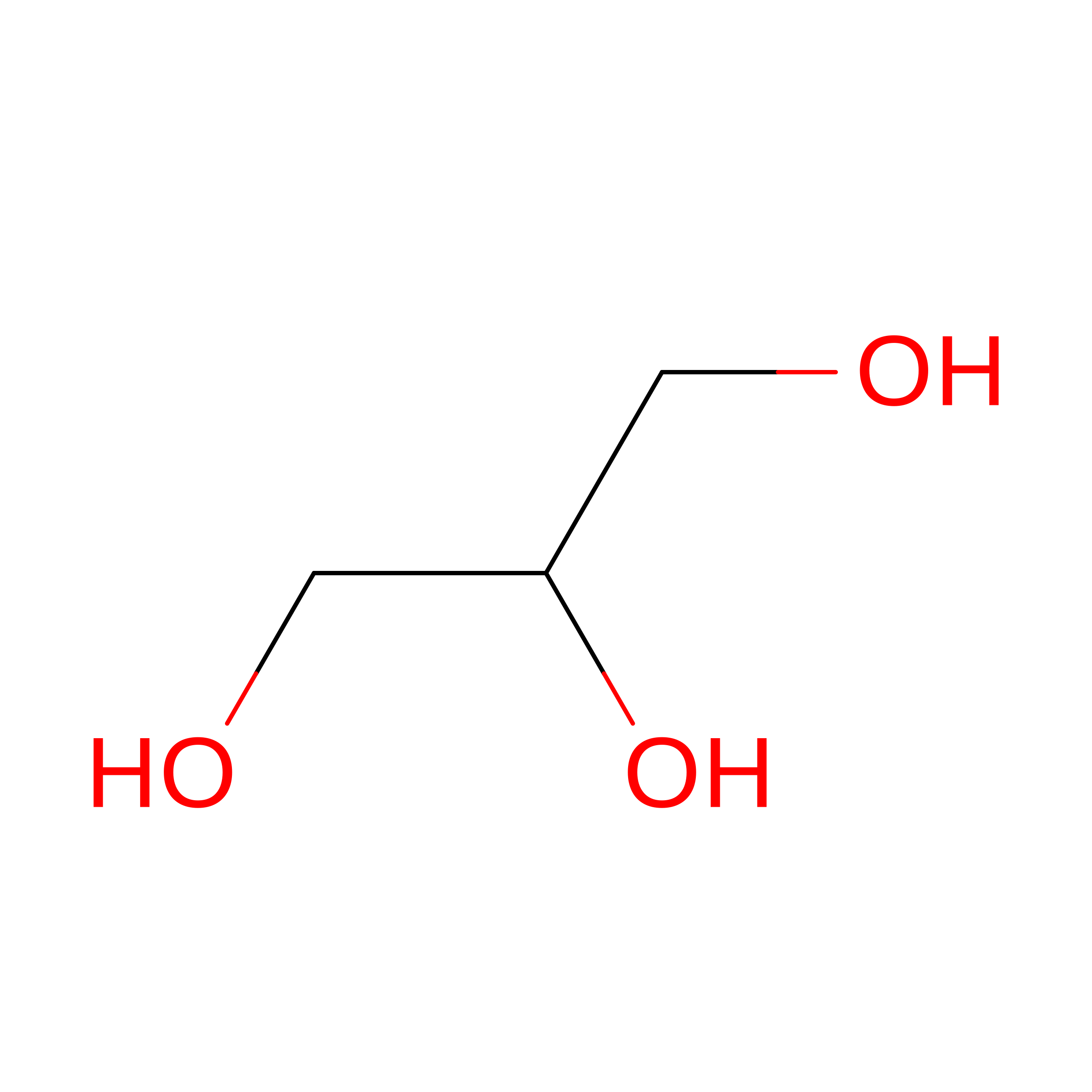
C [auth A]GLYCEROL
C3 H8 O3
PEDCQBHIVMGVHV-UHFFFAOYSA-N
ZN

Query on ZN


Download:Ideal Coordinates CCD File
B [auth A]ZINC ION
Zn
PTFCDOFLOPIGGS-UHFFFAOYSA-N

Experimental Data & Validation

Experimental Data

  • Method: X-RAY DIFFRACTION
  • Resolution: 1.50 Å
  • R-Value Free:  0.245 (Depositor) 
  • R-Value Work:  0.229 (Depositor) 
  • R-Value Observed: 0.229 (Depositor) 
Space Group: P 31 2 1
Unit Cell:
Length ( Å )Angle ( ˚ )
a = 48.424α = 90
b = 48.424β = 90
c = 119.886γ = 120
Software Package:
Software NamePurpose
CNSrefinement
DENZOdata reduction
SCALEPACKdata scaling
CNSphasing

Structure Validation

View Full Validation Report


Entry History 

Deposition Data

  • Released Date: 2000-09-26 
  • Deposition Author(s): Tormo, J.

Revision History  (Full details and data files)

  • Version 1.0: 2000-09-26
    Type: Initial release
  • Version 1.1: 2011-08-24
    Changes: Derived calculations, Non-polymer description, Other, Refinement description, Structure summary, Version format compliance
  • Version 1.2: 2023-12-13
    Changes: Data collection, Database references, Derived calculations, Other, Refinement description
  • Version 1.3: 2024-10-09
    Changes: Structure summary