1DIT | pdb_00001dit

COMPLEX OF A DIVALENT INHIBITOR WITH THROMBIN


Experimental Data Snapshot

  • Method: X-RAY DIFFRACTION
  • Resolution: 2.30 Å

wwPDB Validation 3D Report Full Report

Validation slider image for 1DIT

This is version 2.0 of the entry. See complete history

Literature

Synthesis, structure, and structure-activity relationships of divalent thrombin inhibitors containing an alpha-keto-amide transition-state mimetic.

Krishnan, R.Tulinsky, A.Vlasuk, G.P.Pearson, D.Vallar, P.Bergum, P.Brunck, T.K.Ripka, W.C.

(1996) Protein Sci 5: 422-433

  • DOI: https://doi.org/10.1002/pro.5560050303
  • Primary Citation Related Structures: 
    1DIT

  • PubMed Abstract: 

    A new class of divalent thrombin inhibitors is described that contains an alpha-keto-amide transition-state mimetic linking an active site binding group and a group that binds to the fibrinogen-binding exosite. The X-ray crystallographic structure of the most potent member of this new class, CVS995, shows many features in common with other divalent thrombin inhibitors and clearly defines the transition-state-like binding of the alpha-keto-amide group. The structure of the active site part of the inhibitor shows a network of water molecules connecting both the side-chain and backbone atoms of thrombin and the inhibitor. Direct peptide analogues of the new transition-state-containing divalent thrombin inhibitors were compared using in vitro assays of thrombin inhibition. There was no direct correlation between the binding constants of the peptides and their alpha-keto-amide counterparts. The most potent alpha-keto-amide inhibitor, CVS995, with a Ki = 1 pM, did not correspond to the most potent divalent peptide and contained a single amino acid deletion in the exosite binding region with respect to the equivalent region of the natural thrombin inhibitor hirudin. The interaction energies of the active site, transition state, and exosite binding regions of these new divalent thrombin inhibitors are not additive.


  • Organizational Affiliation
    • Department of Chemistry, Michigan State University, East Lansing 48824-1322, USA.

Macromolecule Content 

  • Total Structure Weight: 36.01 kDa 
  • Atom Count: 2,530 
  • Modeled Residue Count: 296 
  • Deposited Residue Count: 315 
  • Unique protein chains: 3

Macromolecules

Find similar proteins by:|  3D Structure
Entity ID: 1
MoleculeChains  Sequence LengthOrganismDetailsImage
ALPHA-THROMBINA [auth L]36Homo sapiensMutation(s): 0 
EC: 3.4.21.5
UniProt & NIH Common Fund Data Resources
Find proteins for P00734 (Homo sapiens)
Explore P00734 
Go to UniProtKB:  P00734
PHAROS:  P00734
GTEx:  ENSG00000180210 
Entity Groups
Sequence Clusters30% Identity50% Identity70% Identity90% Identity95% Identity100% Identity
UniProt GroupP00734
Sequence Annotations
Expand
Reference Sequence
Find similar proteins by:|  3D Structure
Entity ID: 2
MoleculeChains  Sequence LengthOrganismDetailsImage
ALPHA-THROMBINB [auth H]259Homo sapiensMutation(s): 0 
EC: 3.4.21.5
UniProt & NIH Common Fund Data Resources
Find proteins for P00734 (Homo sapiens)
Explore P00734 
Go to UniProtKB:  P00734
PHAROS:  P00734
GTEx:  ENSG00000180210 
Entity Groups
Sequence Clusters30% Identity50% Identity70% Identity90% Identity95% Identity100% Identity
UniProt GroupP00734
Sequence Annotations
Expand
Reference Sequence
Find similar proteins by:  Sequence   |   3D Structure  
Entity ID: 3
MoleculeChains  Sequence LengthOrganismDetailsImage
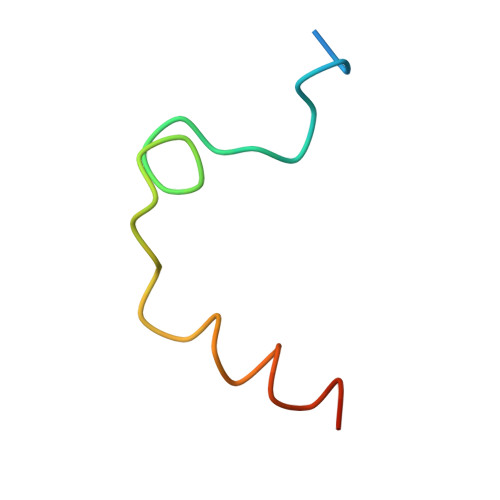
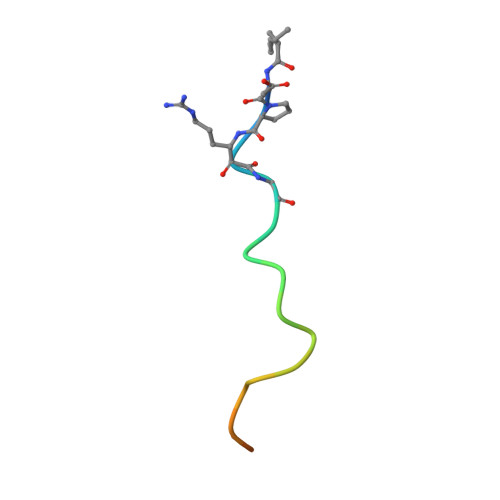
PEPTIDE INHIBITOR CVS995C [auth P]20N/AMutation(s): 0 

Experimental Data & Validation

Experimental Data

  • Method: X-RAY DIFFRACTION
  • Resolution: 2.30 Å
Space Group: C 1 2 1
Unit Cell:
Length ( Å )Angle ( ˚ )
a = 70.9α = 90
b = 72.2β = 100.9
c = 73.2γ = 90
Software Package:
Software NamePurpose
PROLSQrefinement

Structure Validation

View Full Validation Report


Entry History 

Deposition Data

Revision History  (Full details and data files)

  • Version 1.0: 1996-06-10
    Type: Initial release
  • Version 1.1: 2008-03-03
    Changes: Version format compliance
  • Version 1.2: 2011-07-13
    Changes: Atomic model, Database references, Derived calculations, Non-polymer description, Structure summary, Version format compliance
  • Version 2.0: 2023-11-15
    Changes: Atomic model, Data collection, Database references, Derived calculations, Other