Download Mendeley
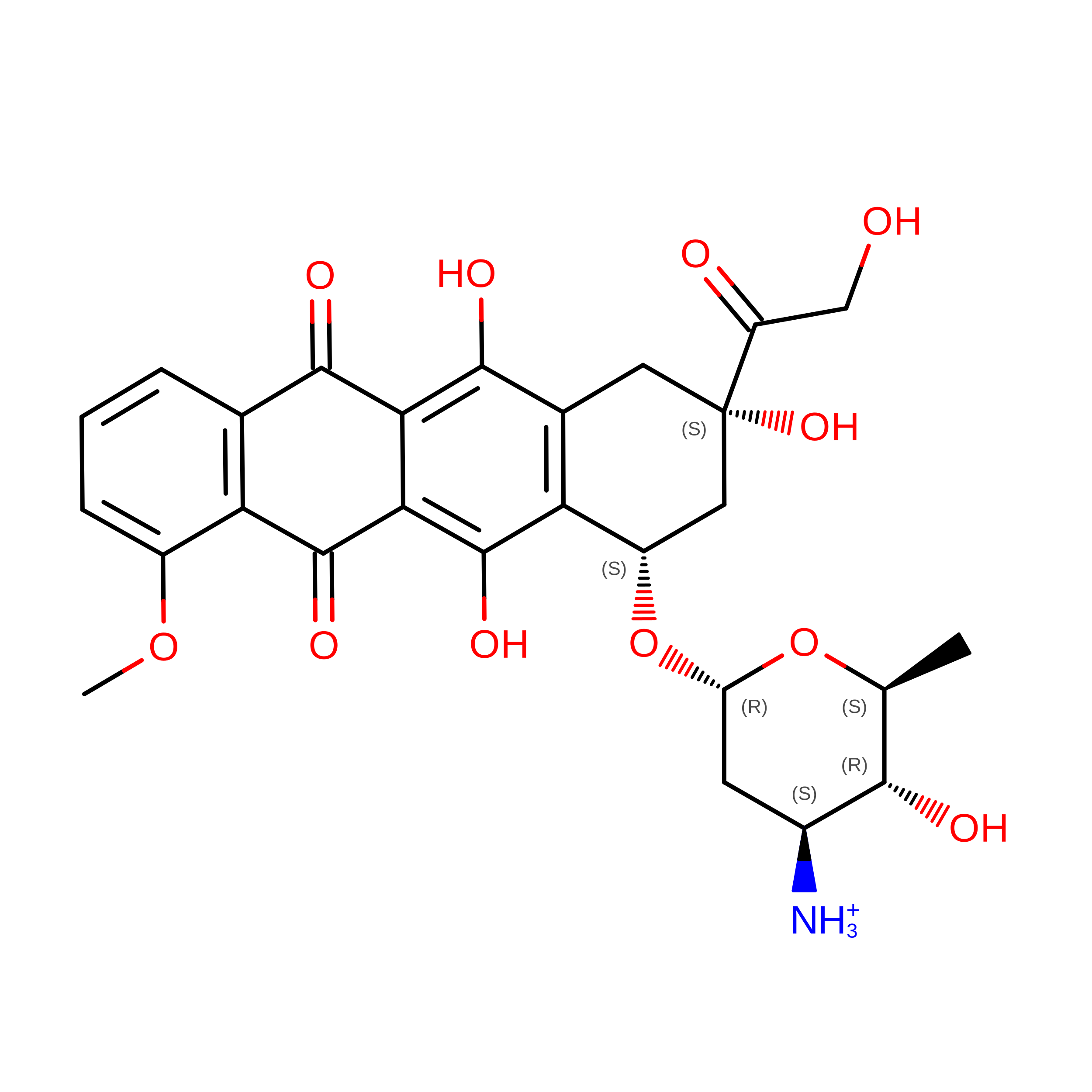
The molecular structure of a 4'-epiadriamycin complex with d(TGATCA) at 1.7A resolution: comparison with the structure of 4'-epiadriamycin d(TGTACA) and d(CGATCG) complexes.
Langlois d'Estaintot, B., Gallois, B., Brown, T., Hunter, W.N.(1992) Nucleic Acids Res 20: 3561-3566
- PubMed: 1641324 Search on PubMedSearch on PubMed Central
- DOI: https://doi.org/10.1093/nar/20.14.3561
- Primary Citation Related Structures:
1D58 - PubMed Abstract:
The structure of the complex between d(TGATCA) and the anthracycline 4'-epiadriamycin has been determined by crystallographic methods. The crystals are tetragonal, space group P4(1)2(1)2 with unit cell dimensions of a = 28.01, c = 52.95A. The asymmetric unit consists of one strand of hexanucleotide, one molecule of 4'-epiadriamycin and 34 waters. The R-factor is 20.2% for 1694 reflections with F greater than or equal to 2 sigma F to 1.7A. Two asymmetric units associate to generate a duplex complexed with two drug molecules at the d(TpG) steps of the duplex. The chromophore intercalates between these base pairs with the anthracycline amino-sugar positioned in the minor groove. The double helix is a distorted B-DNA type structure. Our structure determination of d(TGATCA) complexed to 4'-epiadriamycin allows for comparison with the previously reported structures of 4'-epiadriamycin bound to d(TGTACA) and to d(CGATCG). The three complexes are similar in gross features and the intercalation geometry is the same irrespective of whether a d(CpG) or d(TpG) sequence is involved. However, the orientation of the amino-sugar displays a dependence on the sequence adjacent to the intercalation site. The flexibility of this amino-sugar may help explain why this class of antibiotics displays a relative insensitivity to base sequence when they bind to DNA.
- Laboratoire de Cristallographie, URA CNRS 144, Université de Bordeaux I, Talence, France.
Organizational Affiliation: