Download Mendeley
Novel fold and assembly of the repetitive B region of the Staphylococcus aureus collagen-binding surface protein.
Deivanayagam, C.C., Rich, R.L., Carson, M., Owens, R.T., Danthuluri, S., Bice, T., Hook, M., Narayana, S.V.(2000) Structure 8: 67-78
- PubMed: 10673425 Search on PubMed
- DOI: https://doi.org/10.1016/s0969-2126(00)00081-2
- Primary Citation Related Structures:
1D2O, 1D2P - PubMed Abstract:
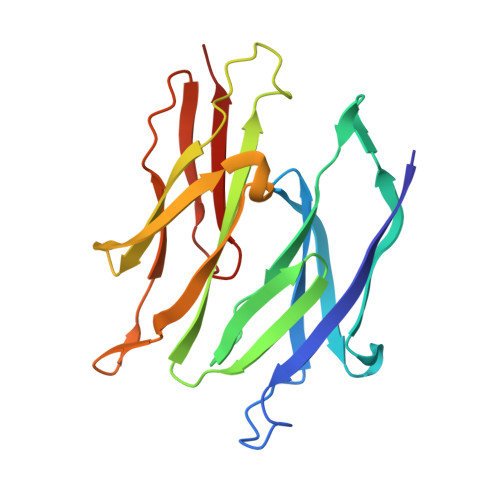
[corrected] The Staphylococcus aureus collagen-binding protein Cna mediates bacterial adherence to collagen. The primary sequence of Cna has a non-repetitive collagen-binding A region, followed by the repetitive B region. The B region has one to four 23 kDa repeat units (B(1)-B(4)), depending on the strain of origin. The affinity of the A region for collagen is independent of the B region. However, the B repeat units have been suggested to serve as a 'stalk' that projects the A region from the bacterial surface and thus facilitate bacterial adherence to collagen. To understand the biological role of these B-region repeats we determined their three-dimensional structure. B(1) has two domains (D(1) and D(2)) placed side-by-side. D(1) and D(2) have similar secondary structure and exhibit a unique fold that resembles but is the inverse of the immunoglobulin-like (IgG-like) domains. Comparison with similar immunoglobulin superfamily (IgSF) structures shows novel packing arrangements between the D(1) and D(2) domains. In the B(1)B(2) crystal structure, an omission of a single glycine residue in the D(2)-D(3) linker loop, compared to the D(1)-D(2) and D(3)-D(4) linker loops, resulted in projection of the D(3) and D(4) in a spatially new orientation. We also present a model for B(1)B(2)B(3)B(4). The B region of the Cna collagen adhesin has a novel fold that is reminiscent of but is inverse in nature to the IgG fold. This B region assembly could effectively provide the needed flexibility and stability for presenting the ligand binding A region away from the bacterial cell surface.
- Center for Macromolecular Crystallography, School of Optometry, University of Alabama at Birmingham, Birmingham, AL 35294-0005, USA.
Organizational Affiliation: