1CM0 | pdb_00001cm0

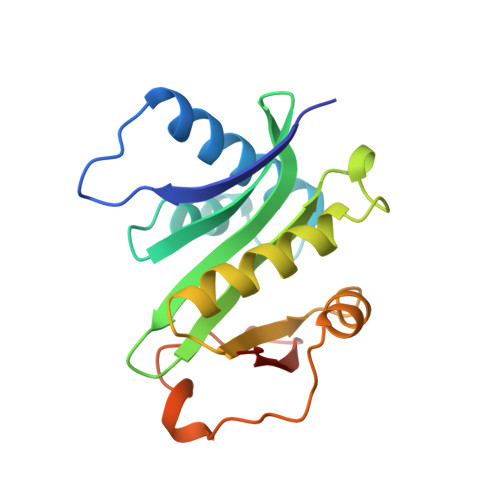
CRYSTAL STRUCTURE OF THE PCAF/COENZYME-A COMPLEX


Experimental Data Snapshot

  • Method: X-RAY DIFFRACTION
  • Resolution: 2.30 Å
  • R-Value Free: 
    0.268 (Depositor) 
  • R-Value Work: 
    0.223 (Depositor) 

Starting Model: experimental
View more details

wwPDB Validation 3D Report Full Report

Validation slider image for 1CM0

This is version 1.4 of the entry. See complete history

Literature

Crystal structure of the histone acetyltransferase domain of the human PCAF transcriptional regulator bound to coenzyme A.

Clements, A.Rojas, J.R.Trievel, R.C.Wang, L.Berger, S.L.Marmorstein, R.

(1999) EMBO J 18: 3521-3532

  • DOI: https://doi.org/10.1093/emboj/18.13.3521
  • Primary Citation Related Structures: 
    1CM0

  • PubMed Abstract: 

    The human p300/CBP-associating factor, PCAF, mediates transcriptional activation through its ability to acetylate nucleosomal histone substrates as well as transcriptional activators such as p53. We have determined the 2.3 A crystal structure of the histone acetyltransferase (HAT) domain of PCAF bound to coenzyme A. The structure reveals a central protein core associated with coenzyme A binding and a pronounced cleft that sits over the protein core and is flanked on opposite sides by the N- and C-terminal protein segments. A correlation of the structure with the extensive mutagenesis data for PCAF and the homologous yeast GCN5 protein implicates the cleft and the N- and C-terminal protein segments as playing an important role in histone substrate binding, and a glutamate residue in the protein core as playing an essential catalytic role. A structural comparison with the coenzyme-bound forms of the related N-acetyltransferases, HAT1 (yeast histone acetyltransferase 1) and SmAAT (Serratia marcescens aminoglycoside 3-N-acetyltransferase), suggests the mode of substrate binding and catalysis by these enzymes and establishes a paradigm for understanding the structure-function relationships of other enzymes that acetylate histones and transcriptional regulators to promote activated transcription.


  • Organizational Affiliation
    • The Wistar Institute, University of Pennsylvania, Philadelphia, PA 19104, USA.

Macromolecule Content 

  • Total Structure Weight: 40.55 kDa 
  • Atom Count: 2,811 
  • Modeled Residue Count: 325 
  • Deposited Residue Count: 336 
  • Unique protein chains: 1

Macromolecules

Find similar proteins by:|  3D Structure
Entity ID: 1
MoleculeChains  Sequence LengthOrganismDetailsImage
P300/CBP ASSOCIATING FACTORA [auth B],
B [auth A]
168Homo sapiensMutation(s): 0 
EC: 2.3.1.57 (UniProt), 2.3.1.48 (UniProt)
UniProt & NIH Common Fund Data Resources
Find proteins for Q92831 (Homo sapiens)
Explore Q92831 
Go to UniProtKB:  Q92831
PHAROS:  Q92831
GTEx:  ENSG00000114166 
Entity Groups
Sequence Clusters30% Identity50% Identity70% Identity90% Identity95% Identity100% Identity
UniProt GroupQ92831
Sequence Annotations
Expand
Reference Sequence

Small Molecules

Ligands 1 Unique
IDChains Name / Formula / InChI Key2D Diagram3D Interactions
COA

Query on COA


Download:Ideal Coordinates CCD File
C [auth B],
D [auth A]
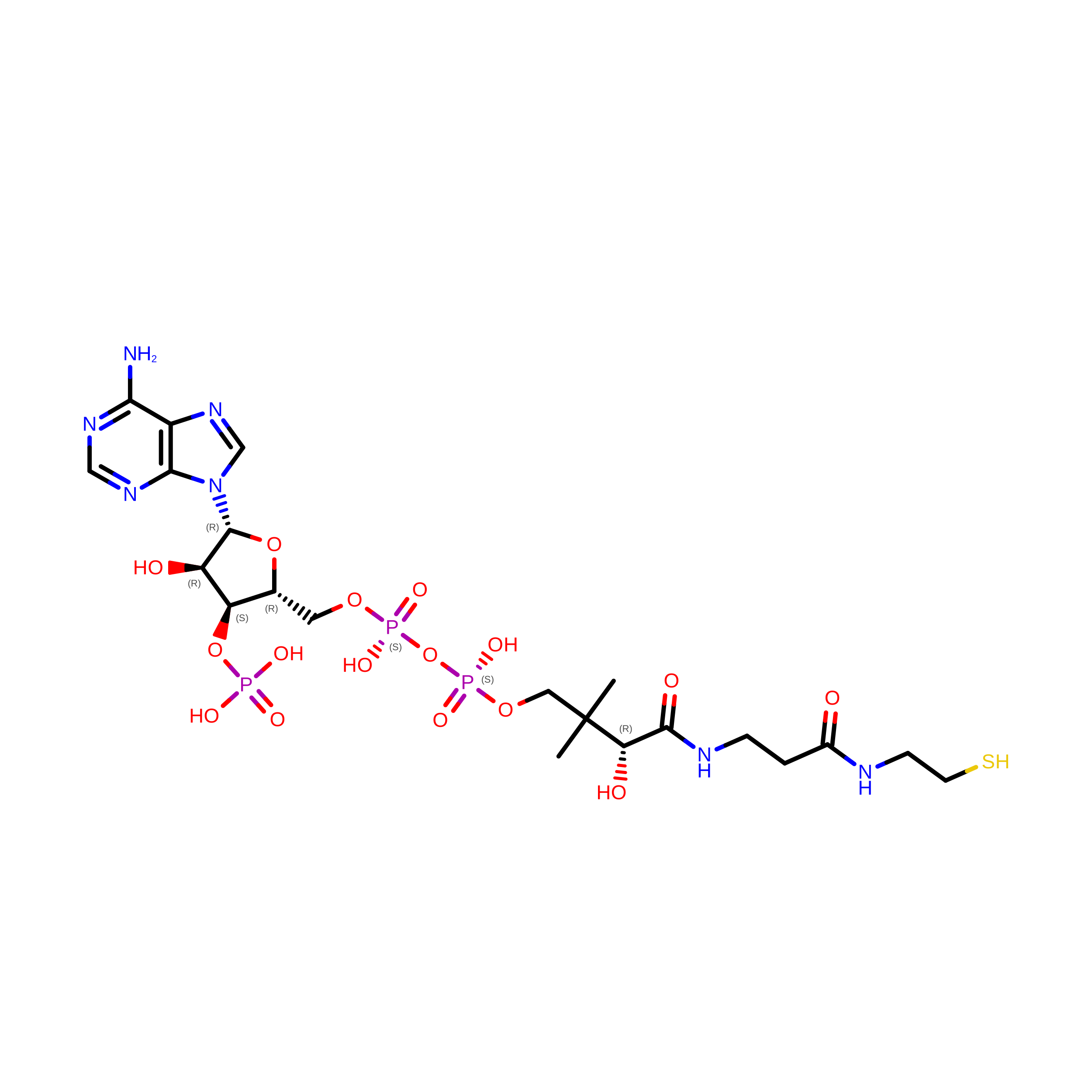
COENZYME A
C21 H36 N7 O16 P3 S
RGJOEKWQDUBAIZ-IBOSZNHHSA-N

Experimental Data & Validation

Experimental Data

  • Method: X-RAY DIFFRACTION
  • Resolution: 2.30 Å
  • R-Value Free:  0.268 (Depositor) 
  • R-Value Work:  0.223 (Depositor) 
Space Group: P 64
Unit Cell:
Length ( Å )Angle ( ˚ )
a = 97α = 90
b = 97β = 90
c = 77.85γ = 120
Software Package:
Software NamePurpose
AMoREphasing
CNSrefinement
DENZOdata reduction
SCALEPACKdata scaling

Structure Validation

View Full Validation Report


Entry History 

Deposition Data

Revision History  (Full details and data files)

  • Version 1.0: 1999-07-06
    Type: Initial release
  • Version 1.1: 2008-04-26
    Changes: Version format compliance
  • Version 1.2: 2011-07-13
    Changes: Version format compliance
  • Version 1.3: 2023-12-27
    Changes: Data collection, Database references, Derived calculations
  • Version 1.4: 2024-04-03
    Changes: Refinement description