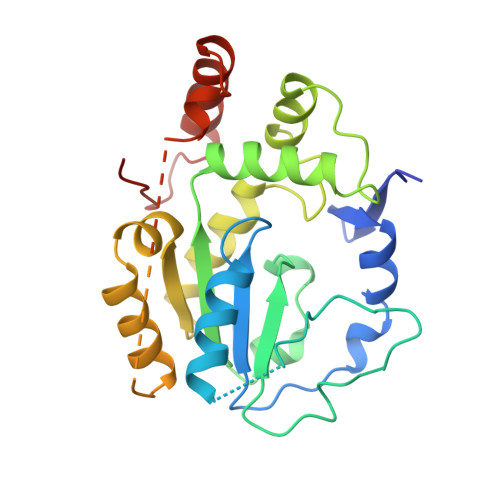
1CJM | pdb_00001cjm

HUMAN SULT1A3 WITH SULFATE BOUND


Experimental Data Snapshot

  • Method: X-RAY DIFFRACTION
  • Resolution: 2.40 Å
  • R-Value Free: 
    0.288 (Depositor), 0.268 (DCC) 
  • R-Value Work: 
    0.276 (Depositor), 0.258 (DCC) 

Starting Model: experimental
View more details

wwPDB Validation 3D Report Full Report

Validation slider image for 1CJM

This is version 1.3 of the entry. See complete history

Literature

Crystal structure of human catecholamine sulfotransferase.

Bidwell, L.M.McManus, M.E.Gaedigk, A.Kakuta, Y.Negishi, M.Pedersen, L.Martin, J.L.

(1999) J Mol Biology 293: 521-530

  • DOI: https://doi.org/10.1006/jmbi.1999.3153
  • Primary Citation Related Structures: 
    1CJM

  • PubMed Abstract: 

    Sulfonation, like phosphorylation, can modify the activity of a variety of biological molecules. The sulfotransferase enzymes sulfonate neurotransmitters, drugs, steroid hormones, dietary carcinogens and proteins. SULT1A3 specifically sulfonates catecholamines such as dopamine, adrenaline and noradrenaline. The crystal structure of SULT1A3 with a sulfate bound at the active site, has been determined at 2.4 A resolution. Although the core alpha/beta fold is like that of estrogen and heparan sulfotransferases, major differences occur in and around the active site. Most notably, several regions surrounding the active site, including a section of 40 residues, are disordered in SULT1A3. Regions that are topologically equivalent to the disordered parts of SULT1A3 are involved in substrate and cofactor binding in estrogen and heparan sulfotransferase. Flexibility in these regions suggests that ligand binding elicits a disorder-order transition in and around the active site of sulfotransferases and might contribute to the broad substrate specificity of these enzymes.


  • Organizational Affiliation
    • Department of Physiology, University of Queensland, Brisbane, Queensland, 4072, Australia.

Macromolecule Content 

  • Total Structure Weight: 34.33 kDa 
  • Atom Count: 1,823 
  • Modeled Residue Count: 223 
  • Deposited Residue Count: 295 
  • Unique protein chains: 1

Macromolecules

Find similar proteins by:|  3D Structure
Entity ID: 1
MoleculeChains  Sequence LengthOrganismDetailsImage
PROTEIN (ARYL SULFOTRANSFERASE)295Homo sapiensMutation(s): 0 
EC: 2.8.2.1
UniProt & NIH Common Fund Data Resources
Find proteins for P0DMM9 (Homo sapiens)
Explore P0DMM9 
Go to UniProtKB:  P0DMM9
PHAROS:  P0DMM9
GTEx:  ENSG00000261052 
Entity Groups
Sequence Clusters30% Identity50% Identity70% Identity90% Identity95% Identity100% Identity
UniProt GroupP0DMM9
Sequence Annotations
Expand
Reference Sequence

Small Molecules

Ligands 1 Unique
IDChains Name / Formula / InChI Key2D Diagram3D Interactions
SO4

Query on SO4


Download:Ideal Coordinates CCD File
B [auth A]SULFATE ION
O4 S
QAOWNCQODCNURD-UHFFFAOYSA-L

Experimental Data & Validation

Experimental Data

  • Method: X-RAY DIFFRACTION
  • Resolution: 2.40 Å
  • R-Value Free:  0.288 (Depositor), 0.268 (DCC) 
  • R-Value Work:  0.276 (Depositor), 0.258 (DCC) 
Space Group: P 32 2 1
Unit Cell:
Length ( Å )Angle ( ˚ )
a = 56.4α = 90
b = 56.4β = 90
c = 191.1γ = 120
Software Package:
Software NamePurpose
X-PLORmodel building
X-PLORrefinement
DENZOdata reduction
SCALEPACKdata scaling
X-PLORphasing

Structure Validation

View Full Validation Report


Entry History 

Deposition Data

Revision History  (Full details and data files)

  • Version 1.0: 1999-11-10
    Type: Initial release
  • Version 1.1: 2008-04-26
    Changes: Version format compliance
  • Version 1.2: 2011-07-13
    Changes: Version format compliance
  • Version 1.3: 2023-08-09
    Changes: Data collection, Database references, Derived calculations, Refinement description