1CC1 | pdb_00001cc1

CRYSTAL STRUCTURE OF A REDUCED, ACTIVE FORM OF THE NI-FE-SE HYDROGENASE FROM DESULFOMICROBIUM BACULATUM


Experimental Data Snapshot

  • Method: X-RAY DIFFRACTION
  • Resolution: 2.15 Å
  • R-Value Free: 
    0.248 (Depositor) 
  • R-Value Work: 
    0.194 (Depositor) 

Starting Model: experimental
View more details

wwPDB Validation 3D Report Full Report

Validation slider image for 1CC1

This is version 1.8 of the entry. See complete history

Literature

The crystal structure of a reduced [NiFeSe] hydrogenase provides an image of the activated catalytic center

Garcin, E.Vernede, X.Hatchikian, E.C.Volbeda, A.Frey, M.Fontecilla-Camps, J.C.

(1999) Structure 7: 557-566

  • DOI: https://doi.org/10.1016/s0969-2126(99)80072-0
  • Primary Citation Related Structures: 
    1CC1

  • PubMed Abstract: 

    [NiFeSe] hydrogenases are metalloenzymes that catalyze the reaction H2<-->2H+ + 2e-. They are generally heterodimeric, contain three iron-sulfur clusters in their small subunit and a nickel-iron-containing active site in their large subunit that includes a selenocysteine (SeCys) ligand. We report here the X-ray structure at 2.15 A resolution of the periplasmic [NiFeSe] hydrogenase from Desulfomicrobium baculatum in its reduced, active form. A comparison of active sites of the oxidized, as-prepared, Desulfovibrio gigas and the reduced D. baculatum hydrogenases shows that in the reduced enzyme the nickel-iron distance is 0.4 A shorter than in the oxidized enzyme. In addition, the putative oxo ligand, detected in the as-prepared D. gigas enzyme, is absent from the D. baculatum hydrogenase. We also observe higher-than-average temperature factors for both the active site nickel-selenocysteine ligand and the neighboring Glu18 residue, suggesting that both these moieties are involved in proton transfer between the active site and the molecular surface. Other differences between [NiFeSe] and [NiFe] hydrogenases are the presence of a third [4Fe4S] cluster replacing the [3Fe4S] cluster found in the D. gigas enzyme, and a putative iron center that substitutes the magnesium ion that has already been described at the C terminus of the large subunit of two [NiFe] hydrogenases. The heterolytic cleavage of molecular hydrogen seems to be mediated by the nickel center and the selenocysteine residue. Beside modifying the catalytic properties of the enzyme, the selenium ligand might protect the nickel atom from oxidation. We conclude that the putative oxo ligand is a signature of inactive 'unready' [NiFe] hydrogenases.


  • Organizational Affiliation
    • Institut de Biologie Structurale JP Ebel, Laboratoire de Cristallographie et Cristallogénèse des Protéines, CEA-CNRS, Grenoble, France.

Macromolecule Content 

  • Total Structure Weight: 87.45 kDa 
  • Atom Count: 6,214 
  • Modeled Residue Count: 762 
  • Deposited Residue Count: 781 
  • Unique protein chains: 2

Macromolecules

Find similar proteins by:|  3D Structure
Entity ID: 1
MoleculeChains  Sequence LengthOrganismDetailsImage
HYDROGENASE (SMALL SUBUNIT)A [auth S]283Desulfomicrobium baculatumMutation(s): 0 
EC: 1.18.99.1 (PDB Primary Data), 1.12.99.6 (UniProt)
UniProt
Find proteins for P13063 (Desulfomicrobium baculatum)
Explore P13063 
Go to UniProtKB:  P13063
Entity Groups
Sequence Clusters30% Identity50% Identity70% Identity90% Identity95% Identity100% Identity
UniProt GroupP13063
Sequence Annotations
Expand
Reference Sequence
Find similar proteins by:|  3D Structure
Entity ID: 2
MoleculeChains  Sequence LengthOrganismDetailsImage
HYDROGENASE (LARGE SUBUNIT)B [auth L]498Desulfomicrobium baculatumMutation(s): 0 
EC: 1.18.99.1 (PDB Primary Data), 1.12.99.6 (UniProt)
UniProt
Find proteins for P13065 (Desulfomicrobium baculatum)
Explore P13065 
Go to UniProtKB:  P13065
Entity Groups
Sequence Clusters30% Identity50% Identity70% Identity90% Identity95% Identity100% Identity
UniProt GroupP13065
Sequence Annotations
Expand
Reference Sequence

Small Molecules

Ligands 5 Unique
IDChains Name / Formula / InChI Key2D Diagram3D Interactions
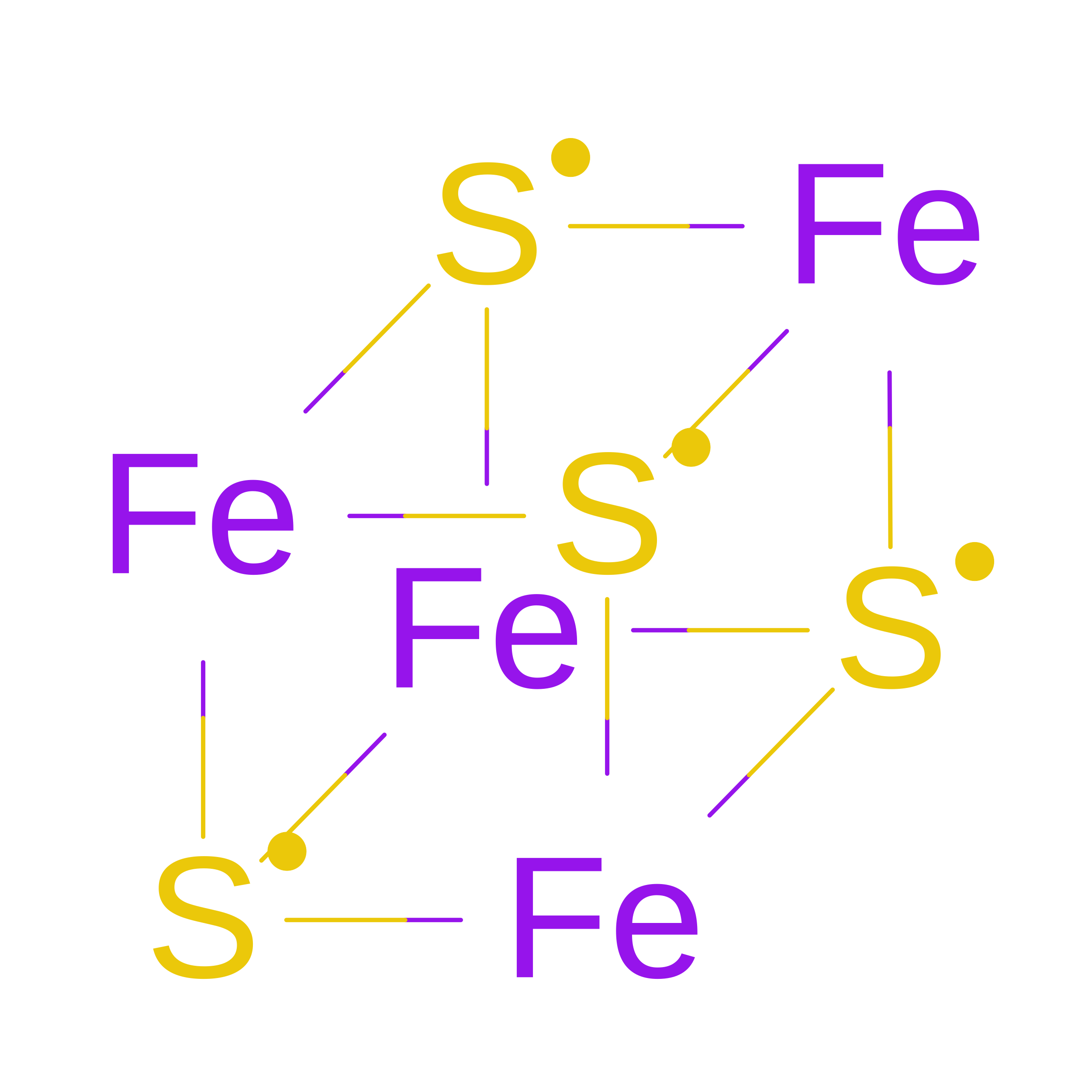
SF4

Query on SF4


Download:Ideal Coordinates CCD File
C [auth S],
D [auth S],
E [auth S]
IRON/SULFUR CLUSTER
Fe4 S4
LJBDFODJNLIPKO-UHFFFAOYSA-N
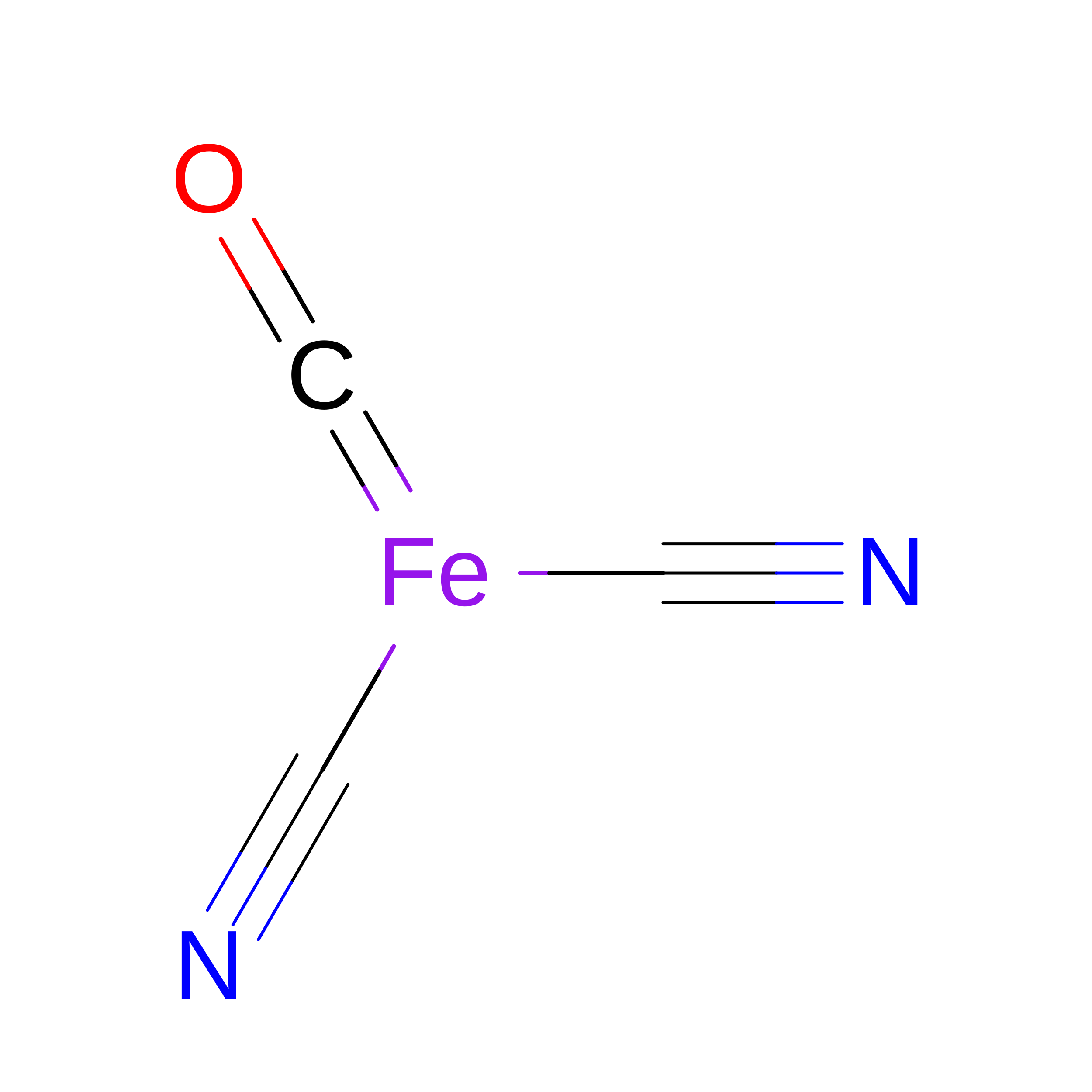
FCO

Query on FCO


Download:Ideal Coordinates CCD File
H [auth L]CARBONMONOXIDE-(DICYANO) IRON
C3 Fe N2 O
VBQUCMTXYFMTTE-UHFFFAOYSA-N
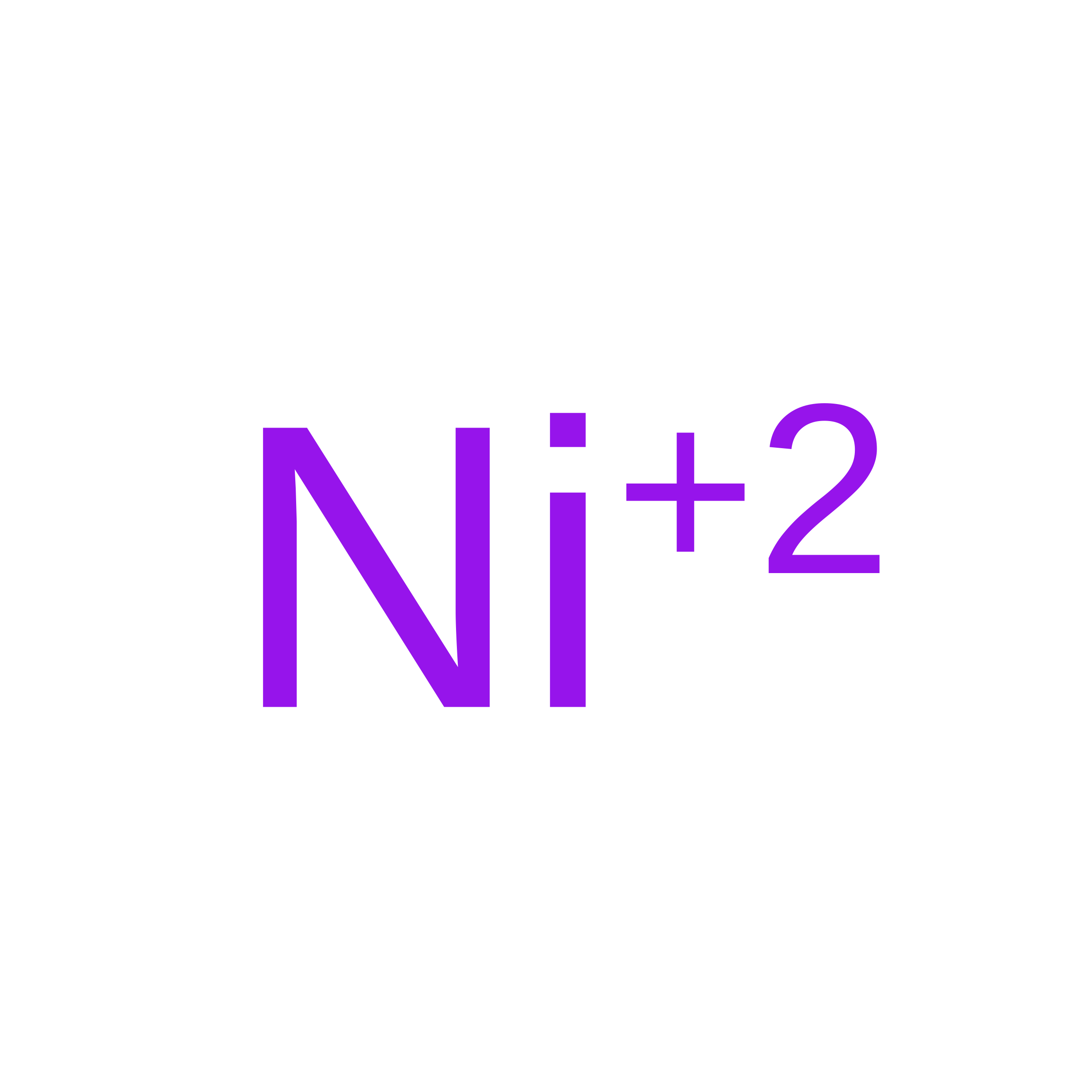
NI

Query on NI


Download:Ideal Coordinates CCD File
F [auth L]NICKEL (II) ION
Ni
VEQPNABPJHWNSG-UHFFFAOYSA-N
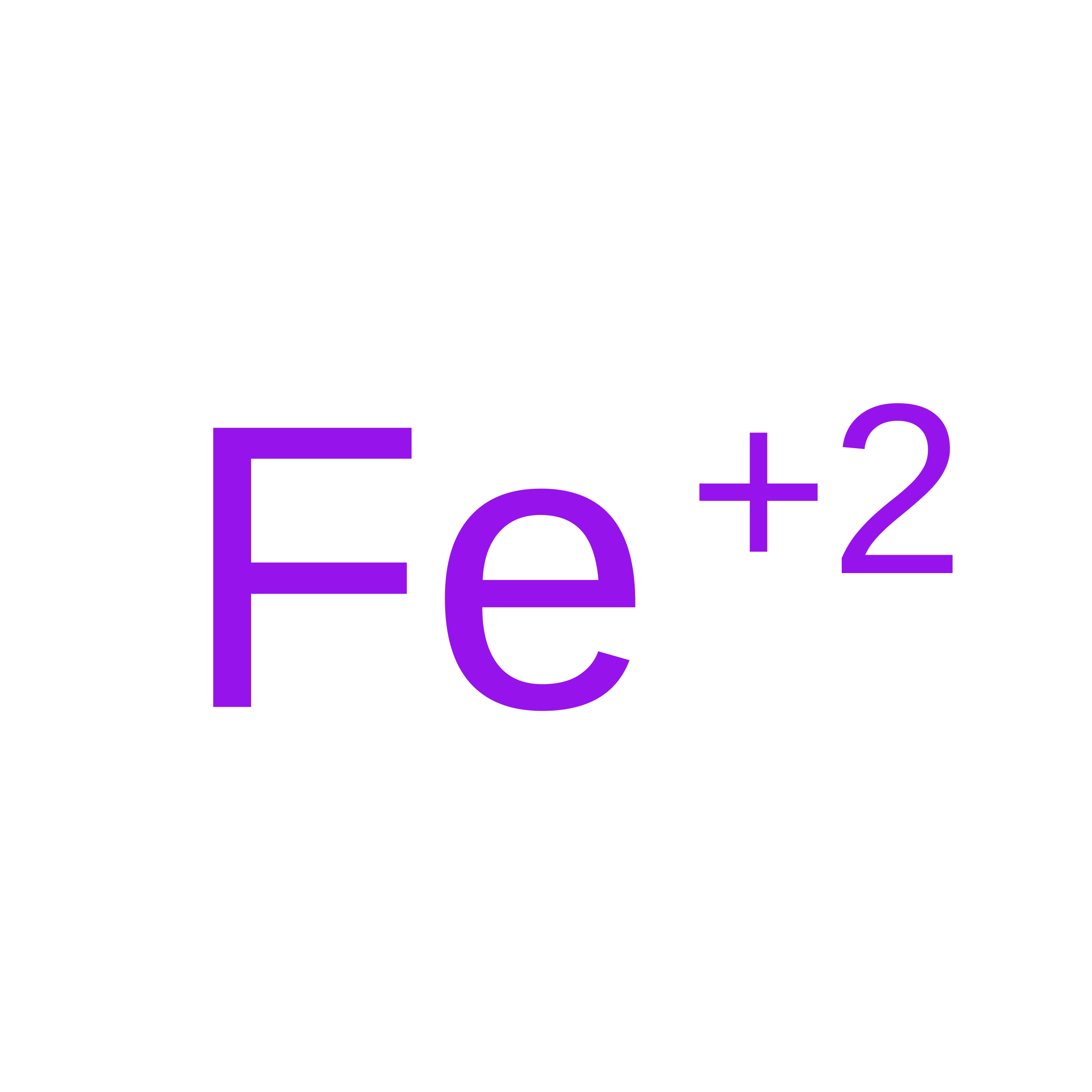
FE2

Query on FE2


Download:Ideal Coordinates CCD File
G [auth L]FE (II) ION
Fe
CWYNVVGOOAEACU-UHFFFAOYSA-N
H2S

Query on H2S


Download:Ideal Coordinates CCD File
I [auth L]HYDROSULFURIC ACID
H2 S
RWSOTUBLDIXVET-UHFFFAOYSA-N

Experimental Data & Validation

Experimental Data

  • Method: X-RAY DIFFRACTION
  • Resolution: 2.15 Å
  • R-Value Free:  0.248 (Depositor) 
  • R-Value Work:  0.194 (Depositor) 
Space Group: P 21 21 21
Unit Cell:
Length ( Å )Angle ( ˚ )
a = 110.39α = 90
b = 63.7β = 90
c = 99.58γ = 90
Software Package:
Software NamePurpose
XDSdata scaling
CCP4data reduction
AMoREphasing
X-PLORrefinement
XDSdata reduction
CCP4data scaling

Structure Validation

View Full Validation Report


Entry History 

Deposition Data

Revision History  (Full details and data files)

  • Version 1.0: 1999-06-01
    Type: Initial release
  • Version 1.1: 2007-10-16
    Changes: Version format compliance
  • Version 1.2: 2011-07-13
    Changes: Derived calculations, Version format compliance
  • Version 1.3: 2014-02-19
    Changes: Atomic model, Structure summary
  • Version 1.4: 2014-08-06
    Changes: Derived calculations, Structure summary
  • Version 1.5: 2018-04-04
    Changes: Data collection
  • Version 1.6: 2018-04-11
    Changes: Data collection
  • Version 1.7: 2019-11-20
    Changes: Database references, Derived calculations
  • Version 1.8: 2023-08-09
    Changes: Data collection, Database references, Derived calculations, Refinement description