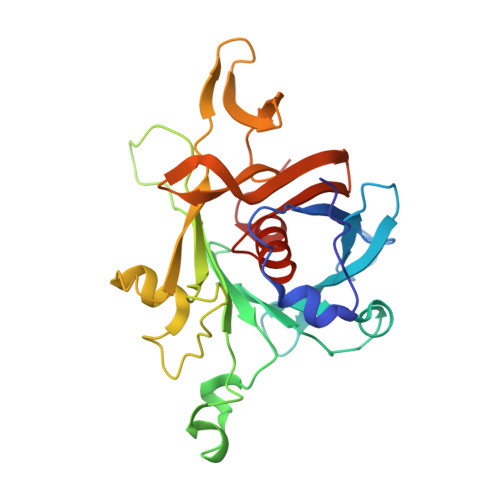
1C8Z | pdb_00001c8z

C-TERMINAL DOMAIN OF MOUSE BRAIN TUBBY PROTEIN


Experimental Data Snapshot

  • Method: X-RAY DIFFRACTION
  • Resolution: 1.90 Å
  • R-Value Free: 
    0.265 (Depositor) 
  • R-Value Work: 
    0.210 (Depositor) 
  • R-Value Observed: 
    0.210 (Depositor) 

wwPDB Validation   3D Report Full Report


This is version 1.3 of the entry. See complete history


Literature

Implication of tubby proteins as transcription factors by structure-based functional analysis.

Boggon, T.J.Shan, W.S.Santagata, S.Myers, S.C.Shapiro, L.

(1999) Science 286: 2119-2125

  • DOI: https://doi.org/10.1126/science.286.5447.2119
  • Primary Citation of Related Structures:  
    1C8Z

  • PubMed Abstract: 

    Tubby-like proteins (TULPs) are found in a broad range of multicellular organisms. In mammals, genetic mutation of tubby or other TULPs can result in one or more of three disease phenotypes: obesity (from which the name "tubby" is derived), retinal degeneration, and hearing loss. These disease phenotypes indicate a vital role for tubby proteins; however, no biochemical function has yet been ascribed to any member of this protein family. A structure-directed approach was employed to investigate the biological function of these proteins. The crystal structure of the core domain from mouse tubby was determined at a resolution of 1.9 angstroms. From primarily structural clues, experiments were devised, the results of which suggest that TULPs are a unique family of bipartite transcription factors.


  • Organizational Affiliation
    • Structural Biology Program, Department of Physiology and Biophysics, Ruttenberg Cancer Center, Mount Sinai School of Medicine of New York University, New York, NY 10029, USA.

Macromolecules
Find similar proteins by:  (by identity cutoff)  |  3D Structure
Entity ID: 1
MoleculeChains Sequence LengthOrganismDetailsImage
TUBBY PROTEIN265Mus musculusMutation(s): 0 
Membrane Entity: Yes 
UniProt
Find proteins for P50586 (Mus musculus)
Explore P50586 
Go to UniProtKB:  P50586
Entity Groups  
Sequence Clusters30% Identity50% Identity70% Identity90% Identity95% Identity100% Identity
UniProt GroupP50586
Sequence Annotations
Expand
  • Reference Sequence
Experimental Data & Validation

Experimental Data

  • Method: X-RAY DIFFRACTION
  • Resolution: 1.90 Å
  • R-Value Free:  0.265 (Depositor) 
  • R-Value Work:  0.210 (Depositor) 
  • R-Value Observed: 0.210 (Depositor) 
Space Group: P 21 21 21
Unit Cell:
Length ( Å )Angle ( ˚ )
a = 43.536α = 90
b = 51.023β = 90
c = 121.074γ = 90
Software Package:
Software NamePurpose
SHARPphasing
CNSrefinement
DENZOdata reduction
SCALEPACKdata scaling

Structure Validation

View Full Validation Report


Entry History 

Deposition Data

Revision History  (Full details and data files)

  • Version 1.0: 1999-12-12
    Type: Initial release
  • Version 1.1: 2008-04-27
    Changes: Version format compliance
  • Version 1.2: 2011-07-13
    Changes: Version format compliance
  • Version 1.3: 2024-02-07
    Changes: Data collection, Database references, Derived calculations